
Current Affairs
Mangroves, Environment & Ecology
Content
- Why in News?
- Introduction
- Distribution of Mangroves
- Characteristics and Adaptations of Mangroves
- Ecological Importance of Mangroves
- Economic Importance of Mangroves
- Major Mangrove Regions in India
- Threats to Mangroves
- Conservation Initiatives
- Way Forward
Why in News?
Mangroves have remained in the news due to several conservation initiatives, restoration programmes, cyclone resilience studies, and climate change discussions. The Government of India has launched initiatives such as MISHTI (Mangrove Initiative for Shoreline Habitats & Tangible Incomes) to expand mangrove cover along the country's coastline. In recent years, mangroves have also gained attention because of their role in blue carbon sequestration, coastal disaster mitigation, biodiversity conservation, and India's commitments towards climate adaptation under international environmental agreements.
Introduction
Mangroves are salt-tolerant trees and shrubs that grow naturally in the intertidal zones of tropical and subtropical coastlines where land meets the sea. These unique ecosystems flourish in saline and brackish water conditions, surviving regular tidal inundation, waterlogged soils, and low oxygen availability. Unlike most terrestrial forests, mangroves possess remarkable physiological and structural adaptations that enable them to survive in harsh coastal environments.
Mangrove forests form an ecological bridge between terrestrial and marine ecosystems. They stabilize coastlines, support rich biodiversity, protect coastal communities from natural disasters, store enormous quantities of carbon, and sustain the livelihoods of millions of people. Owing to these ecological services, mangroves are regarded as one of the world's most productive and valuable ecosystems.
Distribution of Mangroves
Mangroves are predominantly found between 30° North and 30° South latitudes, where warm temperatures and tidal conditions favour their growth. They generally occur along estuaries, river deltas, lagoons, creeks, mudflats, and sheltered coastal bays.
Globally, mangroves are distributed across South and Southeast Asia, Africa, Australia, Central America, and South America. Asia accounts for the largest share of the world's mangrove forests.
India possesses nearly 4,992 sq. km of mangrove cover, constituting about 0.15% of its total geographical area (India State of Forest Report, 2023). The country hosts approximately 3% of the world's mangroves and is among the leading mangrove-rich nations.
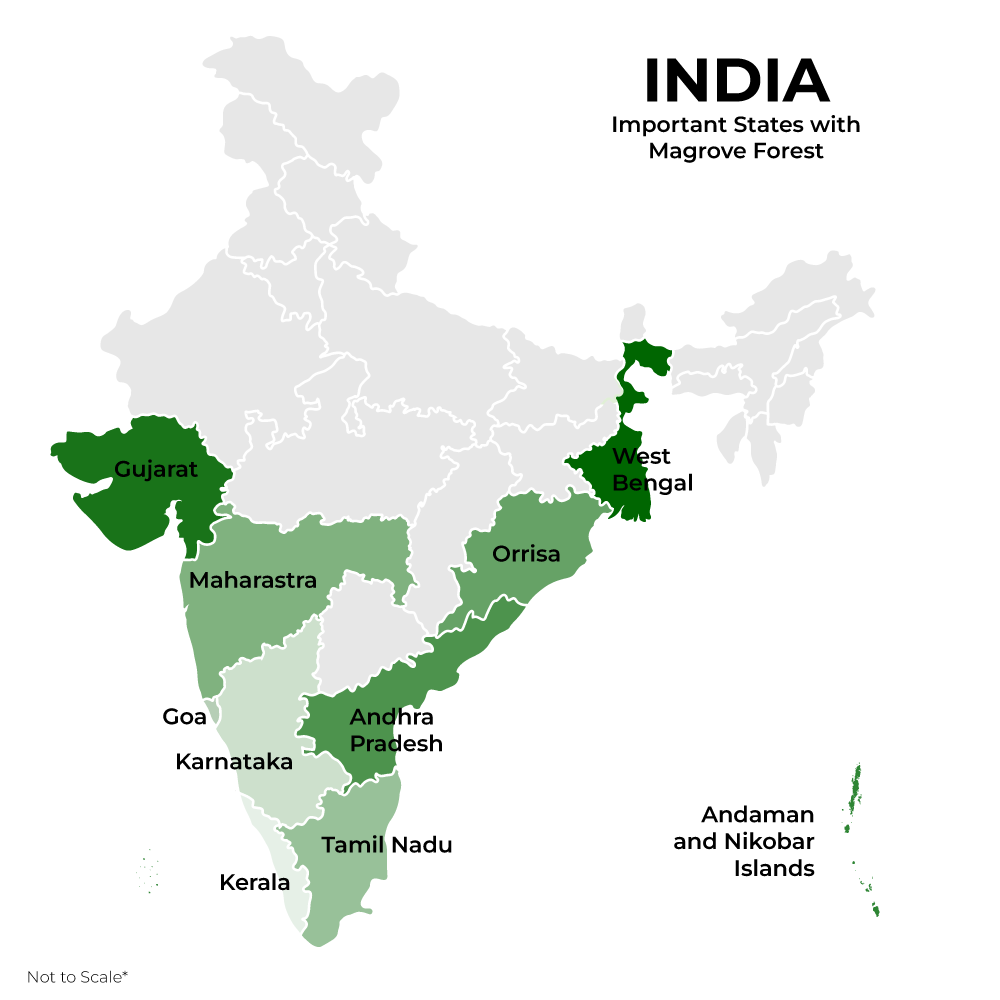
The Sundarbans of West Bengal form the largest mangrove ecosystem in India as well as the largest contiguous mangrove forest in the world. Other major mangrove regions include the Bhitarkanika delta in Odisha, Godavari and Krishna deltas in Andhra Pradesh, Pichavaram and Muthupet in Tamil Nadu, Gulf of Kutch and Gulf of Khambhat in Gujarat, and the Andaman & Nicobar Islands.
Characteristics and Adaptations of Mangroves
Mangroves exhibit remarkable adaptations that enable them to survive in saline, waterlogged, and oxygen-deficient environments.
One of the most important adaptations is salt tolerance. Different mangrove species either exclude salt at the root level or excrete excess salt through specialized glands present on their leaves.
Since the soil remains permanently waterlogged and oxygen availability is extremely low, mangroves develop pneumatophores or breathing roots, which protrude above the ground and absorb oxygen directly from the atmosphere.
Many species possess stilt roots or prop roots that provide mechanical support against strong tidal currents, cyclones, and coastal waves. These roots also trap sediments, gradually stabilizing shorelines.
Another unique adaptation is vivipary, in which seeds germinate while still attached to the parent tree. This allows seedlings to establish themselves immediately after falling into the muddy substrate, thereby increasing survival in tidal conditions.
Mangroves also exhibit high productivity and exceptional carbon storage capacity, making them among the most efficient natural carbon sinks.
Ecological Importance of Mangroves
Mangroves perform multiple ecological functions that are critical for maintaining coastal environmental stability.
They serve as natural barriers against cyclones, storm surges, tsunamis, and coastal erosion by reducing wave energy before it reaches the shoreline. The extensive damage caused by the 2004 Indian Ocean Tsunami demonstrated that coastal areas protected by healthy mangrove belts experienced comparatively lower destruction.
Mangrove forests are often referred to as "Blue Carbon Ecosystems" because they store substantially more carbon per unit area than most terrestrial forests. Their ability to sequester carbon plays a vital role in mitigating climate change.
These ecosystems function as breeding, nursery, and feeding grounds for numerous fish, crustaceans, molluscs, reptiles, birds, and mammals. A significant proportion of commercial marine fisheries depend upon healthy mangrove habitats during their life cycle.
Mangroves also improve coastal water quality by filtering sediments, nutrients, heavy metals, and pollutants. Due to this function, they are frequently described as the "Kidneys of the Coast."
The dense root network traps sediments brought by rivers, reducing coastal erosion while facilitating land formation in deltaic regions.
Economic Importance of Mangroves
Mangroves provide direct and indirect economic benefits to coastal communities.
They support fisheries by providing breeding grounds for commercially valuable fish and shellfish. Local populations depend upon mangrove ecosystems for honey collection, medicinal plants, fodder, fuelwood, and limited timber resources.
Mangrove ecosystems also promote ecotourism, bird watching, scientific research, and environmental education. Healthy mangrove forests significantly reduce economic losses caused by cyclones and coastal disasters by protecting human settlements and infrastructure.
Major Mangrove Regions in India
The Sundarbans in West Bengal represent the world's largest mangrove ecosystem and are recognized as a UNESCO World Heritage Site. The region is famous for the Royal Bengal Tiger and its unique tidal ecology.
Bhitarkanika National Park in Odisha supports one of India's richest mangrove ecosystems and is well known for its population of saltwater crocodiles.
The Godavari and Krishna deltas contain extensive mangrove forests that protect the eastern coastline while supporting fisheries.
Pichavaram Mangroves in Tamil Nadu form one of India's largest mangrove complexes and are increasingly important for ecotourism.
The Gulf of Kutch in Gujarat represents a unique arid-zone mangrove ecosystem, while the Andaman & Nicobar Islands possess some of the most diverse mangrove species in the Indian Ocean region.
Threats to Mangroves
Despite their immense ecological value, mangrove ecosystems are declining rapidly due to both natural and anthropogenic pressures.
Rapid coastal urbanisation, industrialisation, port development, and tourism infrastructure have resulted in large-scale destruction of mangrove habitats. Expansion of shrimp aquaculture and conversion of mangrove land for agriculture remain among the leading causes of mangrove loss worldwide.
Pollution from untreated sewage, industrial effluents, plastics, and oil spills degrades water quality and affects mangrove health. Illegal cutting for fuelwood and timber further accelerates degradation.
Climate change has emerged as a major long-term threat through sea-level rise, increasing cyclone intensity, changes in salinity, and coastal erosion. Although mangroves are naturally resilient, prolonged environmental stress may exceed their adaptive capacity.
Conservation Initiatives
Recognising their ecological significance, both international and national efforts have been undertaken for mangrove conservation.
At the international level, the Ramsar Convention promotes the conservation and wise use of wetlands, including mangrove ecosystems. UNESCO's Man and Biosphere Programme, the International Union for Conservation of Nature (IUCN), and the Blue Carbon Initiative also support mangrove conservation and restoration worldwide.
In India, mangrove conservation is implemented through the Conservation and Management of Mangroves and Coral Reefs Programme under the Ministry of Environment, Forest and Climate Change. The National Mangrove Committee, established in 1976, advises the government on conservation policies.
The Mangrove Initiative for Shoreline Habitats & Tangible Incomes (MISHTI), launched in 2023, aims to restore and expand mangrove plantations along coastal areas and saltpan lands. The Coastal Regulation Zone (CRZ) Notification restricts ecologically damaging activities in sensitive coastal regions, thereby protecting mangrove habitats.
Way Forward
Conserving mangroves requires an integrated approach involving scientific management, community participation, and strong legal protection. Restoration of degraded mangrove forests should be combined with sustainable coastal development and effective implementation of CRZ regulations.
The use of remote sensing, GIS, drones, and artificial intelligence can improve monitoring of mangrove health and detect illegal encroachments. Community-based conservation programmes should be strengthened by providing alternative livelihoods and increasing public awareness about the ecological and economic importance of mangroves.
Greater investment in blue carbon research and ecosystem restoration will not only strengthen India's climate resilience but also contribute towards achieving the Sustainable Development Goals and India's Nationally Determined Contributions (NDCs).
Visit LevelUp IAS- Click Here
Related reads.

Eärendil-1 Satellite
12 Sep 2026 2 min

BrahMos Missile
10 Sep 2026 3 min

NIPUN Bharat Mission
09 Sep 2026 6 min

PM-KISAN: Pradhan Mantri Kisan Samman Nidhi
08 Sep 2026 4 min

Proba-3 Mission
07 Sep 2026 4 min
India-Bhutan Trans-Boundary River Cooperation
04 Sep 2026 3 min
Put it into practice
Reading is step one.
Turn what you've just read into exam-ready answers with mentor-led practice and our structured test series.