
Current Affairs
Sambhar Lake, UPSC Current Affairs
Content
- Why in News?
- Introduction
- Location and Geographical Setting
- Hydrology of Sambhar Lake
- Ecological Importance
- Importance for Migratory Birds
- Ramsar Site Status
- Environmental Challenges
- Conservation Measures
- Way Forward
Why in News?
Sambhar Lake has recently been in the news after a satellite-based study (1984-2023) highlighted its increasing ecological vulnerability and strong dependence on seasonal rainfall. The study observed that while the lake expands during the monsoon months, its water spread has been shrinking during dry seasons. At the same time, the expansion of industrial salt pans around the lake has intensified pressure on its fragile wetland ecosystem, raising concerns regarding biodiversity conservation, sustainable salt production, and long-term hydrological stability.
Introduction
Sambhar Lake is India's largest inland saline wetland and one of the country's most ecologically significant salt lakes. Situated in the arid region of Rajasthan, it represents a unique interaction between climate, geology, hydrology, and biodiversity. Unlike freshwater lakes, Sambhar Lake contains highly saline water, making it an important centre for salt production while simultaneously functioning as a globally significant wetland for migratory birds.
The lake is internationally recognised under the Ramsar Convention because of its ecological importance and its role in supporting thousands of migratory waterbirds along the Central Asian Flyway. Besides its environmental value, Sambhar Lake contributes substantially to Rajasthan's economy through salt extraction and supports the livelihoods of thousands of local communities.
However, changing rainfall patterns, groundwater depletion, illegal encroachments, expansion of salt pans, and climate change have made the lake increasingly vulnerable, making its conservation a matter of national environmental significance.
Location and Geographical Setting
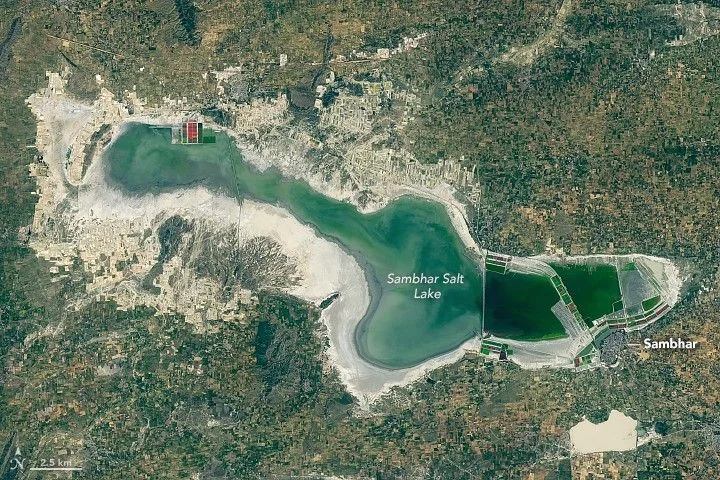
Sambhar Lake is located in the Jaipur and Nagaur districts of Rajasthan, with portions extending into Ajmer district. It lies on the eastern fringe of the Aravalli Range within the semi-arid climatic region of northwestern India.
The lake occupies a shallow inland depression where seasonal rivers drain into a closed basin without any outlet to the sea. Consequently, dissolved salts accumulate over time, giving the lake its characteristic salinity.
Its location within Rajasthan's dry climatic zone makes its hydrology highly dependent on the southwest monsoon, with significant seasonal fluctuations in water level and surface area.
Hydrology of Sambhar Lake
Sambhar Lake is a closed drainage (endorheic) basin, meaning that water entering the lake has no external outlet. Instead, water is lost primarily through evaporation, leaving behind dissolved salts.
The lake receives inflow from six seasonal rivers:
- Samaod River
- Khari River
- Mantha River
- Khandela River
- Medtha River
- Roopangarh River
Since these rivers are largely rain-fed, the lake's water level varies considerably from year to year depending upon monsoon intensity.
Recent satellite observations demonstrate that rainfall remains the single most important factor controlling the lake's hydrological behaviour. During years of deficient rainfall, reduced inflows lead to declining water spread, increased salinity, and deterioration of ecological conditions.
Ecological Importance
Sambhar Lake is among India's most important inland wetland ecosystems because of its exceptional biodiversity and ecological functions.
The lake serves as a major habitat for resident and migratory birds, particularly during winter when thousands of birds arrive from Central Asia, Europe, and Siberia.
The wetland supports diverse ecological communities including phytoplankton, zooplankton, aquatic invertebrates, fish, microorganisms, and salt-tolerant vegetation, forming a complex food web that sustains higher trophic levels.
As a large saline wetland, Sambhar Lake also contributes to regional groundwater recharge, micro-climate regulation, nutrient cycling, and carbon storage.
Importance for Migratory Birds
Sambhar Lake is internationally recognised as one of India's most important wintering grounds for migratory birds.
Every year, particularly between November and February, the lake hosts thousands of migratory species arriving through the Central Asian Flyway.
Among the most iconic visitors are Greater Flamingos and Lesser Flamingos, which depend upon the lake's abundant algae and microorganisms for food.
Other commonly observed bird species include:
- Black-winged Stilts
- Sandpipers
- Redshanks
- Avocets
- Coots
- Pelicans
- Shovelers
- Pintails
- Various species of ducks and waders
The lake therefore functions as an internationally important breeding, feeding and resting site for numerous waterbird species.
Ramsar Site Status
Recognising its global ecological importance, Sambhar Lake was designated a Ramsar Site in 1990.
Its Ramsar recognition reflects its significance as:
- An internationally important saline wetland.
- A critical habitat for migratory birds.
- A representative example of inland saline ecosystems.
- A biodiversity-rich wetland supporting unique ecological processes.
The Ramsar designation also places obligations upon India to ensure its wise use and long-term conservation.
Environmental Challenges
Despite its ecological and economic significance, Sambhar Lake is experiencing severe environmental degradation.
Declining Water Availability
Satellite observations indicate a gradual reduction in the natural water spread of the lake during several recent years.
Erratic monsoon rainfall, rising temperatures, and increased evaporation have disturbed the lake's natural hydrological cycle.
Climate change is expected to further intensify these challenges through increased rainfall variability and prolonged droughts.
Expansion of Illegal Salt Pans
One of the most serious threats is the rapid expansion of industrial and illegal salt pans around the lake.
Construction of salt pans often involves diversion of natural water flows and excessive groundwater extraction, reducing freshwater inflows into the wetland.
This alters the lake's ecological balance and accelerates habitat degradation.
Groundwater Overexploitation
Extensive pumping of groundwater for salt production has lowered groundwater levels in the surrounding region.
Reduced groundwater inflow affects the lake's hydrological sustainability and increases the risk of long-term ecological collapse.
Biodiversity Loss
Shrinking water spread directly affects bird populations by reducing feeding grounds and nesting habitats.
Changes in salinity also disturb aquatic microorganisms that form the primary food source for flamingos and other waterbirds.
Mass bird mortality events observed in previous years have highlighted the fragile ecological condition of the lake.
Climate Change
Increasing temperatures, changing precipitation patterns, and prolonged droughts threaten the long-term survival of inland saline wetlands such as Sambhar Lake.
These climatic changes increase evaporation while simultaneously reducing freshwater inflows.
Pollution and Human Encroachment
Urban expansion, unregulated tourism, solid waste disposal, vehicular movement and illegal construction further degrade the lake ecosystem.
Such anthropogenic pressures reduce habitat quality and increase ecological fragmentation.
Conservation Measures
Conservation of Sambhar Lake requires an integrated ecosystem-based approach that balances ecological sustainability with economic activities.
The Ramsar Convention provides an international framework for wetland conservation and promotes the principle of wise use.
State authorities, environmental agencies and scientific institutions are increasingly using satellite monitoring, GIS mapping and remote sensing to monitor hydrological changes and illegal encroachments.
Efforts are also being directed towards regulating salt extraction, restoring natural drainage channels, preventing groundwater overexploitation, and improving wetland management.
Scientists have particularly recommended maintaining a clear distinction between industrial salt production areas and the natural wetland ecosystem so that ecological functions are not compromised.
Way Forward
The long-term conservation of Sambhar Lake requires adopting an integrated wetland management approach based on scientific evidence and community participation. Restoration of natural hydrological flows, regulation of industrial salt pans, sustainable groundwater management, and strict enforcement against illegal encroachments should be prioritised.
Climate-resilient conservation planning, supported by satellite monitoring and ecological assessments, can help detect environmental changes at an early stage. Local communities involved in salt production should be integrated into conservation efforts through sustainable livelihood programmes that minimise ecological degradation.
Related reads.

ASEAN: Association of Southeast Asian Nations
16 Sep 2026 6 min

National Food Security Act (NFSA), 2013
16 Sep 2026 6 min

Borophene
15 Sep 2026 3 min

WTO Agreement on Fisheries Subsidies
14 Sep 2026 3 min

Eärendil-1 Satellite
12 Sep 2026 2 min

BrahMos Missile
10 Sep 2026 3 min
Put it into practice
Reading is step one.
Turn what you've just read into exam-ready answers with mentor-led practice and our structured test series.