
General
Mastering UPSC Answer Writing by AIR 255
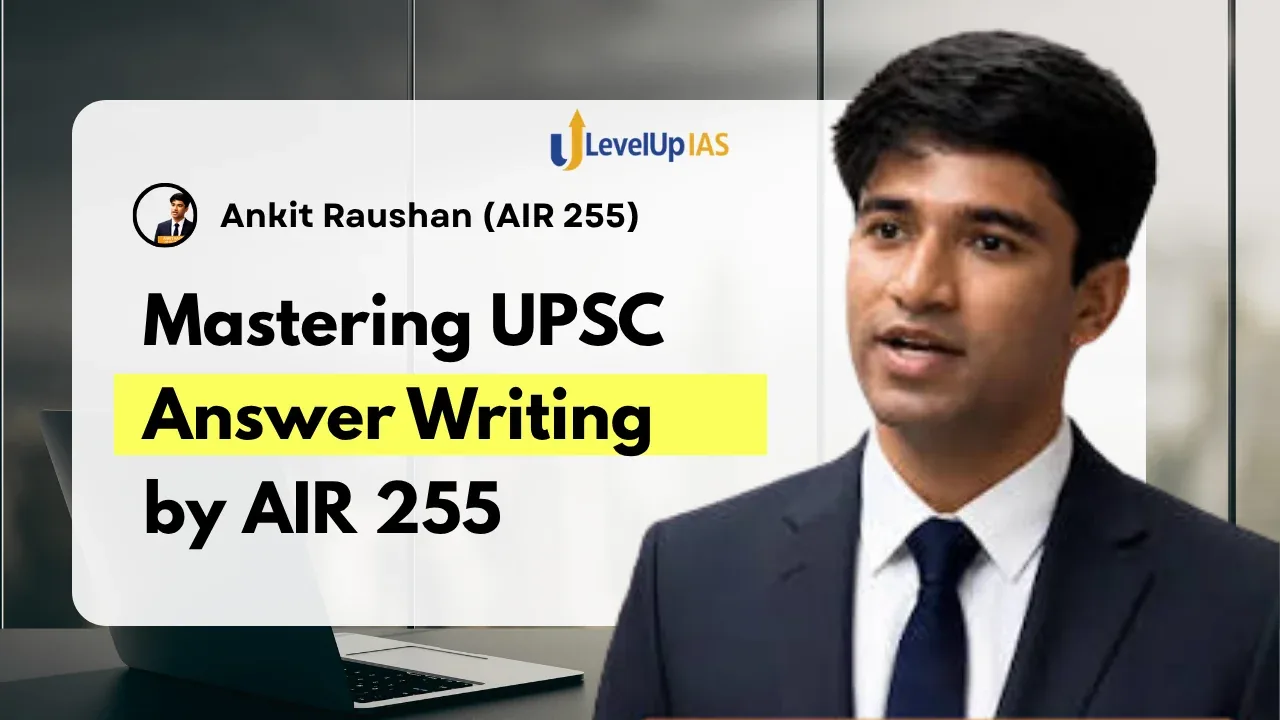
Intro - Ankit Raushan
UPSC Rank: Secured All India Rank (AIR) 255 in the UPSC Civil Services Examination 2025.
Place of Study: Studied at the Indian Institute of Technology (IIT) Delhi.
Graduation: B.Tech in Computer Science and Engineering
University/College: Indian Institute of Technology (IIT) Delhi, Class of 2024. IIT Delhi's Alumni Relations page specifically identifies him as a B.Tech CSE graduate and AIR 255 in CSE 2025.
Optional Subject: Anthropology, he scored 298 marks in Anthropology.
Previous UPSC Attempt: Secured AIR 595 in UPSC CSE 2024 and improved his rank substantially to AIR 255 in CSE 2025.
Background: An IIT Delhi graduate who successfully improved his UPSC rank in his second consecutive successful attempt. In CSE 2025, he secured 829 marks in the written examination and 149 marks in the Personality Test, totaling 978 marks.
For many UPSC aspirants, the General Studies papers represent the most significant hurdle and the greatest opportunity, carrying a massive weightage of 1,750 marks in the Mains examination. Yet, a common phenomenon exists among beginners: "The Great Inertia". Many students delay their answer writing practice until after clearing the Prelims, believing they need a perfect command of the content first.
According to Ankit Raushan (AIR 255), this is a strategic error. There is no "perfect day" to start; the key to selection is the consistency of writing daily, aiming for just a 1% increment in quality every day. In this guide, we break down his workshop on the frameworks, technicalities, and mindsets required to master the art of the UPSC Mains answer.
The Fundamental Structure: Beyond the Basics
The core demand of UPSC is that the question must be answered in its totality. A decent mark is only possible if you meet the specific demand rather than "beating around the bush". Ankit outlines the essential "IBC" (Introduction, Body, Conclusion) framework with specific nuances:
- Introduction: You should define the topic or add current context. For a question on the Governor, for instance, you could start with the relevant Constitutional Article or a recent news event that makes the question relevant.
- Body: This is where you address the dimensions of the question. You must underline the main parts of the prompt to ensure no sub-part is missed. Ankit recommends putting your best 3-4 points at the beginning; if you hide your strongest arguments at the end, a busy examiner might overlook them.
- Conclusion: Since you are a future bureaucrat, your conclusion must be optimistic and solution-oriented. End on a positive note that provides closure to the problem discussed.
Decoding the Directives: "Discuss" vs. "Critically Analyze"
Many aspirants treat all question tags like "Examine," "Discuss," or "Evaluate"as the same. Ankit clarifies that these directives require different treatments:
- Discuss: Focus on presenting multiple sides of an issue in a balanced way, mentioning problems in a lighter tone.
- Examine: This requires an investigation of causes. For example, if examining governance failure, you must investigate the reasons, the effects, and the specific limitations of the current system.
- Critically Analyze: This demands depth and a reasoned judgment. You must cover both positives and negatives and substantiate them with recent examples to avoid sounding like you are "talking in the air".
- Evaluate: Here, you judge the success or failure of a specific initiative, like Digital Public Infrastructure, by weighing its achievements (e.g., financial inclusion) against its shortcomings (e.g., the digital divide).
Five Powerful Frameworks for Every Answer
To break the inertia of a blank page, Ankit suggests using five specific frameworks depending on the nature of the question:
1. The IBC Framework
The simplest starting point: a clear definition/context, a body addressing the demand with examples, and a way-forward conclusion.
2. The Multi-Dimensional (PESTL) Approach
When you lack deep content on a specific topic, think horizontally. Link the issue to Politics, Society, Economics, Technology, Environment, and Ethics (PESTL). For instance, adding a Technological angle like how AI can solve a specific problem is almost always relevant in the modern context.
3. Cause-Impact-Solution
This is best for questions regarding challenges, crises, or reforms. If asked about the textile industry's challenges, structure it by identifying the root causes, the resulting impact on the economy, and a "way ahead" that shows your problem-solving nature.
4. Stakeholder-Value-Option-Decision
Primarily used for GS4 (Ethics) and Case Studies. Identify who is involved (stakeholders), what values are at play, what options you have, and finally, a reasoned decision on which option is best.
5. Value Enrichment Structure
Once you are writing decent answers, you must distinguish yourself from the "average" crowd.
- Maps & Diagrams: In GS1 (History/Geography), draw maps of resource distribution or temple architecture.
- Flowcharts: Use "Hub and Spoke" models to show multi-dimensional roles, such as the Governor’s political, economic, and federal functions.
- Tables: Use tables for "Comparison" or "Difference" questions to make the presentation lucid and attractive.
Technical Precision: The GS3 Example
Ankit emphasizes that for papers like GS3 (Economy, Science & Tech), you should be technical. Using vague language won't earn high marks. Instead, use terms like "economy of scale," "multiplier effect," "positive externality," or "mechanization".
In a sample question about the Indian Textile Industry, Ankit suggests breaking the problem into Input, Operation, and Output:
- Input: Issues with land, labor, and capital (e.g., high interest in the informal sector).
- Operation: Lack of modern power looms leading to efficiency losses.
- Output: High logistic costs (substantiated with a data point: Jamur to Mumbai costs more than Rotterdam to Mumbai).
Linking these challenges to the Global Value Chain and suggesting specific government schemes like PM-MITRA as a "Way Forward" demonstrates the maturity UPSC looks for.
Practical Advice: From 30 Minutes to 7 Minutes
A common complaint is the inability to write such detailed content within the strict 7-minute (for 10-markers) or 11-minute (for 15-markers) time limit. Ankit’s solution is phased practice:
- Day 1 to Day 30: Forget the clock. Take 20-30 minutes if needed. Just focus on forming the skeleton and putting points on paper.
- The Maturity Phase: After 1-2 months of daily writing, start introducing a time limit.
- The "1% Rule": Don't judge your progress on Day 1. In three or four months of consistent writing, you will naturally begin to harness your knowledge and structure your thoughts faster.
Conclusion
The difference between those who clear Prelims repeatedly but fail the final list often lies in their lack of answer writing practice. Ankit Raushan’s message is clear: Do not wait for your foundation course or revision to end. Use the frameworks like PESTL to approach any question, be consistent, and remember that even an average answer written today is better than a "perfect" one that never makes it to the page. Start your journey today; 1% daily is the only way to the final list..
To know his strategy in details, watch the video
Related reads.

Mastering Anthropology: The 292-Mark Roadmap By AIR 521
21 Aug 2026 6 min

GS & Optional Balancing Strategy By AIR 48
13 Aug 2026 5 min
AIR 49’s Brutally Honest UPSC Strategy Session
10 Aug 2026 4 min
Full 12 Months UPSC Roadmap By AIR 13
07 Aug 2026 5 min
Scientific Revision System By AIR 341 Vishal Pattanayak
05 Aug 2026 5 min
Efficient Time Management Strategy by AIR 87
03 Aug 2026 5 min
Put it into practice
Reading is step one.
Turn what you've just read into exam-ready answers with mentor-led practice and our structured test series.