
General
Mastering Anthropology: The 292-Mark Roadmap By AIR 521
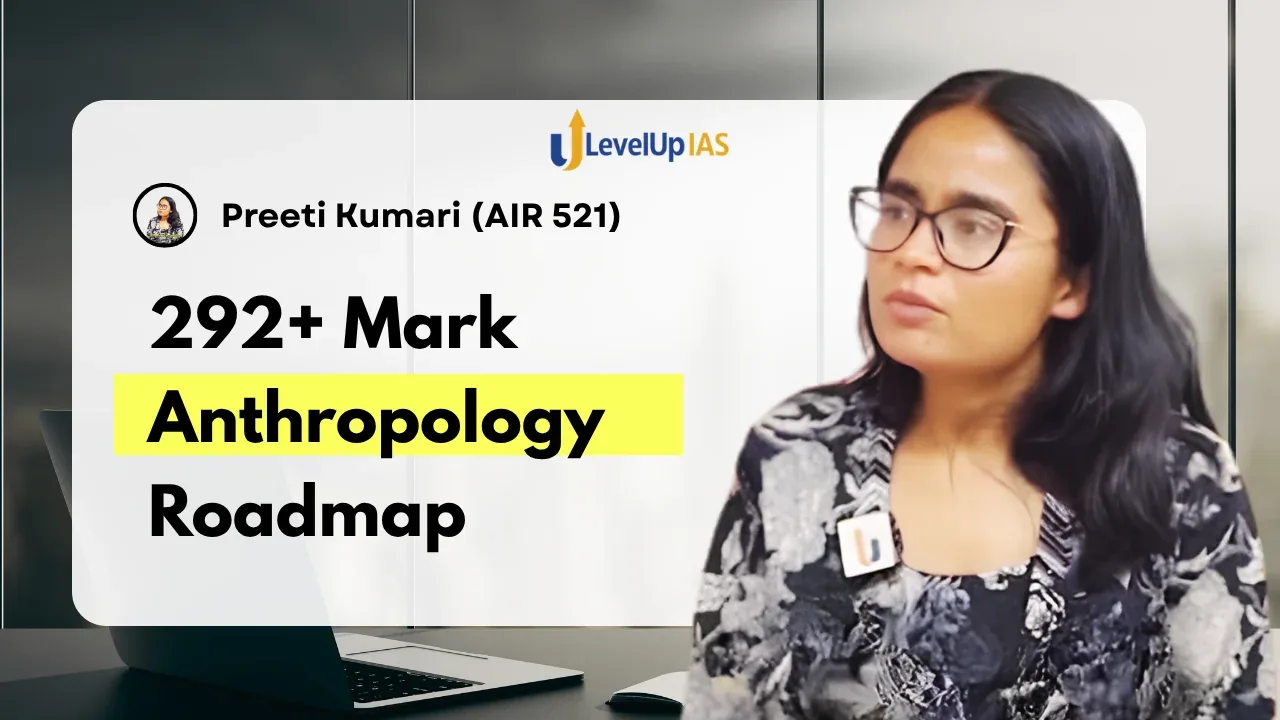
Intro - Preeti Kumari
UPSC Rank: Secured All India Rank (AIR) 521 in the UPSC Civil Services Examination 2025
Place of Study: Studied at the Indian Institute of Technology (IIT) Bombay
Graduation: Engineering
University/College: Indian Institute of Technology (IIT) Bombay
Optional Subject: Anthropology
Anthropology Score: Scored 292 marks in Anthropology in UPSC CSE 2025
Previous UPSC Journey: Had previously reached the interview stage but could not clear it. She continued her preparation and eventually secured AIR 521 in CSE 2025.
Background: An IIT Bombay graduate who overcame repeated setbacks at the UPSC interview stage to finally secure a place in the Civil Services. Her preparation journey reflects persistence and a strong focus on conceptual clarity, answer writing and effective revision. She has also shared her UPSC strategy and experience through topper interactions after securing AIR 521.
Securing a rank in the UPSC Civil Services Examination is often a journey of evolving strategies and harsh self-realisation. For Preeti Kumari (AIR 521), the path to success was paved with a significant academic pivot and a complete overhaul of how she approached her optional subject, Anthropology. Despite having a background in Mathematics from prestigious institutions like Delhi University and IIT Bombay, she found her true scoring potential in Anthropology, securing an impressive 292 marks.
In a candid conversation, Preeti breaks down how she escaped the "230-mark loop" to achieve a score that ultimately placed her on the final merit list.
The Great Pivot: From IIT Maths to Anthropology
One of the most striking aspects of Preeti’s journey is her transition from a Master’s in Mathematics at IIT Bombay to Anthropology. She admits that while she was a science student throughout her life, she eventually realised that Pure Mathematics with its complex fluid dynamics and group theory was becoming too demanding to balance alongside General Studies.
She chose Anthropology because it represents a "beautiful mix of science and humanity". For a science student, the biological and archaeological aspects of the subject provide a familiar objective ground, while the socio-cultural parts offer the breadth of humanities.
The "Material Collector" Trap
In her earlier attempts, Preeti fell into a common aspirant trap: becoming a "material collector". She describes having bookshelves filled with every topper’s notes and every famous textbook, yet possessing very little conceptual clarity.
"I had the bricks, but I was missing the glue," she explains. She could speak two or three lines about any topic, but she couldn't write a high-scoring 15-mark answer because her knowledge wasn't structured. Her "Formo" (Fear of Missing Out) led her to keep adding new resources instead of mastering a concise set of notes.
The Turning Point: Building the "Glue"
To break her score plateau of 220-240 marks, Preeti focused on three major pillars during her successful attempt:
1. Conceptual Clarity and Structuring
She shifted her focus from reading more to understanding better. By using a crash course as a framework, she was able to take her existing "bricks" of knowledge and finally "glue" them together into a logical flow. This allowed her to interlink topics across the syllabus connecting Paper 1 (Universal theories) with Paper 2 (Indian context), and even bringing in elements from GS 1 and GS 2.
2. Religious Adherence to PYQs
Preeti argues that Previous Year Questions (PYQs) are the most essential tool for evaluation. This time, she didn't just look at them; she did them "religiously". If she didn't have time to write a full answer, she would at least perform a mental structuring:
- How will I introduce this?
- What will be the body points?
- Which diagram fits here?
3. The Discipline of Mock Tests
In previous attempts, Preeti had not written a single test a mistake that was clearly reflected in her marks. For this attempt, she wrote 7 to 8 full-length mocks at a dedicated center. These mocks helped her in three critical ways:
- Question Selection: In Anthropology, where you must choose which optional questions to answer alongside the compulsory ones, making the right choice is a 50-mark decision. Mocks taught her which questions she could actually deliver on.
- Identifying Blunders: It is better to "blunder in a mock" than in the final exam. Mocks revealed where she was misinterpreting questions or missing the core demand.
- Feedback Integration: She stopped focusing on the marks she got in mocks and focused entirely on the feedback loop. She would write a test and then watch discussion videos to see if her thinking aligned with the experts.
Mastering Paper 1: The Power of Objectivity
Preeti achieved a stellar 157 marks in Paper 1. Her strategy was to lean heavily into her strengths: Physical Anthropology and Archaeology.
Because these sections are highly objective and scientific, they allow for a lot of diagrams. "Physical anthropology is the best way to fetch marks," she notes, as it allows you to draw clear, labeled diagrams that move your score away from generic humanity-style answers. Even when faced with "alien" or random questions like specific kinship patterns in Manipur her core conceptual clarity allowed her to stay calm and provide a structured response rather than leaving the page blank.
The Art of Answer Writing
Preeti emphasizes that in a "crowded" optional like Anthropology, writing generic material will keep you stuck in the 230s. To stand out, you need Value Addition.
- The "Two-Note" System: She maintained conventional notes for concepts and short 3-4 page notes for Mains. These short notes contained only the "high-value" items: unique diagrams, specific data points, committees, and case studies.
- Standardized Prototypes: She prepared "prototypes" for her introductions and conclusions. For instance, she had a pre-prepared catchphrase or code for any question on architecture or philosophy so she wouldn't waste time thinking on the spot.
- Highlighters and Flowcharts: She made it a point to highlight key terms and use flowcharts naturally. While it felt difficult initially, after five or six tests, making diagrams became a natural instinct.
Mental Resilience and "Self-Introspection"
Beyond the books, Preeti attributes her success to self-introspection. She realized that failing after an interview is devastating because you are effectively back at "point zero" while your peers move ahead.
Her advice to those stuck in the cycle is to be kind to yourself and conduct a deep audit of your mistakes. "If you don't do self-introspection, you will never know if you are making the same mistake again and again," she warns. She credits her success to her parents, who provided a "protective blanket" that shielded her from societal pressures regarding marriage or financial independence, allowing her to stay in her "UPSC cocoon" until she succeeded.
Conclusion: The Path to 292
Preeti Kumari’s story is a testament to the fact that hard work must be paired with strategic refinement. By moving from a "collector of material" to a "master of concepts," and by prioritizing the objective, diagram-heavy portions of Anthropology, she transformed her optional from a hurdle into her greatest strength.
Her final message to aspirants is one of faith: "Have faith; you have the fuel to do this. It will turn out in your favor". For those aiming for a top rank with Anthropology, her blueprint of PYQs, Mocks, and Interlinking is the definitive way forward.
To get the detailed strategy, watch the video
Related reads.
Mastering UPSC Answer Writing by AIR 255
17 Aug 2026 5 min

GS & Optional Balancing Strategy By AIR 48
13 Aug 2026 5 min
AIR 49’s Brutally Honest UPSC Strategy Session
10 Aug 2026 4 min
Full 12 Months UPSC Roadmap By AIR 13
07 Aug 2026 5 min
Scientific Revision System By AIR 341 Vishal Pattanayak
05 Aug 2026 5 min
Efficient Time Management Strategy by AIR 87
03 Aug 2026 5 min
Put it into practice
Reading is step one.
Turn what you've just read into exam-ready answers with mentor-led practice and our structured test series.