
General
How Toppers attempt Prelims By AIR 375 Aditya Kaushik
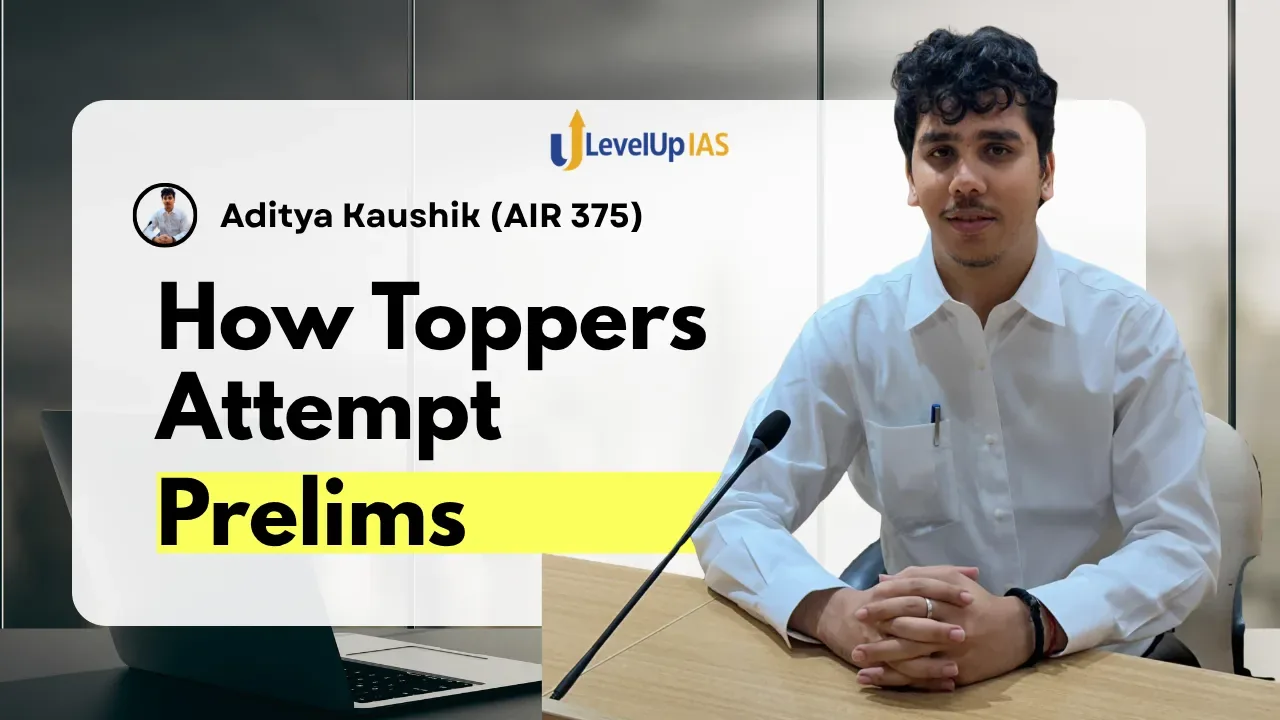
Intro - Aditya Kaushik
UPSC Rank: Secured All India Rank (AIR) 375 in the UPSC Civil Services Examination 2025.
Professional Background: Worked in the corporate sector before deciding to pursue the UPSC Civil Services Examination seriously.
Optional Subject: History.
Background: Aditya Kaushik's UPSC journey involved setbacks, including an illness that interrupted his 2024 Mains attempt. He subsequently resumed preparation, focusing on strengthening static subjects, practising previous years' questions, developing self-made notes and improving answer writing. He also used structured resources for General Studies, History Optional and interview preparation.
If you ask most UPSC aspirants why people fail the Prelims, the default answer is almost always "lack of knowledge." We assume that rankers possess an encyclopedic memory, having memorised dozens of monthly compilations and obscure test series.
However, Aditya Kaushik (AIR 375) challenges this belief. Having interacted with candidates across single-digit and double-digit ranks, he noticed a surprising truth: top rankers do not possess significantly more knowledge than any diligent aspirant. The real differentiator isn't how many books you have read, but your attempt strategy, nerve control, and mindset on D-Day.
The Journey
Aditya’s own UPSC journey illustrates how crucial execution is over brute-force reading:
- 2022: He appeared casually while working a corporate job, admitted to not even knowing the basic structural differences between Lok Sabha and Rajya Sabha, and was promptly exposed to the reality of the exam.
- 2023: After studying intensely, he scored roughly 69 marks against a cutoff of 75. Looking back, he realized it wasn't a knowledge deficit that held him back, but a lack of ego control during the paper. Over-attempting questions simply because he had "heard of the topic" cost him precious negative marks.
- 2024 & 2025: Armed with lessons from his earlier failures, he refined his attempt technique, cleared the Prelims comfortably in both years, scored 470 in GS Mains, 271 in his History optional, and secured Rank 375.
His core takeaway is simple: Prelims is largely a mathematical game of managing risk, controlling your nerves, and systematically building a score buffer above the cutoff.
The "Nonu Baccha" Mindset and the 55-60 Golden Questions
Aditya introduces a helpful mental model he calls the "Nonu Baccha" mindset. Imagine an honest, disciplined aspirant who has strictly mastered the "Big Four" foundational subjects Polity, History, Geography, and Economy alongside standard newspapers or PIB updates and monthly magazines. This student hasn't touched obscure 200-page booklets or endless Telegram dumps.
Across almost every UPSC paper from 2019 to 2025 (with 2023 being a minor statistical anomaly), the paper setters consistently include 55 to 60 questions that are directly solvable using basic static knowledge and logical deduction.
If you get 50 to 55 of these doable questions right, you immediately secure a baseline score well above the official cutoff. UPSC naturally builds in a 15-to-20-mark safety buffer for candidates who simply execute their basics cleanly without making careless errors.
The SIP Method
One of the biggest traps on exam day is panicking when you encounter a cluster of 10 or 15 difficult questions in a row. Candidates often react by either freezing up or making wild guesses to make up for lost ground.
Instead of scanning the paper linearly or trying to solve everything in a single frantic rush, Aditya advocates for the SIP (Systematic Investment Plan) Method:
- Sectional and Page-Wise Rounds: Process the paper page by page or topic by topic. Focus on extracting guaranteed marks from whatever section lands in front of you.
- Accumulate Small Wins: Secure 10 to 12 marks from basic Economy, another 12 from Polity, and 10 from Geography.
- Build the Buffer First: Step by step, watch your score stack up toward the 70–80 mark range before you even look at 50/50 eliminations or calculated risks.
By securing your core marks early, you eliminate exam panic and approach the rest of the paper from a position of financial luxury.
Decoding Questions with Common Sense
UPSC paper setters are not trying to test obscure trivia; they want to see if you can think like a calm, observant bureaucrat on the spot. Often, the hints required to solve a question are embedded directly within the phrasing or draw from everyday life:
- Real-World Logic: In a question regarding activated charcoal and its properties, simply recalling an everyday advertisement like a charcoal face wash or L'Oreal charcoal shampoo reminds you of its high surface area and adsorption capacity.
- Welfare State Assumptions: When evaluating government scheme statements (such as the Rashtriya Gokul Mission), ask yourself if the stated objective sounds like a genuine welfare initiative for indigenous cattle or a manipulated trick line. A lazy paper setter will often copy-paste straightforward welfare objectives verbatim from PIB.
- Deciphering Extreme vs. Balanced Lines: Recognizing rigid, unfeasible constraints versus broad, scientifically plausible statements allows you to eliminate options even when you don't possess 100% textbook certainty.
Finding Your Attempt "Sweet Spot" and the Art of Leaving
A major mistake aspirants make is adopting a one-size-fits-all attempt target, such as believing everyone must attempt 90+ questions.
Through data analytics on his own mock tests and PYQ practice, Aditya discovered that his personal sweet spot was 75 to 80 questions. Because his strength lay in accuracy rather than mass guessing, pushing his attempts into the 85+ range consistently resulted in negative marks that dragged his total down.
Equally important is mastering the art of leaving questions:
- If a question asks for obscure dates, niche UN mission timelines, or facts you have never encountered, recognize it as an "unsolvable trap" within two seconds.
- Skip it immediately without letting your ego get involved. Saving 30 seconds on an unviable question gives you the mental bandwidth to carefully solve a doable multi-statement question later.
Source Discipline: NCERTs, PIB, and PYQ Reverse-Engineering
To build high accuracy, Aditya emphasizes sticking to primary, authoritative sources:
- NCERTs as Bibles: Class 11 and 12 Geography NCERTs are often used by paper setters for verbatim, line-by-line questions. Respect these foundational texts over secondary coaching notes.
- Reverse-Engineering PYQs: Don't just check the answer key for past papers. Examine every option keyword whether it is a reference to crustaceans, arborial species, isotherms, or specific statutory boards. UPSC frequently revisits these options a few years later. For instance, a reference to the Coir Board under the MSME Ministry or a past question from 2015 can easily reappear on its 10th anniversary in 2025.
- Following Multi-Year Themes: Major environmental or technological themes such as Hoolock Gibbons, Amur Falcons, Green Hydrogen, or international UPI integration remain active in news cycles for two to three years. Following these broader themes naturally during your regular reading builds a deep intuition that pays off on exam day.
Final Takeaway
At the end of the day, clearing the Prelims is less about chasing endless market noise and more about protecting your execution on D-Day.
By mastering your foundational textbooks, analyzing PYQs deeply, keeping your attempt strategy aligned with your personal accuracy profile, and maintaining a calm, analytical mindset, you can consistently stay 10 to 15 marks above the cutoff no matter how unconventional the paper appears.
Related reads.

Mastering Anthropology: The 292-Mark Roadmap By AIR 521
21 Aug 2026 6 min
Mastering UPSC Answer Writing by AIR 255
17 Aug 2026 5 min
GS & Optional Balancing Strategy By AIR 48
13 Aug 2026 5 min
AIR 49’s Brutally Honest UPSC Strategy Session
10 Aug 2026 4 min
Full 12 Months UPSC Roadmap By AIR 13
07 Aug 2026 5 min
Scientific Revision System By AIR 341 Vishal Pattanayak
05 Aug 2026 5 min
Put it into practice
Reading is step one.
Turn what you've just read into exam-ready answers with mentor-led practice and our structured test series.