
General
UPSC Notes Making Strategy By AIR 13
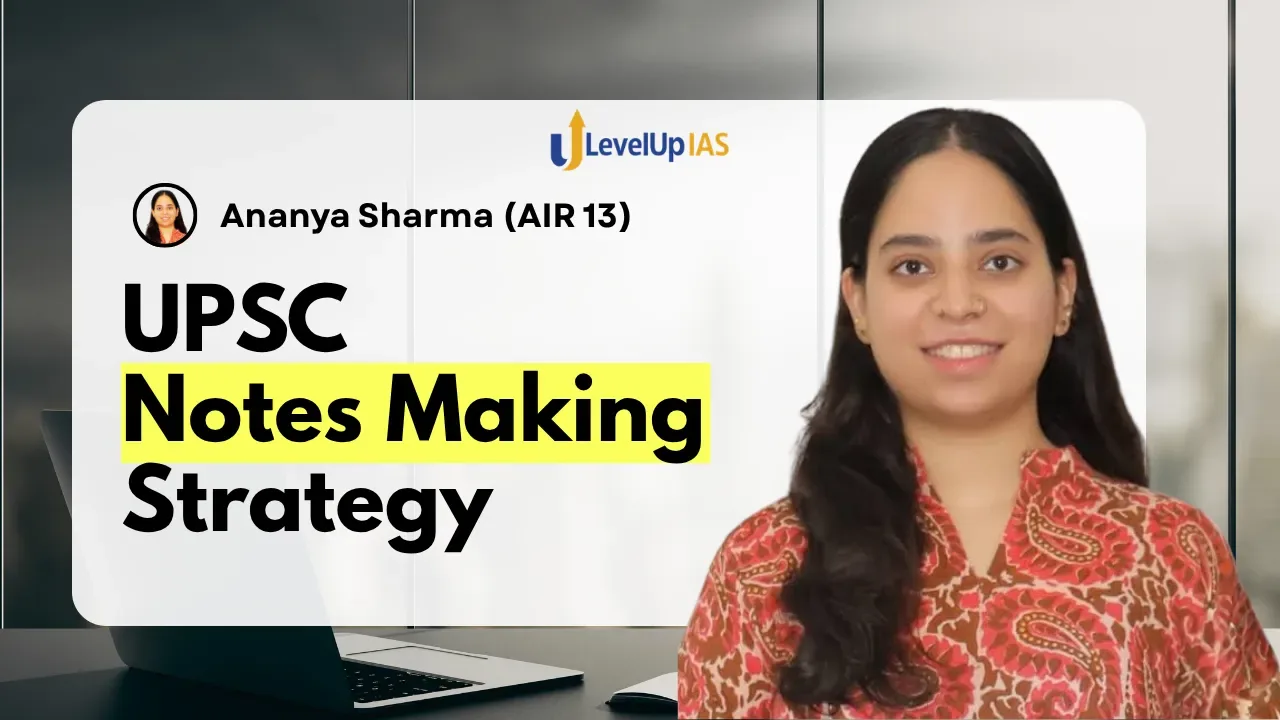
Intro - Ananya Sharma
- UPSC Rank: Secured All India Rank (AIR) 13 in the UPSC Civil Services Examination 2025
- Optional Subject: Sociology
- Place of Study: Completed schooling at Daly College, Indore, Madhya Pradesh.
- Graduation: B.A. (Hons.) in Economics.
- University/College: Graduated from Hindu College, Delhi.
- Background: Economics graduate who transitioned into full-time UPSC preparation. Her success has been attributed to disciplined self-study, structured mentorship, consistent answer-writing practice, and conceptual clarity across all stages of the examination.
If you ask a hundred UPSC aspirants about their biggest hurdle, most will point to the vastness of the syllabus. Aspirants read Laxmikanth for Polity and Spectrum for History multiple times, yet when they face a 10-marker question in the Mains examination, they often struggle to recall the right points under time pressure.
According to Ananya Sharma (AIR 13), the problem is not a lack of reading but an inability to compress content effectively. The purpose of note-making is not to create a miniature version of a textbook. Instead, it is to develop a personalised content-compression mechanism that helps you recall information, structure your answers, and reproduce high-value content within seven to eleven minutes.
Here is a comprehensive breakdown of Ananya Sharma’s step-by-step framework for preparing exam-ready UPSC notes that improve scores and make revision more efficient.
1. The Core Philosophy: Why Make Notes at All?
Before putting pen to paper or opening a digital document, it is essential to understand why you are making notes. Ananya identifies four foundational reasons:
- Volume Management: With four General Studies papers and an optional subject, revisiting entire textbooks during the short interval between Prelims and Mains is practically impossible. Notes condense thousands of pages into a concise collection that can be revised within hours.
- Committing Content to Memory: Writing is an active learning process. Organising information, whether physically or digitally, helps transfer knowledge into long-term memory more effectively than passive reading.
- The Power of Personalisation: Downloading another topper’s notes may appear to be a shortcut, but it removes an important part of the learning process. Your own notes reflect your understanding, language, and conceptual gaps. Borrowed notes should be used only for niche topics with a limited scope, such as World History.
- Matching Thought Speed with Writing Speed: In Mains, you have seven minutes for a 10-marker and eleven minutes for a 15-marker. Effective writing requires your thoughts to move faster than your handwriting. Such fluency develops only after revising your core notes at least five to seven times.
2. Structuring Notes Like a Mains Answer
One of Ananya’s most practical insights is that notes should follow the structure of a model Mains answer. Rather than writing lengthy, continuous paragraphs, organise every topic around an answer-oriented template.
A. The Conceptual Introduction
Begin each topic with a precise definition or an official factual baseline. For example, instead of writing a vague introduction to air pollution, use a definition provided by the World Health Organization (WHO) or include specific Air Quality Index (AQI) data. Similarly, when preparing notes on inflation, record the exact or approximate projections of the Reserve Bank of India (RBI). Official figures from authoritative institutions immediately add depth to an answer in the evaluator’s eyes.
B. Significance and Multi-Dimensional Impacts
Brainstorm seven to eight distinct dimensions explaining why a topic matters or how an issue affects society. Broadly classify these impacts into the following categories:
- Social and Cultural: Gender-related impacts, changes within communities, or shifts in everyday living.
- Economic and Sectoral: Purchasing power, monetary decisions, or industrial losses.
- Geographical and Environmental: Regional vulnerabilities or climate feedback loops.
C. Challenges and Root Causes
Analyse the main issues clearly and systematically. For example, while preparing notes on environmental degradation, classify its causes into governance bottlenecks, technological gaps, and public habits.
D. Solutions, Committees, and Global Best Practices
Conclude your notes with a proactive, administration-oriented approach.
- Government Committees: Include recommendations from important committees without having to read entire 200-page reports. Note four or five actionable recommendations from committees such as NK Singh’s committee on fiscal policy, the BN Srikrishna Committee on data protection, or the Ashok Dalwai Committee on doubling farmers’ income.
- Global Best Practices: Identify international examples, such as Beijing’s model for addressing urban smog or Estonia’s digital governance framework.
E. Pre-Prepared Visual Elements
Incorporate simple visual tools directly into your notes, including hub-and-spoke diagrams, process flowcharts, and spatial maps. Avoid experimenting with unfamiliar visual formats for the first time in the examination hall; practise using them while preparing your notes.
3. Smart Value Addition: The 10% Edge
Core static content constitutes 80% to 90% of your answer. The remaining 10% comes from strategic value additions that help your answer stand out among thousands of answer scripts.
- Official Reports and Indices: Use data from official government resources, such as Press Information Bureau (PIB) backgrounders and the Economic Survey, as well as international sources such as the UNDP’s Human Development Index and Oxfam.
- Ethics Case Studies and Examples: For GS Paper 4, collect real-world examples from platforms such as The Better India or highlight the stories of Padma Award recipients to illustrate values such as empathy, integrity, and dedication.
- Leveraging AI for Efficiency: Use AI tools strictly as research assistants. For example, when looking for global best practices on a particular topic, ask the tool to generate a table of five international solutions. This can save hours of manual research.
4. The Hybrid Note-Making Model
Ananya recommends a hybrid approach to note-making that combines the flexibility of digital platforms with the speed of handwritten revision.
- Digital Base Notes: Maintain your primary notes on a digital platform such as OneNote, Evernote, or Word. Digital notes allow you to search for information instantly, reorganise subheadings, and insert updated facts without disrupting the formatting.
- Physical Cheat Sheets Before Mains: Shortly before the Mains examination, prepare brief, handwritten cheat sheets containing only high-value keywords, committee names, statistics, and diagrams. These micro-notes serve as quick revision sheets immediately before entering the examination hall.
5. What to Skip: Avoid the “Note-Making Trap”
Ananya emphasises that restraint is just as important as effort. To avoid spending disproportionate time on topics with lower returns, follow these guidelines:
- Skip Notes for Prelims: Avoid preparing exhaustive notes for Prelims. Read standard textbooks, underline important information directly, and use sticky notes. For current affairs, highlight relevant information within monthly current affairs compilations covering the 15 months preceding the examination. The only exception is factual, timeline-heavy subjects such as Modern History.
- Follow the Return on Investment (ROI): Allocate your study time according to the weightage of each paper. For example, in GS Paper 3, Economy and Agriculture constitute nearly 50% of the marks, while Internal Security generates four questions annually. Dedicate most of your time to these areas instead of investing excessively in lower-yield topics such as Disaster Management.
- Set a Deadline for Base Notes: Complete your primary notes for both General Studies and your Optional subject by December or mid-January at the latest. This leaves sufficient time for multiple revision cycles and full-length mock tests before the examination.
Conclusion
At its core, Ananya Sharma’s strategy treats note-making not as an academic exercise but as a practical tool built around Previous Year Questions (PYQs) and the demands of the syllabus. By keeping notes concise, structuring them like Mains answers, and enriching them with targeted data and global examples, aspirants can transform an overwhelming volume of information into a clear, effective system designed to achieve one goal: securing high marks on examination day.
Related reads.

How Toppers attempt Prelims By AIR 375 Aditya Kaushik
22 Oct 2026 5 min

Mastering Anthropology: The 292-Mark Roadmap By AIR 521
21 Aug 2026 6 min
Mastering UPSC Answer Writing by AIR 255
17 Aug 2026 5 min

GS & Optional Balancing Strategy By AIR 48
13 Aug 2026 5 min
AIR 49’s Brutally Honest UPSC Strategy Session
10 Aug 2026 4 min

Full 12 Months UPSC Roadmap By AIR 13
07 Aug 2026 5 min
Put it into practice
Reading is step one.
Turn what you've just read into exam-ready answers with mentor-led practice and our structured test series.