
General
GS & Optional Balancing Strategy By AIR 48
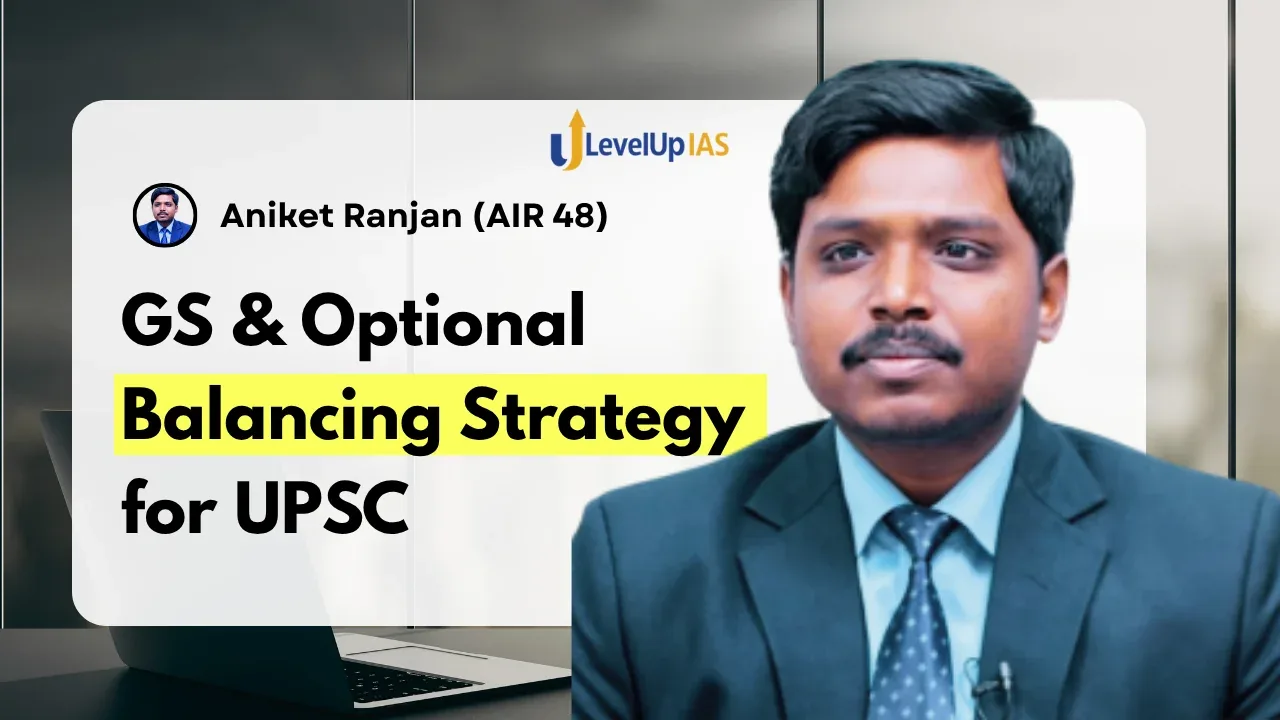
Intro - Aniket Ranjan
UPSC Rank: Secured All India Rank (AIR) 48 in the UPSC Civil Services Examination 2025
Place/State: Belongs to Banka district, Bihar
Place of Study: Completed his schooling and early education in Bihar and pursued higher education in Delhi
Graduation: B.Sc. Mathematics (Honours)
University/College: Ramjas College, University of Delhi
Optional Subject: Anthropology
UPSC Journey: Secured AIR 857 in UPSC CSE 2024 before making a remarkable improvement to AIR 48 in CSE 2025. This was his fourth attempt.
Background: Aniket Ranjan comes from Bihar and has demonstrated remarkable persistence in his UPSC journey. After securing AIR 857 in 2024 and joining the Indian Revenue Service (Customs & Indirect Taxes), he returned to preparation and improved his rank significantly in his fourth attempt.
Many UPSC aspirants enter the cycle with a common dream: clearing the exam in their first attempt. Yet, as Aniket Ranjan (AIR 48) admits, even those with the best intentions often fall into "fundamental mistakes" that turn a one-year plan into a four-year journey.
Having cleared the exam in his fourth attempt, Aniket’s strategy is a masterclass in shifting from a "resource collector" to a "disciplined executor."
If you are aiming for the 2027 or 2028 examination, his advice is simple: stop trying to be a perfectionist and start treating the Syllabus and Previous Year Questions (PYQs) as your "Constitution".
Here is the breakdown of his strategy to balance General Studies (GS) and Optional subjects effectively.
1. The Trap of "Resource Maximization"
The biggest mistake first-attempters make is chasing every new book, PDF, or crash course that hits the market. This "resource maximization" leads to a lack of trust in one's own sources. Aniket insists that you must trust your primary source whether it’s a textbook or coaching notes and only use Google, AI, or additional materials to plug specific gaps identified through the syllabus.
He calls the Syllabus and PYQs the "Constitution for UPSC". Deviating from them to focus on random tests or scattered materials makes an aspirant "directionless".
2. Planning the "Mains-Ready" Timeline
For those starting their journey, the goal should be to be "Mains-ready" by December or January. Aniket suggests a broad six-month window (July to December) to cover the core syllabus.
- The Monthly View: Assign one GS paper per month (e.g., GS 1 in July, GS 4 in August).
- The Weekly View: Identify your weakest subjects within that GS paper like Society or Geography and target them first.
- The Daily View: Use "Micro-targets". Rather than saying "I will study for 10 hours," decide whether you are a "topic-specific" student (finishing a chapter) or a "page-specific" student (finishing 50 pages). This prevents procrastination because you always know exactly what to do when you sit at your desk.
3. The Daily Split: How to Balance GS and Optional
Aniket avoids "hour-specific" targets, focusing instead on a high-intensity parallel schedule. He is a "morning person," and his daily routine offers a clear template for balancing the two pillars of the exam:
- The Morning Block (5:00 AM - 1:00 PM): Dedicated entirely to General Studies. This includes revising the previous day’s work, reading new content, and note-making.
- The Afternoon/Evening Block (2:00 PM - 8:00 PM): Dedicated to the Optional subject. He suggests a deep-dive approach for example, spending the first three months on Optional Paper 1 and the next three on Paper 2.
- The "Switch" Rule: If you get bored with the Optional in the evening, use the final hour for light GS reading or current affairs to keep the momentum going.
4. Choosing and Sustaining the Optional
Many students make the mistake of choosing an optional subject late in the year. Aniket himself chose his optional in October during his first attempt, a delay he now regrets.
To choose correctly, don’t look at "scoring" trends. Instead, perform two tests:
- The PYQ & Topper Test: Look at the PYQs and read toppers' copies. If you feel you can understand their logic and replicate their writing style after 4–6 months of study, that optional is for you.
- The Sustainability Test: Can you read this subject for a year? Every optional has "boring parts" (like Archaeology in Anthropology), but you must be able to sustain interest in the subject as a whole.
5. The "Scientific" Approach to Prelims
Aniket’s early failures in Prelims (scoring 42 and 45 marks) taught him that rote learning isn’t enough. His recovery was built on Conceptual Clarity and deep PYQ Analysis.
- The Essence of Basics: When reading Lakshmikanth or Spectrum, don’t just memorize; understand the "essence" (e.g., the difference between Rule of Law and Natural Justice).
- Deep PYQ Analysis: He went back to 1980 for History and Geography and 2009 for other subjects. He also analyzed other UPSC exams like CDS, CAPF, and NDA.
- The Wikipedia Trick: For tricky mapping or environment questions, he would Google the options. Often, UPSC lifts its statements directly from the first two lines of a Wikipedia page.
6. Mains: Breaking the Inertia of Answer Writin
The biggest hurdle in Mains is the "perfectionist" trap waiting to finish the syllabus before writing a single answer. Aniket’s advice? Don't be a perfectionist; just be average. Even Rank 1 writes average answers for some questions.
To build writing momentum:
- Daily Answer Writing: Write 1-2 answers daily based on the theme you studied that day. Use PYQs to break your inertia.
- Reverse Engineering: If you can't write an answer, read the content first, then write. You can even read a topper’s answer and then try to rewrite it in your own words.
- Value Addition: Use toppers' copies to find unique keywords (e.g., "Sanskritization of Corruption") to make your answers stand out.
7. The "Trinity" of High Scores
To secure a rank, Aniket targets a Mains score of 800+. He emphasizes the "Trinity" of high-scoring areas: Essay, Ethics (GS 4), and Optional.
- Ethics: He improved his score from 96 to 128 by working on weak areas.
- Optional: He calls it the "Real King," as it provides the most significant boost to the final merit list.
Conclusion
Aniket Ranjan concludes that UPSC is a "very boring examination" because it requires doing the same thing reading, writing, and revising again and again. Success doesn't come from discovering new "secret" materials, but from the intensity and frequency of revision of a limited set of high-quality sources.
By maintaining a scheduled, parallel track for GS and Optional, and by treating the syllabus as your guide, you can avoid the "four-attempt" cycle and find your name on the final list much sooner.
To know his strategy in details, watch the video
Related reads.
Mastering Anthropology: The 292-Mark Roadmap By AIR 521
21 Aug 2026 6 min
Mastering UPSC Answer Writing by AIR 255
17 Aug 2026 5 min
AIR 49’s Brutally Honest UPSC Strategy Session
10 Aug 2026 4 min
Full 12 Months UPSC Roadmap By AIR 13
07 Aug 2026 5 min
Scientific Revision System By AIR 341 Vishal Pattanayak
05 Aug 2026 5 min
Efficient Time Management Strategy by AIR 87
03 Aug 2026 5 min
Put it into practice
Reading is step one.
Turn what you've just read into exam-ready answers with mentor-led practice and our structured test series.