
GS-I (History, Geography, Society)
Coral Reefs
Introduction
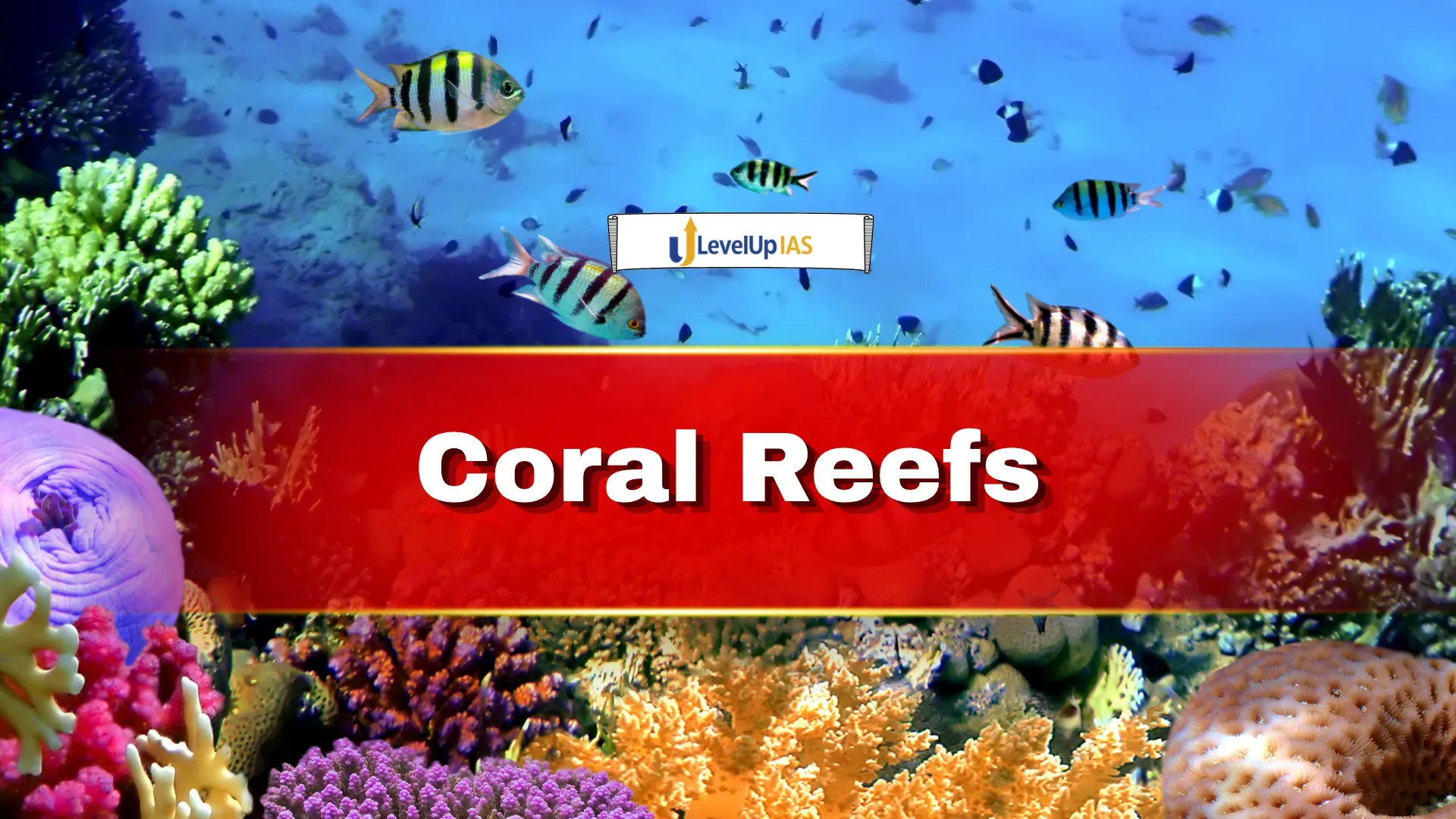
Coral reefs are underwater ecosystems formed primarily by colonies of reef-building corals that secrete calcium carbonate (limestone) skeletons. Over long periods, these skeletons accumulate and create complex reef structures that support a remarkable diversity of marine life.
Often called the “rainforests of the sea,” coral reefs provide habitats, breeding grounds and feeding areas for numerous marine organisms. Although they occupy a very small proportion of the ocean floor, they play a disproportionately important role in marine biodiversity, coastal protection, fisheries and tourism.
Formation and Growth of Coral Reefs
Corals are marine invertebrates belonging to the class Anthozoa of the phylum Cnidaria. Individual coral animals, called polyps, secrete calcium carbonate skeletons. Over generations, these skeletons accumulate to form reef structures.
Many reef-building corals have a symbiotic relationship with microscopic algae called zooxanthellae, which live within their tissues. These algae use sunlight for photosynthesis and provide much of the energy needed by the corals. In return, the corals provide shelter and access to nutrients.
This relationship explains why most reef-building corals thrive in warm, clear, shallow tropical waters where sunlight can penetrate sufficiently. Coral growth is also influenced by salinity, water circulation, nutrient availability and the nature of the seabed.
Conditions Required for Coral Reef Formation
- Temperature: Most tropical reef-building corals thrive in warm waters, generally around 23–29°C, although tolerance varies by species.
- Depth and sunlight: Shallow waters allow sufficient sunlight for photosynthesis by symbiotic algae.
- Salinity: Relatively stable marine salinity is favourable; large freshwater inputs can stress corals.
- Clear water: Low turbidity allows sunlight to penetrate, while excessive sediment can smother coral surfaces.
- Suitable substrate: Hard surfaces provide a foundation on which coral larvae can settle and grow.
- Water movement: Waves and currents supply oxygen and nutrients and help remove waste, although excessive wave energy can damage reefs.
These conditions explain why extensive tropical coral reefs are concentrated in relatively narrow geographical zones, particularly in the Indo-Pacific region.
Types of Coral Reefs
Coral reefs are commonly classified into three major types based on their structure and relationship with the coastline: fringing reefs, barrier reefs and atolls. Patch reefs are also recognised as a distinct form of reef development.
1. Fringing Reefs
Fringing reefs develop directly along coastlines or around islands, usually with little separation from the shore. They are the most common type of coral reef.
They may extend from the shoreline into shallow coastal waters and can contain a narrow lagoon between the reef and land.
2. Barrier Reefs
Barrier reefs develop parallel to coastlines but are separated from the mainland or island by a relatively wide and often deep lagoon.
The Great Barrier Reef of Australia, located off the northeastern coast of Queensland, is the world's largest coral reef system and a major example of this type.
3. Atolls
Atolls are generally ring-shaped reefs that enclose a central lagoon. They commonly develop around oceanic islands that gradually subside or become submerged while coral growth continues upwards.
Charles Darwin's subsidence theory explained how fringing reefs could develop into barrier reefs and eventually atolls as volcanic islands gradually sink relative to sea level. Although other processes also influence reef development, the theory remains an important contribution to physical geography.
4. Patch Reefs
Patch reefs are relatively small, isolated reef structures that commonly occur within lagoons or on continental shelves. They provide habitats for fish and other marine organisms and may occur alongside larger reef systems.
Global Distribution of Coral Reefs
Most tropical reef-building corals are concentrated between approximately 30°N and 30°S, although their distribution varies with ocean temperature, currents, water clarity and local environmental conditions.
Major coral reef regions include:
- Indo-Pacific region: Contains the world's greatest diversity of reef-building corals, particularly around Indonesia, the Philippines and Papua New Guinea.
- Great Barrier Reef, Australia: The largest coral reef system in the world, extending along Australia's northeastern coast.
- Red Sea: Contains extensive reefs adapted to relatively high salinity and other regional environmental conditions.
- Caribbean Sea: Important reef systems occur around Belize, the Bahamas and the Florida Keys.
- Indian Ocean: Significant reefs occur around the Maldives, Seychelles, Madagascar and other island groups.
The Coral Triangle, covering marine areas around Indonesia, the Philippines, Malaysia, Papua New Guinea, Timor-Leste and the Solomon Islands, is particularly important for coral and marine biodiversity.
Coral Reefs in India
India has four major coral reef regions, each with distinct ecological and geographical characteristics.
1. Gulf of Kutch, Gujarat
Located along Gujarat's northwestern coast, the Gulf of Kutch contains extensive intertidal and subtidal reef habitats. Its marine environment experiences considerable tidal variation, fluctuating salinity and relatively high turbidity in some areas.
2. Gulf of Mannar and Palk Bay
Situated along the southeastern coast of Tamil Nadu, these regions contain coral communities, seagrass beds and other marine habitats. The Gulf of Mannar is particularly important for its biodiversity and associated island ecosystems.
3. Andaman and Nicobar Islands
These islands in the Bay of Bengal support extensive coral reefs and diverse marine ecosystems. Their location in the tropical Indo-Pacific contributes to their ecological significance, although reefs face pressures from warming, storms, sedimentation and human activities.
4. Lakshadweep Islands
Located in the Arabian Sea, Lakshadweep is characterised by coral atolls, lagoons and reef-associated islands. Coral reefs are fundamental to the formation and stability of these low-lying islands and help protect them from wave action and coastal erosion.
Ecological and Economic Importance of Coral Reefs
1. Marine Biodiversity
Coral reefs provide shelter, feeding grounds and breeding habitats for numerous fish, molluscs, crustaceans and other marine organisms. Their complex structure creates a wide variety of ecological niches.
2. Coastal Protection
Reefs absorb and dissipate a portion of incoming wave energy, reducing coastal erosion and helping protect shorelines from wave damage. This is especially important for low-lying islands and coastal settlements.
3. Fisheries and Livelihoods
Reef ecosystems support fish populations and provide food and employment for coastal communities. Healthy reefs contribute to small-scale fisheries and sustain livelihoods dependent on marine resources.
4. Tourism and Recreation
Coral reefs support activities such as diving, snorkelling and ecotourism. These activities generate income and employment, particularly in island economies.
5. Scientific and Medicinal Value
Reef organisms possess diverse biological and chemical properties that are of interest to scientific research, including investigations into potential pharmaceutical applications.
Major Threats to Coral Reefs
1. Climate Change and Coral Bleaching
Rising sea temperatures are one of the most serious threats to coral reefs. When corals experience prolonged thermal stress, they may expel their symbiotic algae, causing them to turn white. This phenomenon is called coral bleaching.
Bleached corals are not necessarily dead, but prolonged stress can lead to starvation, disease and mortality. Repeated marine heatwaves reduce the time available for reefs to recover.
2. Ocean Acidification
Oceans absorb carbon dioxide from the atmosphere. This changes seawater chemistry and reduces the availability of carbonate ions needed by corals to build calcium carbonate skeletons. Ocean acidification can therefore weaken reef growth and recovery.
3. Pollution and Sedimentation
Sewage, plastic waste, agricultural runoff and industrial pollutants degrade reef water quality. Excess nutrients can encourage algal growth, while sedimentation reduces sunlight penetration and may smother coral colonies.
4. Overfishing and Destructive Fishing
Overfishing disrupts ecological relationships within reef ecosystems. Destructive practices, including blast fishing and the use of harmful chemicals, can physically damage reef structures and destroy marine habitats.
5. Coastal Development and Tourism
Dredging, land reclamation, port construction and poorly managed tourism can damage coral habitats. Boat anchoring, careless diving and the collection of coral specimens can add further pressure.
Conservation and Management
Effective coral reef conservation requires both local action and global climate measures.
- Marine protected areas: Restricting damaging activities in ecologically sensitive reef habitats can support recovery and biodiversity.
- Pollution control: Treating sewage, managing agricultural runoff and reducing plastic waste improve water quality.
- Sustainable fisheries: Enforcing fishing regulations and preventing destructive fishing help restore ecological balance.
- Climate action: Reducing greenhouse gas emissions is essential to limit ocean warming and acidification.
- Scientific monitoring: Satellite observations, reef surveys and early-warning systems can help identify bleaching and other environmental stresses.
- Community participation: Involving coastal communities in conservation, responsible tourism and sustainable resource use improves long-term protection.
In India, coral reefs receive protection through applicable wildlife and environmental laws, including provisions of the Wild Life (Protection) Act, 1972, and measures under coastal regulation and marine conservation frameworks. Effective implementation and ecosystem-specific management remain important.
Conclusion
Coral reefs are among the most biologically productive and ecologically valuable marine ecosystems. Their formation depends on the interaction of coral organisms, symbiotic algae, seawater conditions and geological processes. Beyond supporting biodiversity, reefs protect coastlines, sustain fisheries and contribute to local economies.
However, climate change, ocean acidification, pollution and destructive human activities threaten their survival. Protecting coral reefs requires coordinated conservation, sustainable coastal management and urgent action to limit global warming.
Related reads.
Ocean Pollution
21 Oct 2026 7 min
Thermohaline Circulation
21 Oct 2026 7 min
Ocean Waves
19 Oct 2026 7 min

Decolonisation in Asia and Africa
18 Oct 2026 8 min
Temperature Distribution in Oceans
10 Oct 2026 9 min

Globalisation and Its Effects
09 Oct 2026 8 min
Put it into practice
Reading is step one.
Turn what you've just read into exam-ready answers with mentor-led practice and our structured test series.