
GS-II (Polity, Governance, IR)
Citizen’s Charter in India
Introduction
Good governance requires public institutions to be transparent, accountable and responsive to citizens. The Citizen’s Charter is an important administrative tool that seeks to improve the quality of public service delivery by defining the commitments of government organisations towards citizens.
It specifies the services offered, expected standards, timeframes, costs and grievance redressal mechanisms. It aims to make administration more citizen-centric by treating citizens as stakeholders rather than passive recipients of government services.
Origin and Evolution in India
The concept of the Citizen’s Charter originated in the United Kingdom in 1991 under Prime Minister John Major. It was introduced to improve the quality and responsiveness of public services.
India adopted the concept in 1997, following the Conference of Chief Ministers on Responsive Administration. The conference adopted an Action Plan for Effective and Responsive Government, which emphasised the preparation of Citizen’s Charters by public service organisations.
The Department of Administrative Reforms and Public Grievances (DARPG) was assigned the responsibility of coordinating the formulation and implementation of these charters across Central Government ministries and departments.
Over time, the initiative expanded to various sectors, including education, healthcare, transport, taxation and public utilities.
Key Features of a Citizen’s Charter
A Citizen’s Charter generally contains the following elements:
1. Vision and Mission: It explains the organisation's objectives and its commitment towards citizens.
2. Details of Services: It provides information about the services offered, eligibility conditions and procedures for accessing them.
3. Service Standards: It specifies measurable standards relating to service quality, delivery timelines and costs.
4. Grievance Redressal: It identifies the officers responsible for handling complaints and provides information about the grievance redressal process.
5. Expectations from Citizens: It explains the responsibilities of citizens, such as submitting correct information, providing necessary documents and following prescribed procedures.
6. Accountability: It identifies officials responsible for delivering services and provides a basis for assessing their performance.
Principles of Citizen’s Charter
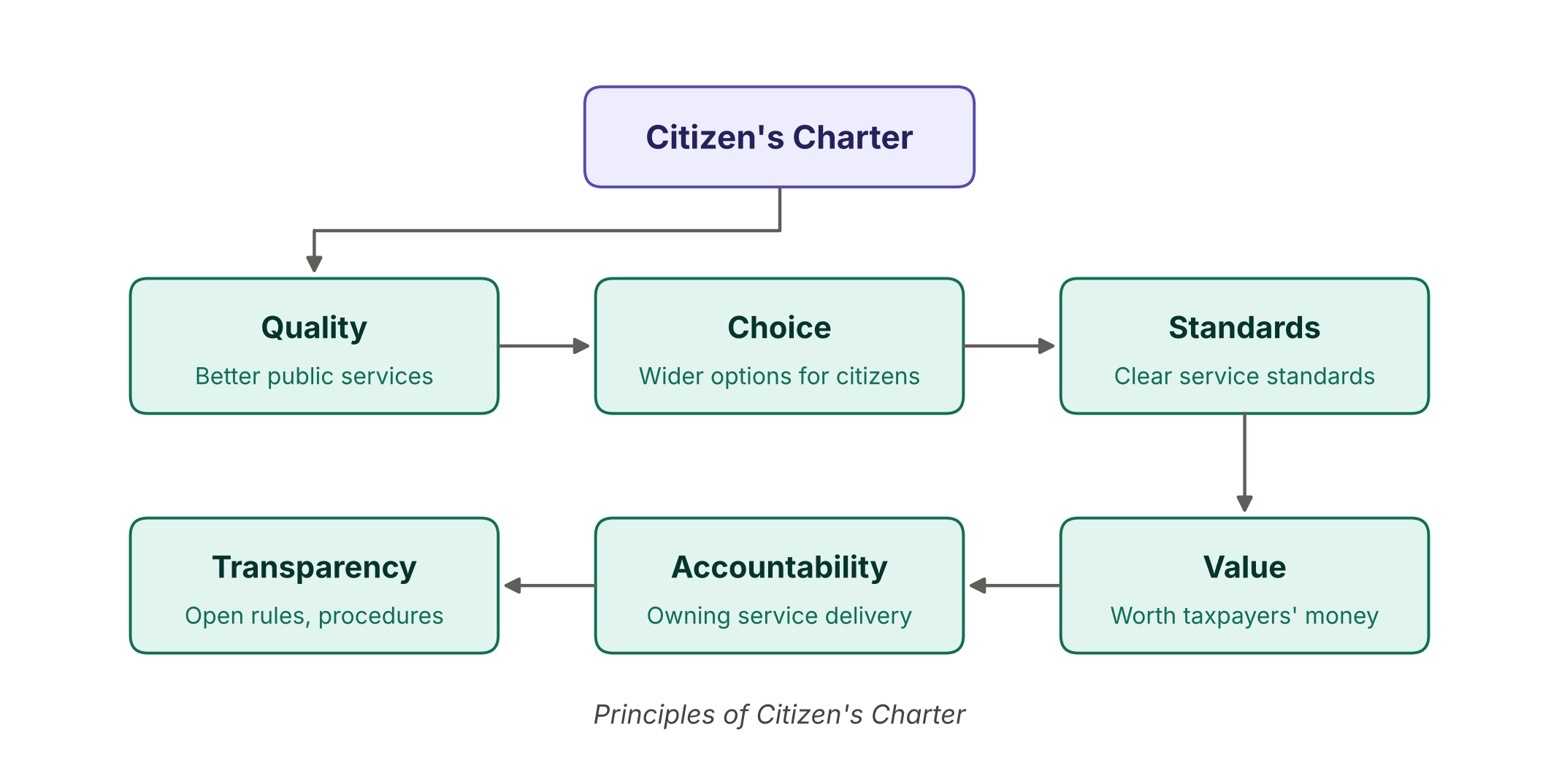
The original Citizen’s Charter movement in the United Kingdom was based on six principles:
- Quality: Improving the quality of public services.
- Choice: Providing citizens with choices wherever possible.
- Standards: Clearly specifying service standards and expected outcomes.
- Value: Ensuring value for taxpayers' money.
- Accountability: Making individuals and organisations responsible for service delivery.
Transparency: Providing information about rules, procedures and grievance mechanisms.
The Indian approach also emphasises consultation, accessibility, fairness, responsiveness and continuous improvement in public service delivery.
Seven-Step Model of the Second Administrative Reforms Commission
The Second Administrative Reforms Commission (ARC), in its 12th Report titled “Citizen Centric Administration - The Heart of Governance”, recommended a seven-step model to make Citizen’s Charters more effective.
- Define Services: Identify the services that the organisation provides and the citizens who use them.
- Set Standards: Establish measurable and realistic service delivery standards.
- Develop Capacity: Build the capacity of employees and improve infrastructure to meet the promised standards.
- Perform: Deliver services according to the prescribed standards.
- Monitor Performance: Regularly assess service delivery and identify gaps.
- Evaluate Outcomes: Obtain citizen feedback and evaluate the effectiveness of services.
- Improve Continuously: Make necessary changes to improve service quality and organisational performance.
The model aims to make Citizen’s Charters an integral part of administrative functioning rather than merely formal documents.
Sevottam Model
The DARPG developed the Sevottam Model in 2006 to improve the quality of public service delivery. The term combines the words Seva (service) and Uttam (excellence).
It provides a framework for assessing and improving the performance of public service organisations.
The model has three major components:
- Citizen’s Charter: Formulation of clear service standards and commitments.
- Public Grievance Redressal: Establishment of an effective system for receiving, addressing and preventing grievances.
- Service Delivery Capability: Improvement in organisational capacity, infrastructure and employee performance.
The model is also linked to Indian Standard IS 15700:2005, which provides quality-management requirements for public service organisations.
Importance of Citizen’s Charter
Promotes Transparency: It makes information about government services, procedures, costs and timelines publicly available.
Strengthens Accountability: Clearly defined service standards help citizens question delays and poor service delivery.
Improves Administrative Efficiency: It encourages departments to simplify procedures, reduce delays and improve internal functioning.
Empowers Citizens: Awareness of service entitlements and grievance mechanisms enables citizens to demand better public services.
Promotes Participatory Governance: Consultation and feedback involve citizens in improving public administration.
Builds Public Trust: Timely and predictable service delivery strengthens the relationship between citizens and government institutions.
Challenges in Implementation
Despite its potential, the Citizen’s Charter has not achieved its intended effectiveness across many public institutions.
- Lack of Legal Enforceability: Most Citizen’s Charters are voluntary administrative commitments. Failure to meet promised standards does not automatically attract legal penalties.
- Poor Formulation: Many charters contain vague promises instead of measurable service delivery standards.
- Limited Public Awareness: Citizens are often unaware of the commitments and grievance mechanisms mentioned in the charters.
- Inadequate Consultation: Charters are frequently prepared by senior officials without sufficient participation from citizens, civil society and frontline employees.
- Administrative Resistance: Bureaucratic inertia and reluctance to change existing procedures affect implementation.
- Resource Constraints: Shortages of staff, infrastructure and technological facilities make it difficult to fulfil service commitments.
- Lack of Regular Review: Many charters are not updated to reflect changing citizen needs and administrative realities.
Measures to Strengthen Citizen’s Charters
The following measures can improve their effectiveness:
- Citizen Participation: Involve citizens, civil society organisations and frontline employees in preparing and reviewing charters.
- Clear Standards: Specify realistic, measurable and time-bound service delivery commitments.
- Legal Backing: Strengthen the accountability framework through enforceable Right to Public Services laws.
- Regular Review: Update charters periodically based on citizen feedback and changing service requirements.
- Public Awareness: Make charters accessible through local languages, websites, service centres and public offices.
- Independent Evaluation: Introduce regular audits and performance assessments to examine whether commitments are being fulfilled.
- Technology Integration: Use digital platforms to monitor service delivery, receive feedback and improve grievance redressal.
Recent Developments in Public Grievance Redressal
The government has introduced several reforms to strengthen citizen-centric administration.
Centralised Public Grievance Redress and Monitoring System (CPGRAMS): It is an online platform that enables citizens to lodge grievances concerning Central Government ministries and departments, as well as participating State and Union Territory administrations.
Reduction in Grievance Disposal Timeline: The prescribed grievance redressal timeline under CPGRAMS has been reduced from 30 days to 21 days, with a focus on faster resolution.
Samadhan Didi: Launched in May 2026, this AI-enabled multilingual voice chatbot allows citizens to register grievances by speaking in their own languages. It also helps identify the appropriate ministry or department for the complaint.
Grievance Redressal Assessment and Index (GRAI): It benchmarks the performance of ministries and departments in handling public grievances and encourages improvements in grievance redressal.
These initiatives complement the objectives of Citizen’s Charters by improving accessibility, responsiveness and accountability in public service delivery.
Conclusion
The Citizen’s Charter is an important instrument for transforming public administration from a procedure-oriented system into a citizen-centric system. However, its success depends on realistic service standards, public participation, effective grievance redressal and administrative accountability. Strengthening its implementation through regular evaluation, technology and enforceable service guarantees can help make governance more transparent, responsive and accountable.
FAQs
1. What is a Citizen’s Charter?
A Citizen’s Charter is a public document that specifies the services offered by a government organisation, service standards, timelines and grievance-redressal mechanisms.
2. When was the Citizen’s Charter initiative launched in India?
It was launched in 1997, following the Conference of Chief Ministers on Effective and Responsive Administration.
3. What are the main objectives of a Citizen’s Charter?
To improve transparency, accountability, responsiveness and the quality of public services.
4. Is the Citizen’s Charter legally enforceable in India?
Generally, no. It is an administrative commitment rather than a legally enforceable contract, unless supported by specific legislation.
5. What are the key components of a Citizen’s Charter?
- Vision and mission of the organisation.
- Details of services offered.
- Service delivery standards and timelines.
- Expectations from citizens.
- Grievance-redressal mechanisms.
Related reads.
E-Governance in India
20 Nov 2026 10 min
Territory of India: (Articles 1-4)
17 Nov 2026 7 min
Making of the Indian Constitution
09 Oct 2026 7 min

UN Convention on the Law of the Sea (UNCLOS)
24 Sep 2026 7 min
Zonal Councils, UPSC Polity
21 Sep 2026 7 min
Social Sector and Services
15 Sep 2026 7 min
Put it into practice
Reading is step one.
Turn what you've just read into exam-ready answers with mentor-led practice and our structured test series.