
GS-II (Polity, Governance, IR)
Making of the Indian Constitution
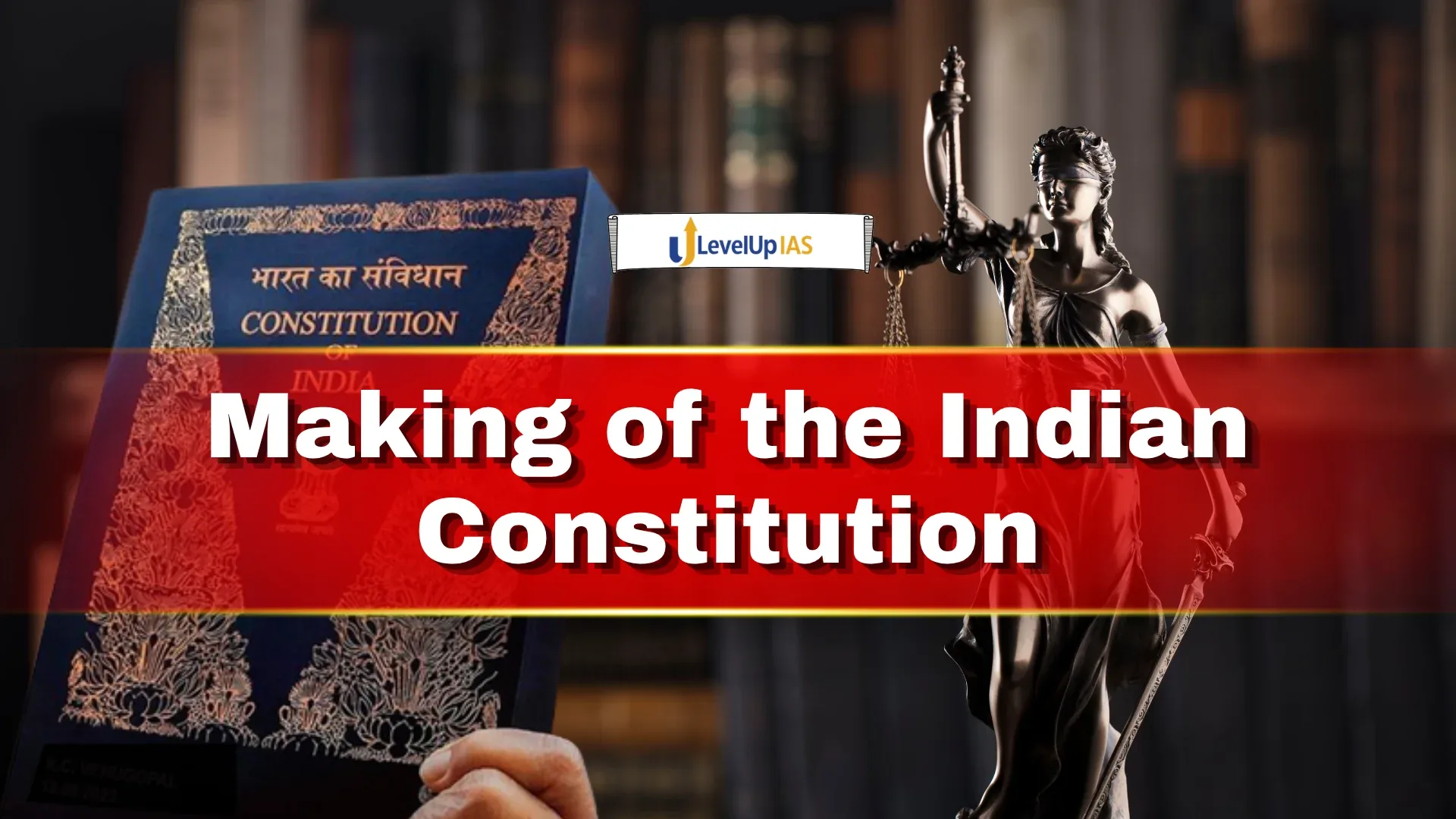
Introduction
The Constitution of India is the supreme law of the country, establishing the framework of government, defining the powers of constitutional institutions and guaranteeing citizens' rights. Its making was a landmark exercise in democratic institution-building, undertaken during a period marked by Partition, communal violence, widespread poverty and the challenge of integrating a diverse society into a united nation.
The Constitution was framed by the Constituent Assembly of India, which drew upon the experience of the freedom movement, debates within the Assembly and constitutional practices from different countries. Its objective was not merely to establish a system of government but also to create a democratic framework committed to justice, liberty, equality and fraternity.
Background to Constitution-Making
The demand for a constitution framed by Indians developed alongside the freedom struggle. Indian nationalists increasingly opposed the idea that Britain's Parliament should determine the constitutional future of India.
In 1934, M. N. Roy proposed the idea of a Constituent Assembly. The Indian National Congress subsequently adopted the demand, and it gained wider acceptance during the freedom movement. The Cabinet Mission Plan of 1946 ultimately provided the framework for establishing the Constituent Assembly.
The Assembly was therefore a product of both the nationalist demand for self-government and negotiations over the transfer of power from British rule.
Formation and Composition of the Constituent Assembly
The Constituent Assembly was constituted under the Cabinet Mission Plan of 1946. Its members were not directly elected by the people through universal adult franchise. Instead, representatives of British Indian provinces were elected indirectly by the provincial legislative assemblies through proportional representation by means of the single transferable vote. Representatives of princely states were to be nominated.
The Assembly originally had 389 members: 292 representatives from British Indian provinces, four from Chief Commissioners' provinces and 93 from princely states. Following Partition, its strength was reduced to 299 members.
The Assembly first met on 9 December 1946. Dr. Sachchidananda Sinha served as its temporary President, while Dr. Rajendra Prasad was elected its permanent President on 11 December 1946. B. N. Rau served as the Constitutional Adviser and played an important role in preparing the initial constitutional draft.
Although the Assembly was not elected through universal adult suffrage, its deliberations brought together representatives with different political, social, regional and ideological perspectives. Women members, legal experts, social reformers and representatives of different communities also contributed to the constitutional debates.
Objectives Resolution: The Philosophical Foundation
On 13 December 1946, Jawaharlal Nehru moved the Objectives Resolution in the Constituent Assembly. It was adopted on 22 January 1947 and established the guiding principles for constitution-making.
The Resolution envisaged India as an independent sovereign republic, affirmed the authority of the people, and emphasised justice, equality, freedom and safeguards for minorities and disadvantaged groups.
Its principles substantially influenced the Preamble to the Constitution, which expresses the foundational values and aspirations of the Indian Republic. The Resolution thus provided a philosophical framework within which the Assembly debated the structure of government, citizens' rights and the nature of the Indian state.
Major Committees of the Constituent Assembly
Much of the Assembly's detailed work was carried out through committees. These committees examined specific constitutional questions and submitted reports that were subsequently debated by the full Assembly.
Committee | Chairperson | Principal area of work |
| Drafting Committee | Dr. B. R. Ambedkar | Preparation and revision of the constitutional draft |
| Union Powers Committee | Jawaharlal Nehru | Distribution of powers between the Union and the provinces |
| Union Constitution Committee | Jawaharlal Nehru | Constitutional structure of the Union |
| Provincial Constitution Committee | Sardar Vallabhbhai Patel | Constitutional framework for provinces |
| Advisory Committee on Fundamental Rights, Minorities and Tribal and Excluded Areas | Sardar Vallabhbhai Patel | Rights, minority safeguards and protections for tribal areas |
| Rules of Procedure Committee | Dr. Rajendra Prasad | Rules governing the Assembly's proceedings |
| Steering Committee | Dr. Rajendra Prasad | Coordination of Assembly business |
The committee system allowed specialised examination of complex issues, including fundamental rights, minority protections, tribal administration, legislative powers and the relationship between the Union and the states. Their recommendations provided the foundation for subsequent deliberations in the full Assembly.
Drafting Committee and Dr. B. R. Ambedkar
The Drafting Committee was established on 29 August 1947, with Dr. B. R. Ambedkar as its chairman. Its original members were N. Gopalaswami Ayyangar, Alladi Krishnaswami Ayyar, K. M. Munshi, Syed Mohammad Saadulla, B. L. Mitter and D. P. Khaitan, in addition to Ambedkar. Changes in membership occurred subsequently.
The Committee examined the reports of the various committees, the Constitutional Adviser's draft and the Assembly's decisions to prepare a coherent constitutional document. Dr. Ambedkar played a central role in explaining provisions, responding to objections and defending the constitutional framework during the debates.
However, constitution-making was a collective process, involving the Assembly's members, committee chairpersons, constitutional experts and numerous contributors. Ambedkar's contribution was particularly significant in coordinating and presenting the Drafting Committee's work, but the Constitution emerged from extensive deliberation rather than the work of any single individual.
Stages of Drafting and Deliberation
The Constitution evolved through several stages of drafting, publication, debate and revision.
Preparation and Publication of the Draft
B. N. Rau prepared an initial constitutional draft drawing on committee reports, comparative constitutional study and the Assembly's decisions. The Drafting Committee subsequently revised this work.
The draft Constitution was published in February 1948, allowing members and the public to examine its provisions and submit comments.
First Reading
Dr. Ambedkar introduced the Draft Constitution in the Assembly on 4 November 1948. The first reading involved a general discussion of its overall principles and structure.
Second Reading
The second reading, from 15 November 1948 to 17 October 1949, involved clause-by-clause consideration. Members proposed amendments and debated subjects such as fundamental rights, citizenship, the powers of the Union, the position of states, judicial independence and the relationship between the legislature and the executive.
Third Reading and Adoption
The third reading began on 14 November 1949. Following the final debates, the Constituent Assembly adopted the Constitution on 26 November 1949. The process involved extensive scrutiny and consideration of thousands of proposed amendments.
Sources of the Indian Constitution
The framers studied constitutional systems from several countries while adapting relevant features to Indian conditions. The United Kingdom influenced the parliamentary system and cabinet government; the United States influenced Fundamental Rights and judicial review; Ireland influenced the Directive Principles of State Policy; and Canada influenced aspects of the federal structure and the distribution of powers.
The Government of India Act, 1935, also provided an important administrative and institutional foundation, including elements of federal administration, public services and provincial governance.
These influences were selectively adapted rather than copied mechanically. The resulting Constitution reflected India's own historical experiences, political priorities and social diversity.
Adoption, Enactment and Commencement
The Constitution was adopted on 26 November 1949 and its members signed the final document on 24 January 1950. It came into force on 26 January 1950, when India became a republic.
The date of commencement was chosen to honour the Purna Swaraj declaration of 26 January 1930, which had marked the national movement's commitment to complete independence.
At commencement, the Constitution contained 395 Articles, 22 Parts and 8 Schedules. Certain provisions, including those relating to citizenship and the Election Commission, had already come into force upon adoption. The bulk of the Constitution commenced on 26 January 1950.
Conclusion
The making of the Indian Constitution was a complex process shaped by the freedom struggle, comparative constitutional experience and debates over democracy, social justice, national unity and individual liberty. The Constituent Assembly, its committees and the Drafting Committee collectively converted these aspirations into a constitutional framework.
The Constitution's significance lies not only in its provisions but also in the deliberative process through which they emerged. It established the institutional foundations of the Republic while creating a framework through which future generations could pursue democratic change, protect rights and address social inequalities.
FAQs
1. How was the Indian Constitution formed?
The Indian Constitution was drafted by the Constituent Assembly, which was established in 1946 under the Cabinet Mission Plan. The Assembly debated and adopted the Constitution on 26 November 1949.
2. When was the Constituent Assembly formed?
The Constituent Assembly was formed in 1946. Its first meeting was held on 9 December 1946, with Dr. Sachchidananda Sinha as the temporary chairman.
3. Who was the President of the Constituent Assembly?
Dr. Rajendra Prasad was elected President of the Constituent Assembly on 11 December 1946.
4. Who chaired the Drafting Committee?
Dr. B. R. Ambedkar chaired the Drafting Committee, which was established on 29 August 1947 to prepare the draft Constitution.
5. What was the Objectives Resolution?
The Objectives Resolution was moved by Jawaharlal Nehru on 13 December 1946 and adopted on 22 January 1947. It laid down the guiding principles and constitutional ideals that informed the Preamble.
Related reads.

UN Convention on the Law of the Sea (UNCLOS)
24 Sep 2026 7 min
Zonal Councils, UPSC Polity
21 Sep 2026 7 min
Social Sector and Services
15 Sep 2026 7 min
Sessions of Parliament
12 Sep 2026 7 min
Planning in India (Five-Year Plans)
07 Aug 2026 7 min

G7 Grouping and Its Summit
05 Aug 2026 5 min
Put it into practice
Reading is step one.
Turn what you've just read into exam-ready answers with mentor-led practice and our structured test series.