
GS-II (Polity, Governance, IR)
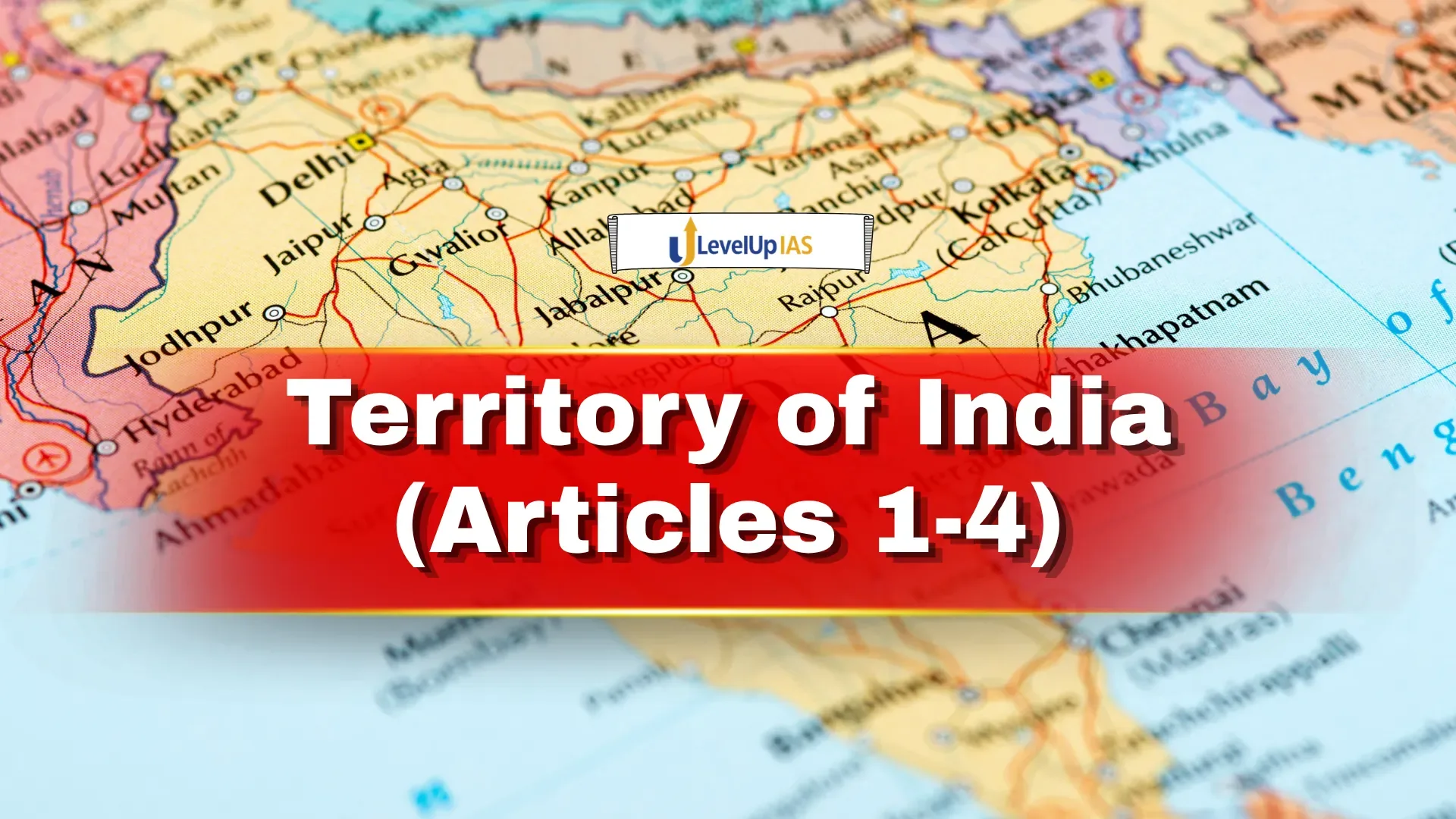
Territory of India: (Articles 1-4)
Introduction
Part I of the Indian Constitution, titled “The Union and its Territory,” contains Articles 1 to 4. These provisions define the territorial identity of India, explain the composition of the Indian Union and empower Parliament to admit new States, establish new States and reorganise the boundaries or names of existing States.
These provisions reflect the constitutional vision of India as an integrated political entity with a flexible federal structure. Unlike some federations formed through an agreement among independent units, the Indian Union is not based on an agreement among States, and no State has the right to secede from it.
Article 1: Name and Territory of the Union
Article 1 declares that “India, that is Bharat, shall be a Union of States.” It establishes the constitutional name and territorial composition of the country.
The Constituent Assembly debated whether India should be described as a federation or a Union. The term Union of States was adopted to emphasise the unity and permanence of the country. It indicates that the Indian Union is indestructible, although its constituent States can be reorganised.
Article 1 has three important provisions:
- Article 1(1): India, that is Bharat, shall be a Union of States.
- Article 1(2): The States and their territories shall be specified in the First Schedule of the Constitution.
- Article 1(3): The territory of India comprises the territories of the States, the Union Territories specified in the First Schedule and any other territories that may be acquired.
Union of India vs Territory of India
Although these expressions are often used interchangeably, they have different constitutional meanings.
Union of India | Territory of India |
| Refers to the federal structure comprising the States. | Refers to the entire geographical territory under India's sovereignty. |
| Includes the States. | Includes States, Union Territories and acquired territories. |
| Has a narrower meaning. | Has a wider meaning. |
Thus, the Territory of India is wider than the Union of India because it includes Union Territories and any other territories acquired by India.
Article 2: Admission or Establishment of New States
Article 2 empowers Parliament to admit new States into the Union or establish new States on such terms and conditions as it considers appropriate.
It covers two situations:
- Admission: Bringing an already existing political or territorial entity into the Indian Union.
- Establishment: Creating a new State as a constituent unit of the Union.
This provision gives Parliament flexibility in expanding the territorial and political composition of India.
Example – Sikkim: Sikkim became an associate State of India through the 35th Constitutional Amendment Act, 1974, which inserted Article 2A. Subsequently, the 36th Constitutional Amendment Act, 1975, made Sikkim a full-fledged State of the Indian Union and repealed Article 2A.
Article 3: Formation of New States and Alteration of Existing States
Article 3 empowers Parliament to reorganise the internal boundaries of India. It allows Parliament to form new States and alter the areas, boundaries or names of existing States.
Under this Article, Parliament can:
- Form a new State by separating territory from an existing State.
- Form a new State by uniting two or more States or parts of States.
- Unite any territory with a part of an existing State.
- Increase or decrease the area of a State.
- Alter the boundaries of a State.
- Change the name of a State.
Procedure for Reorganisation of States
The Constitution prescribes a specific procedure for introducing a Bill under Article 3.
- Recommendation of the President: A Bill for the purposes mentioned under Article 3 can be introduced in either House of Parliament only on the recommendation of the President.
- Reference to the State Legislature: If the proposal affects the area, boundaries or name of a State, the President must refer the Bill to the concerned State Legislature to express its views within a specified period.
- Consideration by Parliament: After receiving the State Legislature's views or the expiry of the specified period, Parliament may proceed with the Bill.
- Passing of the Bill: The Bill is passed through the ordinary legislative process by a simple majority.
An important point is that the views of the concerned State Legislature are not binding on Parliament. Parliament may accept or reject these views. It may also pass the Bill even if the State Legislature does not respond within the prescribed period.
The term State under Article 3 includes Union Territories for the purpose of the substantive clauses. However, the consultation requirement does not extend to Union Territories.
Examples of State Reorganisation in India
The power under Article 3 has been used several times to reorganise the Indian Union.
- Andhra Pradesh (1953): The first linguistic State was formed by separating Telugu-speaking areas from the erstwhile Madras State.
- Maharashtra and Gujarat (1960): The Bombay Reorganisation Act, 1960, created Maharashtra and Gujarat.
- Haryana (1966): The Punjab Reorganisation Act, 1966, created Haryana and reorganised Punjab.
- Chhattisgarh, Jharkhand and Uttarakhand (2000): These three States were created by reorganising Madhya Pradesh, Bihar and Uttar Pradesh, respectively.
- Telangana (2014): Telangana was formed by separating it from Andhra Pradesh under the Andhra Pradesh Reorganisation Act, 2014.
These developments demonstrate Parliament's authority to reshape the internal territorial organisation of the country in response to administrative, linguistic, cultural and political considerations.
Article 4: Laws Made Under Articles 2 and 3
Article 4 deals with the constitutional consequences of laws made under Articles 2 and 3.
It provides that such laws may make necessary changes to the First and Fourth Schedules of the Constitution, along with supplemental, incidental and consequential provisions.
- First Schedule: Contains the names of States and Union Territories and specifies their territorial extent.
- Fourth Schedule: Deals with the allocation of seats in the Rajya Sabha to States and Union Territories.
The most important feature of Article 4 is that laws made under Articles 2 and 3 are not considered constitutional amendments under Article 368. Therefore, they can be passed by a simple majority through the ordinary legislative process.
This provision makes territorial reorganisation easier and more flexible without requiring the special majority procedure prescribed for constitutional amendments.
Important Constitutional Amendments Related to the Territory of India
Several constitutional amendments have shaped the territorial organisation of India.
35th Constitutional Amendment Act, 1974: Introduced Article 2A and made Sikkim an associate State of India.
36th Constitutional Amendment Act, 1975: Made Sikkim a full-fledged State of the Indian Union and repealed Article 2A.
7th Constitutional Amendment Act, 1956: Implemented major changes in the constitutional framework of States and Union Territories following the States Reorganisation Act, 1956.
100th Constitutional Amendment Act, 2015: Gave effect to the India-Bangladesh Land Boundary Agreement, facilitating the exchange of enclaves between the two countries and the settlement of certain boundary disputes.
Important Supreme Court Judgments
The Supreme Court has clarified the scope of Parliament's territorial powers through important judgments.
1. Berubari Union Case (1960)
In the Berubari Union Reference, the Supreme Court examined whether Indian territory could be ceded to another country through a law made under Article 3. It held that the cession of Indian territory to a foreign country could not be carried out under Article 3 alone. Such a transfer required a constitutional amendment under Article 368.
This principle was later reflected in the 9th Constitutional Amendment Act, 1960, which sought to implement the India-Pakistan agreement concerning the Berubari Union and certain other territories.
2. In Re: Article 370 (2023)
In its judgment on the constitutional changes relating to Jammu and Kashmir, the Supreme Court examined Parliament's powers concerning the reorganisation of the former State. It upheld the constitutional validity of the reorganisation into the Union Territories of Jammu and Kashmir and Ladakh. The Court also emphasised that the restoration of statehood to Jammu and Kashmir should take place at the earliest.
The judgment is significant for understanding the relationship between Parliament's reorganisation powers and India's federal structure.
Conclusion
Part I of the Indian Constitution establishes the constitutional framework governing the Union and its territory. While Article 1 defines India as a Union of States, Articles 2 and 3 provide Parliament with the power to admit, establish and reorganise States. Article 4 ensures that such changes can be made through the ordinary legislative process without invoking Article 368. Together, these provisions balance national unity with the changing administrative and political needs of the country.
FAQs
1. What does Article 1 of the Indian Constitution deal with?
Article 1 defines India as a Union of States. It also specifies that the territory of India comprises:
- Territories of the States.
- Union Territories specified in the First Schedule.
- Territories that may be acquired by India.
2. Why is India described as a Union of States?
The term emphasises that the Indian Union is not the result of an agreement among independent states and that no state has the right to secede from the Union.
3. What is the significance of Article 2?
Article 2 empowers Parliament to admit new states into the Union or establish new states on terms and conditions it considers appropriate.
4. What powers does Article 3 grant to Parliament?
Parliament can:
- Form new states.
- Increase or diminish the area of a state.
- Alter state boundaries.
- Change the name of a state.
5. Is the consent of a state legislature necessary for its reorganisation under Article 3?
No. The President refers the Bill to the concerned state legislature for its views, but Parliament is not bound by those views.
Related reads.
Making of the Indian Constitution
09 Oct 2026 7 min

UN Convention on the Law of the Sea (UNCLOS)
24 Sep 2026 7 min

Zonal Councils, UPSC Polity
21 Sep 2026 7 min

Social Sector and Services
15 Sep 2026 7 min
Sessions of Parliament
12 Sep 2026 7 min
Planning in India (Five-Year Plans)
07 Aug 2026 7 min
Put it into practice
Reading is step one.
Turn what you've just read into exam-ready answers with mentor-led practice and our structured test series.