
GS-II (Polity, Governance, IR)
Role of Civil Services

Introduction
Civil services form the permanent administrative machinery of a democratic government. While elected representatives formulate policies and make political decisions, civil servants assist in policy formulation, implement government programmes and ensure the delivery of public services.
In a diverse country like India, civil services play an important role in maintaining administrative continuity, upholding constitutional values and connecting the government with citizens. They are often described as the “steel frame of India”, a phrase associated with Sardar Vallabhbhai Patel, reflecting their importance in maintaining national administration and unity.
Constitutional Framework of Civil Services in India
The Constitution provides a framework for the organisation, recruitment and service conditions of civil servants.
- Article 309: Empowers Parliament and State Legislatures to regulate the recruitment and conditions of service of persons serving the Union or a State.
- Article 310: Provides for the doctrine of pleasure, under which civil servants hold office during the pleasure of the President or the Governor, subject to constitutional provisions.
- Article 311: Provides safeguards against arbitrary dismissal, removal or reduction in rank of civil servants.
- Article 312: Provides for the creation of All India Services common to the Union and the States, subject to the prescribed constitutional procedure.
- Article 315: Provides for the establishment of the Union Public Service Commission (UPSC) and State Public Service Commissions.
- Article 320: Defines the functions of Public Service Commissions, including conducting examinations and advising on recruitment-related matters.
The three existing All India Services are the Indian Administrative Service (IAS), Indian Police Service (IPS) and Indian Forest Service (IFoS).
Role of Civil Services in a Democracy
1. Implementation of Government Policies: Civil servants translate laws, policies and welfare programmes into action. They ensure that government decisions reach the intended beneficiaries through administrative institutions at the national, state and local levels.
2. Policy Formulation and Advice: They provide technical expertise, administrative experience and field-level information to elected representatives. Their advice helps the political executive assess policy options, financial implications and implementation challenges.
3. Maintaining Administrative Continuity: Governments may change after elections, but the administrative machinery continues to function. Civil servants preserve institutional memory and ensure that essential public services are not disrupted during political transitions.
4. Upholding Constitutional Values: Civil servants are expected to act according to the Constitution, protect the rule of law and ensure equality before the law. Their impartial functioning is essential for maintaining public confidence in democratic institutions.
5. Ensuring Law and Order: Civil services, particularly the police and district administration, maintain public order, prevent crime and manage situations involving social tensions or public disturbances.
6. Conducting Free and Fair Elections: Civil servants assist the Election Commission of India in conducting elections by managing polling arrangements, maintaining law and order and implementing electoral procedures.
7. Promoting Welfare and Inclusive Development: They implement programmes relating to education, healthcare, poverty alleviation, rural development and social security. Their role is particularly important in ensuring that vulnerable and marginalised communities receive government benefits.
8. Crisis and Disaster Management: During floods, cyclones, pandemics and other emergencies, civil servants coordinate rescue operations, relief distribution, rehabilitation and interdepartmental response.
9. Strengthening Centre-State Relations: All India Services provide an administrative link between the Union and State Governments. Officers serving in different cadres help coordinate policies and maintain administrative cooperation within India's federal structure.
Significance of Civil Services in Democratic Governance
Civil services contribute to democracy beyond the routine functioning of government departments.
Institutional Stability: A professional and permanent administrative structure ensures that governance continues despite changes in political leadership.
Administrative Expertise: Civil servants bring specialised knowledge and experience to complex areas such as public finance, infrastructure, security, environment and social development.
Citizen-Centric Administration: Through public service delivery and grievance redressal, civil servants help make government institutions more accessible and responsive.
National Integration: All India Services promote administrative coordination across regions and help maintain common standards of governance.
Accountability: Civil servants are responsible for implementing laws and public policies within the constitutional and legal framework. Their conduct is subject to legislative, judicial, administrative and public scrutiny.
Challenges Faced by Civil Services in India
Despite their importance, civil services face several institutional and administrative challenges.
1. Political Interference: Frequent transfers, pressure from political authorities and expectations of partisan loyalty can weaken administrative neutrality and professional independence.
2. Lack of Accountability: Delays, procedural inefficiency and inadequate performance evaluation can reduce the quality of public service delivery.
3. Generalist Versus Specialist Debate: The generalist structure provides administrative coordination and a broad understanding of governance. However, complex policy areas increasingly require specialised knowledge in fields such as technology, finance, healthcare and climate change.
4. Corruption and Ethical Concerns: Misuse of official authority, favouritism and conflicts of interest can undermine public trust in administrative institutions.
5. Bureaucratic Red-Tapism: Excessive procedures, rigid hierarchies and risk-averse decision-making can delay development projects and discourage innovation.
6. Capacity and Resource Constraints: Shortages of personnel, inadequate infrastructure and uneven access to training affect administrative performance, particularly at the grassroots level.
7. Insecure Tenure: Frequent changes in postings can disrupt policy implementation, weaken institutional memory and discourage officers from taking long-term initiatives.
Reforms Needed in Civil Services
Strengthening civil services requires a shift towards a professional, accountable, transparent and citizen-oriented administrative system.
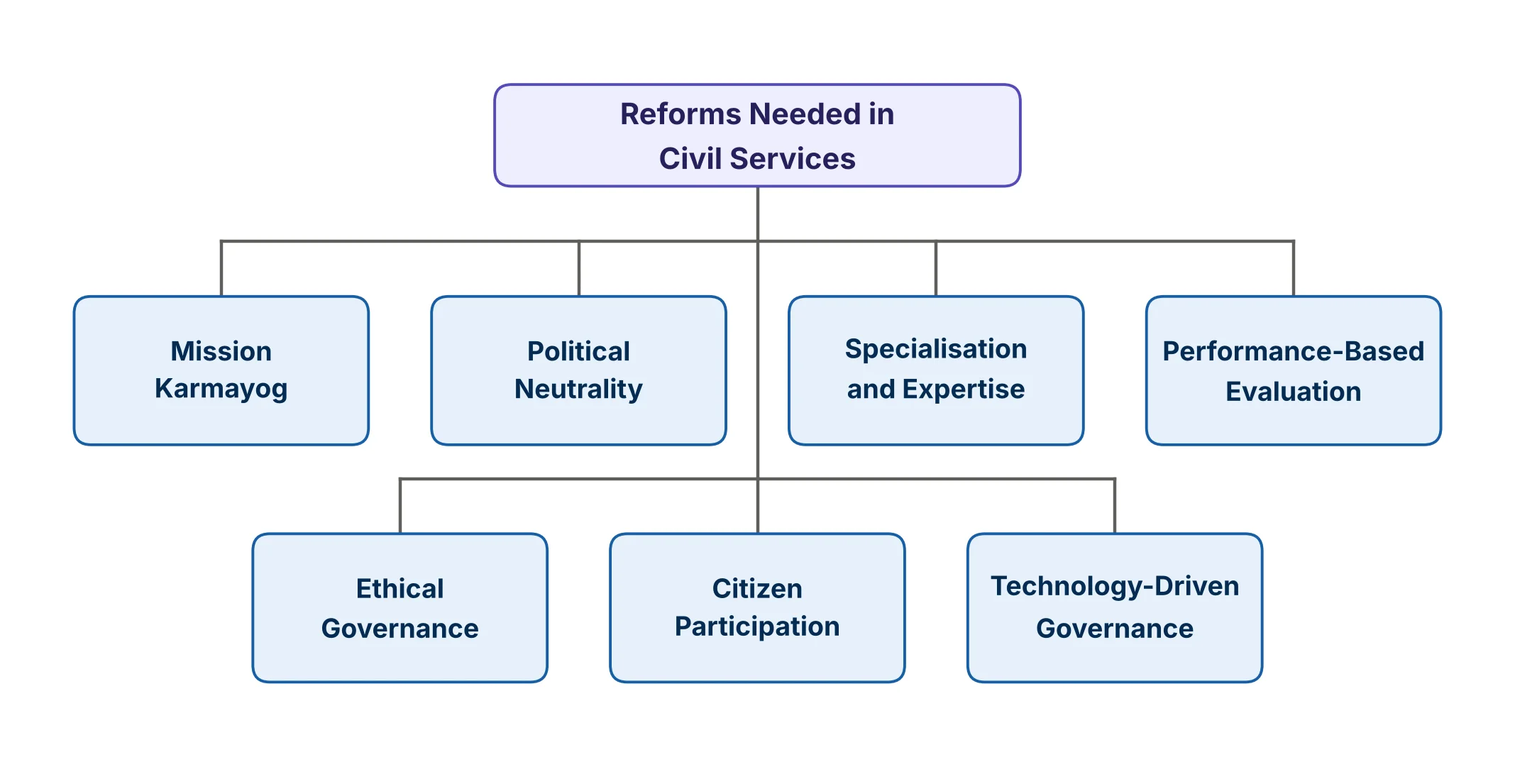
- Mission Karmayogi: The National Programme for Civil Services Capacity Building (NPCSCB), launched in 2020, seeks to develop a competent and future-ready civil service through continuous, competency-based training. The iGOT Karmayogi digital platform supports online learning and capacity building.
- Political Neutrality: Civil Services Boards and transparent transfer and posting policies should be strengthened to reduce arbitrary interference and ensure reasonable tenure stability.
- Specialisation and Expertise: Domain knowledge, mid-career training and the appropriate use of external expertise can improve decision-making in technically complex sectors.
- Performance-Based Evaluation: Performance assessment should focus on measurable outcomes, service quality and public satisfaction rather than merely procedural compliance.
- Ethical Governance: Stronger codes of conduct, transparency, vigilance mechanisms and protection for officers acting in good faith can promote integrity.
- Citizen Participation: Social audits, public consultations, grievance redressal and citizen feedback should be integrated into administrative processes.
- Technology-Driven Governance: Digital platforms, data analytics and emerging technologies can improve transparency, efficiency and access to public services, while protecting citizens' privacy.
Conclusion
Civil services are indispensable to the functioning of Indian democracy. They provide continuity, administrative expertise and institutional support to elected governments while ensuring the implementation of constitutional values and public policies. However, their effectiveness depends on political neutrality, professional competence, ethical conduct and accountability. Reforms that strengthen these qualities are essential for building a citizen-centric administration and achieving the objectives of good governance.
FAQs
1. What are civil services?
Civil services are the permanent executive institutions responsible for implementing government policies, administering laws and delivering public services.
2. What is the main role of civil services in India?
To ensure continuity in administration and translate government policies into effective action.
3. What is the difference between the political executive and the permanent executive?
The political executive consists of elected representatives who determine policies, while the permanent executive comprises civil servants who implement them.
4. What is the role of civil services in policy implementation?
Civil servants translate policies into administrative programmes, coordinate departments and monitor their execution.
5. How do civil services contribute to nation-building?
They support development programmes, maintain administrative stability, promote national integration and strengthen institutions.
Related reads.
Citizen’s Charter in India
27 Nov 2026 6 min
E-Governance in India
20 Nov 2026 10 min
Territory of India: (Articles 1-4)
17 Nov 2026 7 min
Making of the Indian Constitution
09 Oct 2026 7 min

UN Convention on the Law of the Sea (UNCLOS)
24 Sep 2026 7 min

Zonal Councils, UPSC Polity
21 Sep 2026 7 min
Put it into practice
Reading is step one.
Turn what you've just read into exam-ready answers with mentor-led practice and our structured test series.