
Current Affairs
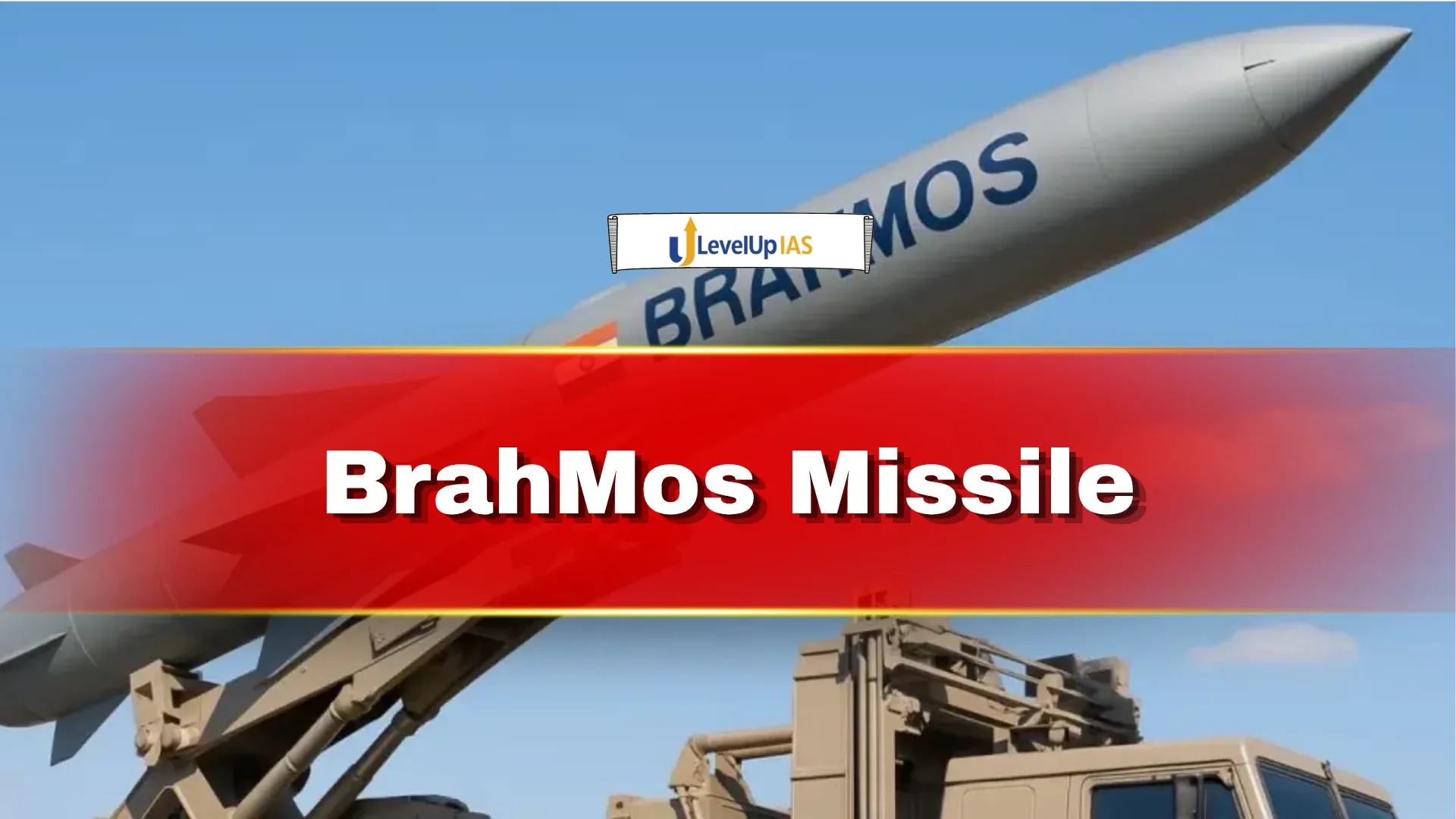
BrahMos Missile
Why in News?
In July 2026, Indonesia signed a Memorandum of Understanding (MoU) with BrahMos Aerospace for the phased procurement of two coastal missile batteries, estimated at around $200 million. The development is significant for India's growing defence-export footprint and reflects the increasing international interest in the BrahMos missile system.
About BrahMos Missile
BrahMos is a medium-range, supersonic cruise missile designed for precision strikes against land and maritime targets. It follows a “Fire and Forget” principle, meaning the missile can complete its mission without requiring continuous guidance from the launching platform after launch.
The missile can travel at around Mach 2.8, making BrahMos one of the fastest operational cruise missiles in its category. It is also described as the only supersonic cruise missile available for export globally.
BrahMos Aerospace was established in 1998 as a joint venture between India's Defence Research and Development Organisation (DRDO) and Russia's NPO Mashinostroyeniya. India holds a 50.5% stake, while Russia holds 49.5%. The joint-venture structure also means that Russian concurrence is required for sales of the missile to third countries.
The primary objective of the BrahMos weapon system is to provide long-range, precision-strike capability against heavily defended land and maritime targets.
Key Technical Features
BrahMos uses a two-stage propulsion system. A solid-fuel booster provides rapid acceleration after launch, while a liquid-fuel ramjet engine sustains the missile's supersonic cruise speed. This combination enables the missile to maintain speeds of around Mach 2.8 during its flight.
One of BrahMos's major strengths is its multi-platform capability. It can be launched from land-based systems, warships, submarines and Su-30MKI fighter aircraft. This gives the Indian Armed Forces a common precision-strike weapon that can be deployed across different operational environments.
The missile also uses a sea-skimming flight profile during the terminal phase. After operating at higher altitude during parts of its flight, it can descend to around 5 metres above sea level near the target. Such low-altitude flight can make detection and interception more difficult for conventional radar systems.
BrahMos carries a substantial warhead and combines explosive power with the enormous kinetic energy generated by its high speed. This makes it capable of delivering significant destructive force against heavily protected military targets.
The missile is also stored and launched through a sealed Transport Launch Canister (TLC). Canisterisation improves storage life, allows rapid deployment and reduces maintenance requirements.
Range and Export Potential
BrahMos has evolved considerably since its initial development, with different variants being developed for India's armed forces and for export. According to the reference material, export versions are limited to around 290 km under MTCR-related range restrictions, while India operates extended-range variants exceeding 450 km for domestic requirements.
The system has also become an important component of India's defence-export strategy. The Philippines became the first foreign customer for the BrahMos missile system, while Vietnam and Indonesia have emerged as other important countries associated with India's efforts to expand exports.
The proposed Indonesian procurement is particularly significant because coastal missile batteries can strengthen a country's ability to monitor and defend its maritime approaches. For India, such exports also deepen strategic and defence cooperation with countries in the Indo-Pacific region.
Significance for India
BrahMos represents the convergence of advanced missile technology, India-Russia defence cooperation and India's growing defence manufacturing capabilities. Its successful development and export demonstrate India's increasing ability to offer sophisticated weapon systems to international partners.
Beyond its military utility, BrahMos has strategic significance for India's defence diplomacy. Expanding exports can strengthen India's partnerships with friendly countries while supporting the broader objective of establishing India as a reliable defence technology and manufacturing hub.
Conclusion
The BrahMos missile has evolved from a joint India-Russia missile programme into one of India's most prominent indigenous defence-production and export capabilities. Its supersonic speed, multi-platform deployment, precision-strike capability and canisterised launch system provide it with considerable operational versatility.
The growing international demand for BrahMos, including the proposed Indonesian procurement, highlights the increasing role of defence exports in India's strategic outreach and supports the country's broader ambition of becoming a major defence manufacturing and technology power.
Related reads.
Election Commission of India (ECI)
24 Oct 2026 7 min
18th BRICS Summit 2026
24 Oct 2026 5 min

Thiksey Monastery
23 Oct 2026 4 min

Pradhan Mantri Jan Arogya Yojana (AB-PMJAY)
23 Oct 2026 4 min

Loggerhead Sea Turtle
19 Oct 2026 4 min

West Nile Fever
18 Oct 2026 3 min
Put it into practice
Reading is step one.
Turn what you've just read into exam-ready answers with mentor-led practice and our structured test series.