
Current Affairs
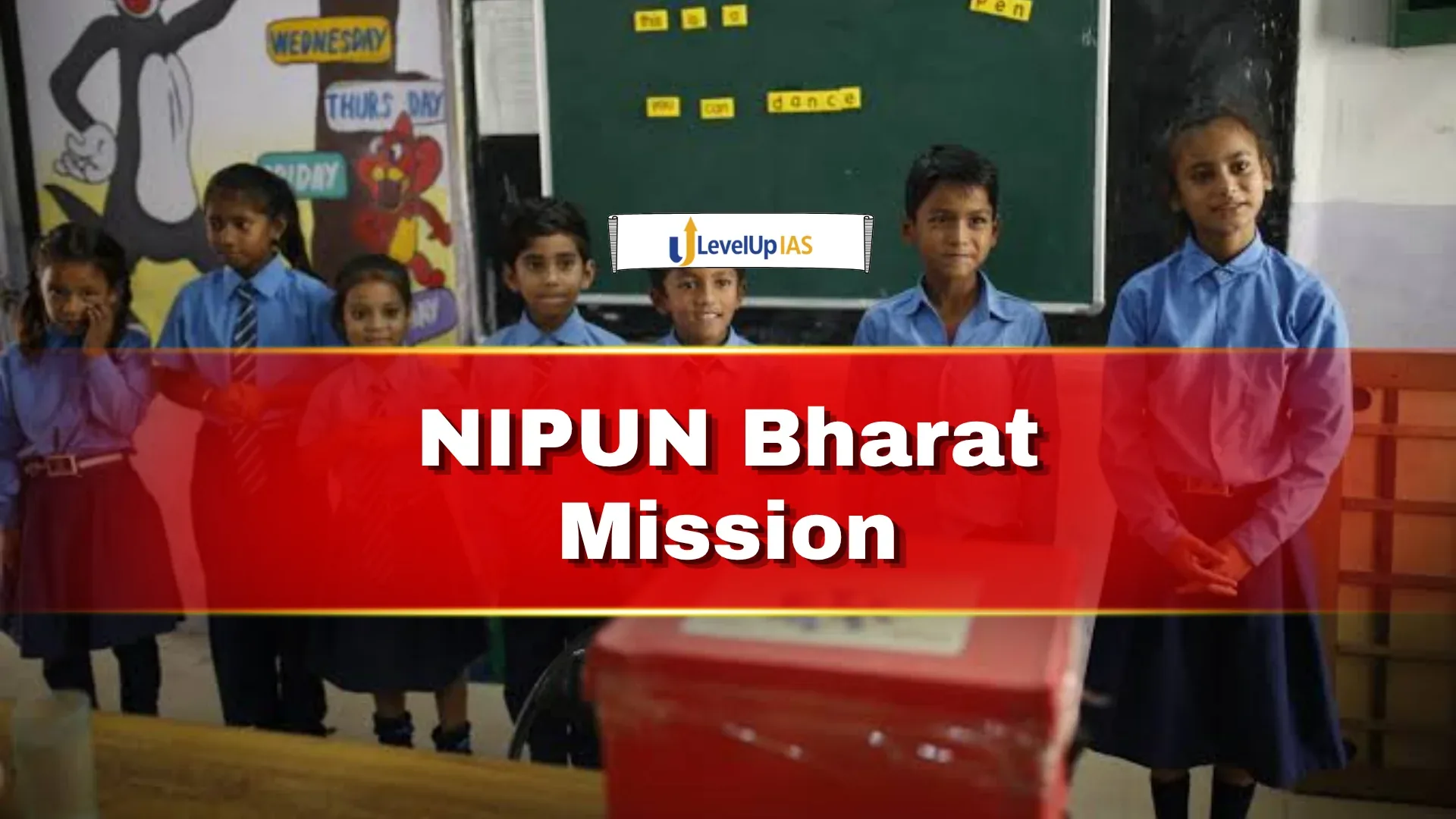
NIPUN Bharat Mission
Why in News?
Five years after the launch of the NIPUN Bharat Mission in July 2021, the focus has shifted towards consolidating the learning gains achieved so far, extending foundational learning support beyond Grade 3 and strengthening the foundation required for India’s long-term educational and developmental goals. The Mission assumes particular importance as India seeks to build the human capital required for Viksit Bharat.
The emphasis on foundational learning stems from the National Education Policy (NEP) 2020, which identified Foundational Literacy and Numeracy (FLN) as the highest priority in school education. The policy recognised that children who fail to acquire basic reading, writing and numeracy skills in the early years face difficulties in understanding more advanced concepts in subsequent classes.
About NIPUN Bharat
NIPUN Bharat stands for National Initiative for Proficiency in Reading with Understanding and Numeracy. It was launched by the Ministry of Education in July 2021 under the framework of NEP 2020 and is implemented under Samagra Shiksha. The Mission aims to ensure that every child develops the foundational skills necessary to participate meaningfully in the school education system.
The central objective of NIPUN Bharat is to ensure that children acquire the required competencies in reading, writing and numeracy by the end of Grade 3, and not later than Grade 5, by 2026–27. Its primary target group consists of children in the 3–9 years age group, covering the period from Balvatika to Grade 3. Grade-wise learning targets, known as Lakshyas, have been designed to provide a structured pathway for achieving these competencies.
Foundational literacy is not restricted to simply recognising alphabets or reading words. It includes oral language development, decoding, reading fluency, comprehension and writing. Similarly, foundational numeracy involves developing an understanding of numbers, mathematical operations, measurement, shapes, spatial relationships and basic data handling.
Learning Approach and Implementation
NIPUN Bharat places considerable emphasis on making early learning child-centred and experiential. Instead of relying exclusively on conventional classroom instruction, the Mission promotes play-based, activity-based and toy-based learning along with storytelling, art-integrated and sports-integrated approaches. Such methods are intended to make learning more engaging and suitable for the linguistic and social backgrounds of young children.
Teachers and school heads are important to the implementation of the Mission. Their capacity-building is supported through FLN-specific NISHTHA modules, with emphasis on classroom support, peer learning, appropriate teaching-learning materials and the use of children's familiar language. The approach also gives importance to mother-tongue instruction, particularly at the foundational stage, where comprehension and language development are closely connected.
Digital technology is another important component. DIKSHA (Digital Infrastructure for Knowledge Sharing) provides digital learning resources such as reading materials, worksheets, videos, assessment resources, children's literature and teacher handbooks. These resources are intended to support both classroom teaching and independent learning while strengthening the professional capacity of teachers.
NIPUN Bharat is implemented in mission mode by the Department of School Education and Literacy, Ministry of Education, under the centrally sponsored Samagra Shiksha scheme. Its implementation follows a five-tier structure involving the national, State, district, block or cluster and school levels. School Management Committees, parents, local bodies and communities also have a role in supporting foundational learning.
Assessment and Monitoring
A major feature of NIPUN Bharat is its emphasis on competency-based and stress-free assessment rather than assessments focused merely on memorisation. Continuous assessment can help identify learning gaps at an early stage and enable teachers to provide appropriate classroom support.
Technology-enabled systems are also used for child-wise tracking, monitoring and periodic assessment. Such mechanisms are important because foundational learning is cumulative: a child who misses basic competencies in the early grades may face increasing difficulties as the curriculum becomes more complex.
The broader expected outcomes of the Mission therefore extend beyond reading and mathematics. Strong foundational skills can improve learning outcomes, reduce the likelihood of school dropouts, facilitate smoother transition to higher classes and create the basis for acquiring higher-order skills such as critical thinking and problem-solving.
Status of Foundational Literacy and Numeracy in India
Foundational Literacy and Numeracy (FLN) refers broadly to a child's ability to read and understand simple text and perform basic mathematical operations by the end of the foundational stage, particularly by Grade 3. These are considered gateway skills because children cannot effectively learn more advanced subjects if they struggle with basic comprehension and numeracy.
Despite FLN being placed at the centre of NEP 2020, achieving universal foundational learning remains a significant challenge. According to the Annual Status of Education Report (ASER) cited in the reference material, the proportion of Grade 3 children in government schools who could read a Grade 2-level text increased from 16.3% in 2022 to 23.4% in 2024. While this indicates improvement, the figures also highlight the continuing gap between policy targets and actual learning outcomes.
The challenge is further reflected in the concept of learning poverty, used by the World Bank to describe the inability of a child to read and understand a simple text by around the age of 10. The reference material notes that India faces a high level of learning poverty, with the problem being further aggravated by disruptions caused by the Covid-19 pandemic.
Policy Support for Foundational Learning
NIPUN Bharat functions within a wider policy ecosystem for improving school education. At the highest level, NEP 2020 identifies foundational literacy and numeracy as a prerequisite for all further learning and places responsibility on the education system to ensure that children acquire these competencies during the foundational stage.
Samagra Shiksha provides the broader institutional framework for school education, covering the continuum from pre-school to Class XII. It was created by subsuming the Sarva Shiksha Abhiyan, Rashtriya Madhyamik Shiksha Abhiyan and Teacher Education schemes, thereby adopting a more integrated approach towards school education.
Other initiatives complement the FLN ecosystem. PM SHRI (PM Schools for Rising India) seeks to develop more than 14,500 schools as exemplary institutions demonstrating the implementation of NEP 2020. Meanwhile, DIKSHA provides a national digital infrastructure for educational content and teacher support.
Way Forward
The next phase of NIPUN Bharat needs to focus not merely on achieving numerical targets but on ensuring that foundational competencies are retained and strengthened as children move into higher grades. The continued improvement of teacher capacity, availability of appropriate learning materials and timely identification of learning gaps will remain crucial.
Greater attention is also required to address differences in learning outcomes across regions, schools and socio-economic groups. Community participation, parental involvement and the effective use of local languages can make foundational education more responsive to children's actual learning environments.
Most importantly, foundational learning should be treated as a long-term educational investment rather than a short-term target. Reading with comprehension and basic numeracy provide the foundation upon which critical thinking, problem-solving, digital skills and higher-order learning are developed. Strengthening these capabilities at an early age is therefore essential for improving both educational outcomes and India's future human capital.
Conclusion
NIPUN Bharat represents India's focused policy response to the foundational learning challenge identified by NEP 2020. By combining competency-based learning, child-centred pedagogy, teacher training, digital resources and continuous assessment, the Mission seeks to ensure that children acquire essential literacy and numeracy skills during the earliest years of schooling.
Its long-term significance extends beyond Grade 3. A strong foundation in reading, writing and numeracy can improve children's ability to learn across subjects and reduce the accumulation of learning deficits. The success of NIPUN Bharat will therefore be important not only for school education but also for India's broader objective of developing a skilled and capable population for Viksit Bharat.
Related reads.

Election Commission of India (ECI)
24 Oct 2026 7 min

18th BRICS Summit 2026
24 Oct 2026 5 min

Thiksey Monastery
23 Oct 2026 4 min

Pradhan Mantri Jan Arogya Yojana (AB-PMJAY)
23 Oct 2026 4 min

Loggerhead Sea Turtle
19 Oct 2026 4 min

West Nile Fever
18 Oct 2026 3 min
Put it into practice
Reading is step one.
Turn what you've just read into exam-ready answers with mentor-led practice and our structured test series.