
General
AIR 49’s Brutally Honest UPSC Strategy Session
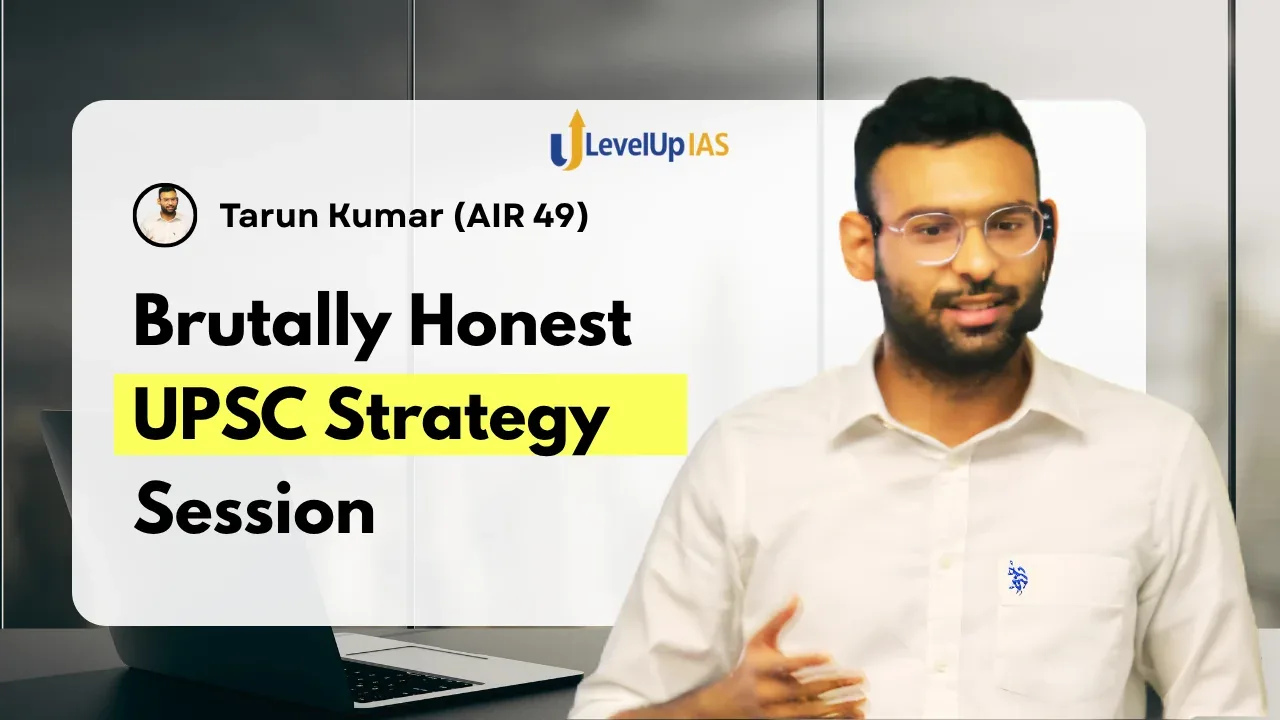
Intro - Tarun Kumar Yadav
UPSC Rank: Secured All India Rank (AIR) 49 in the UPSC Civil Services Examination 2025
Place of Birth: Belongs to Uttar Pradesh
Place of Study: Completed his higher education at IIT Delhi
Graduation: B.Tech in Engineering
University/College: Indian Institute of Technology (IIT) Delhi
Optional Subject: Mathematics
Background: IIT Delhi graduate and former software engineer who cleared the UPSC Civil Services Examination in his second attempt. He improved from AIR 203 in his first attempt to AIR 49 in CSE 2025, following a structured, PYQ-based preparation strategy with a strong focus on active recall, answer writing, Essay and Ethics.
Tarun Kumar Yadav (AIR 49) isn’t your typical "topper" who will give you a sugar-coated path to success. An IIT Delhi graduate who spent four years as a software engineer before diving into the UPSC cycle, Tarun’s approach is defined by a software developer’s efficiency: focus on the Return on Investment (ROI), leverage technology, and cut out the noise. His strategy session is a masterclass in what he calls being your "own light" rather than a blind follower of topper copies.
Here is the breakdown of the brutally honest strategy that took him from Rank 203 to Rank 49.
The "Simple vs. Easy" Paradox
Tarun makes a critical distinction: the UPSC exam is simple, but it is definitely not easy. It is simple because the requirements are clear, you need to understand the syllabus and address the demand of the questions. It is not easy because it requires an immense amount of "brain work," original thinking, and the courage to ignore 90% of the "garbage" material available in the market. He argues that instead of being "upodeep" (blindly following), you must recognize that you know yourself better than any teacher or topper ever could.
The Prelims Filter: The ROI Method
For Tarun, the Prelims are not about how much you read, but about how much value each hour of study adds to your score. He categorizes every topic into three buckets:
- Category A (High ROI): Topics like Jainism, Buddhism, National Parks, and Environmental Acts. These are tedious but guaranteed to appear. You must understand and memorize these.
- Category B (Medium ROI): Topics like specific species or historical stories. You should read these carefully to understand the "story," but don't obsess over memorizing every detail.
- Category C (Low ROI): Obscure reports, niche art and culture facts, and 200-page monthly compilations. His advice? Ignore them completely.
He notes that in his successful attempt, he only knew 20-25 questions for sure. The rest were cleared through smart guessing. He argues that if you can eliminate just two options, the "expected value" of your score becomes positive, making it mathematically logical to take the risk.
Active Recall: How to Actually Remember
Tarun admitted he struggled with memory, taking nearly two weeks just to remember the Fundamental Rights. He abandoned passive reading in favor of Active Recall. His method was simple: study a topic in the morning, and in the evening, take a blank white page and try to recreate everything important from memory. If he couldn't write it, he went back to the notes and repeated the process the next day. For mapping, he would draw all national parks on a blank map daily until it became muscle memory.
The "No-Fact" Mains Strategy
In a move that sounds like heresy to most aspirants, Tarun revealed that in one of his GS papers, he wrote zero facts. He argues that examiners are often frustrated by "fact-dumping" and instead value a logical, multi-dimensional thinking process.
His Mains preparation was almost entirely based on Previous Year Questions (PYQs). He didn't make extensive notes; instead, he wrote answers to 700+ PYQs. For each topic, he developed 5-7 "ready-made" points that could be reused across various questions. This "meta-knowledge" allowed him to write incredibly fast during the actual exam without needing to think from scratch.
Revolutionizing the Essay
Tarun found the standard "Social-Economic-Political" framework for essays boring and predictable. To stand out, he used Evolutionary and Biological perspectives.
- Instead of just discussing happiness, he would write about the "hedonic treadmill" or how our ancestors’ survival instincts (seeking safety and resources) make us perpetually unsatisfied today.
- He used the "fight or flight" response to explain human resilience.
He prepared only 15-20 such unique stories and theories, which he then "merged" into whatever topic the exam presented. He used AI to find these stories like the one about Nasaruddin searching for keys under a streetlamp because the "light was better" there, a metaphor for seeking happiness in the wrong places.
The AI-Powered Study Partner
As a former software engineer, Tarun used AI (ChatGPT, Perplexity, Gemini) as his primary mentor. He used it for:
- Categorizing PYQs: Grouping years of questions into logical themes.
- Generating "Folders": Asking AI for "counter-intuitive" points or "biological perspectives" on philosophical topics.
- Model Answers: Since he studied alone at home without a peer group, he used AI to provide feedback on his answers and suggest points he had missed.
- Fact Collection: Instead of reading 100-page reports, he asked AI to give him the four most important facts for a specific industry (like food processing) that he could use in any answer.
Final Advice: Trust the Path, Not the Noise
Tarun’s most "brutal" advice is to stop reading daily commentaries on wars or pro-government vs. anti-government editorials. These consume hours with almost zero return in the exam. He suggests relying on high-quality, systematic courses for dry subjects like Science & Tech or Ancient History rather than struggling through textbooks alone.
Ultimately, his success came from the courage to do less but do it better. By focusing on logic over rote learning and PYQs over random test series, he proved that the UPSC is a test of your ability to think, not just your ability to store information.
To know his strategy in details, watch the video
Related reads.
Mastering Anthropology: The 292-Mark Roadmap By AIR 521
21 Aug 2026 6 min
Mastering UPSC Answer Writing by AIR 255
17 Aug 2026 5 min
GS & Optional Balancing Strategy By AIR 48
13 Aug 2026 5 min
Full 12 Months UPSC Roadmap By AIR 13
07 Aug 2026 5 min
Scientific Revision System By AIR 341 Vishal Pattanayak
05 Aug 2026 5 min
Efficient Time Management Strategy by AIR 87
03 Aug 2026 5 min
Put it into practice
Reading is step one.
Turn what you've just read into exam-ready answers with mentor-led practice and our structured test series.