
General
Efficient Time Management Strategy by AIR 87
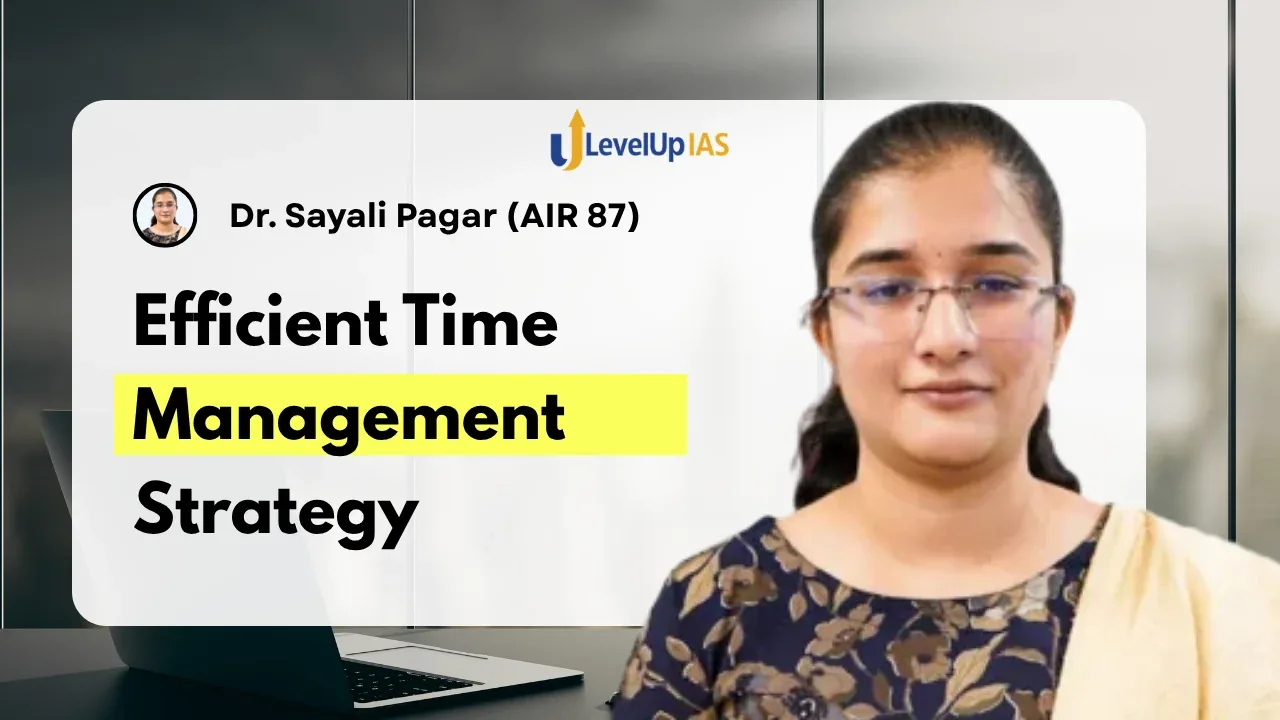
Intro - Dr. Sayali Bhika Pagar
UPSC Rank: Secured All India Rank (AIR) 87 in the UPSC Civil Services Examination 2025
Place of Birth: Kalwan, Nashik District, Maharashtra
Place of Study: Completed schooling and higher education in Maharashtra and Karnataka
Graduation: MBBS (Bachelor of Medicine and Bachelor of Surgery)
University/College: Studied at Sapthagiri Institute of Medical Sciences and Research Centre, Bengaluru
Background: Medical doctor turned civil servant; left clinical practice to pursue UPSC full-time with a vision to contribute to public service through health, education, and women’s empowerment.
For many UPSC aspirants, the first thing they look for is a "prescription": tell me exactly how many hours to study, which books to read, and what time to wake up. According to Dr. Sayali Bhika Pagar (AIR 87), this is the biggest mistake you can make.
Time management in UPSC isn't about following a topper’s schedule; it is about conducting a "Time Audit" of your own life and understanding the difference between sitting at a desk and doing Deep Work. Dr. Sayali, who balanced her preparation during a grueling medical internship and as a full-time aspirant, offers a roadmap that moves away from the "Morning 7 to Night 11" myth and toward a system of high-productivity blocks.
The Myth of 16-Hour Days
We often feel that if we sit from 7 AM to 11 PM, we are doing enough. However, Dr. Sayali argues that much of this is "Passive Learning" time spent in coaching classes, watching YouTube videos, or reading newspapers without active engagement.
The real progress happens in Deep Work Blocks. These are dedicated 60–90 minute sessions where you focus on high-impact tasks like reading standard books, writing answers, or solving Previous Year Questions (PYQs). If you are not actively integrating what you learn by taking notes or brainstorming you are experiencing a "Time Leak".
Identifying Your "Leaks"
To manage time, you first have to see where it’s going. Dr. Sayali identifies several types of "leaks" that drain an aspirant’s potential:
- Content Leak: This happens when you have too much time. You start reading two newspapers, watching multiple YouTube summaries, and downloading 20 different PDFs for one subject from Telegram. Her advice? Stick to one source and ignore the noise.
- Planning Leak: Spending two hours every single day just making a schedule is a waste of time. Planning should happen the night before.
- Energy Leak: This is often caused by bad sleep. As a doctor, Sayali emphasizes that memory is built during sleep; if you don't get 8 hours, your brain won't form the neuron connections needed to retain what you studied.
- Social/Digital Leak: Scrolling Instagram or watching "unnecessary" YouTube videos that you didn't intend to watch when you first opened the app.
The "Time Audit" and Energy Mapping
Instead of a rigid schedule, use Energy Mapping. Match your hardest tasks to your highest energy periods.
- High Energy (Deep Work): Use these blocks for new concepts, Optional subjects, and answer writing. For Sayali, this was 9 AM to 11 AM and late at night.
- Medium/Low Energy (Passive/Light Work): Use these times, usually after lunch for reading the newspaper, watching coaching lectures, or micro-revisions like flashcards.
The Micro-Planning Framework
A "Planning Leak" often occurs because targets are too broad (e.g., "I will finish Polity this week"). This leads to procrastination. Instead, use Micro-Targets. The night before, decide exactly which topic you will cover in your first Deep Work block (e.g., "Judiciary" or "Federalism"). Have the sources ready on your table so you don't spend your productive morning hours searching for materials.
The "Minimum Day" Rule: Saving Your Identity
One of the most profound pieces of advice from Dr. Sayali is how to handle a "bad day." We all have them family emergencies, sickness, or just low motivation. When we miss a day, we often spiral into a "negative identity," thinking we’ve failed the whole week.
To prevent this, have a Minimum Day Plan. This consists of non-negotiables that take only an hour or two like watching one current affairs video or doing 20 MCQs. By doing even a small amount, you avoid the "guilt trip" and keep your momentum alive for the next day.
Phase-Wise Time Allocation
Your time management should shift as the exam approaches:
- June to July (Foundation): Focus 50% of your time on core subjects like Polity, Economy, Geography, and History.
- August to December (Mains Intensive): Dedicate three-hour morning blocks to GS Mains topics and two hours in the evening to your Optional. Your goal is to finish the Mains syllabus and Optional by December.
- January to April (Prelims Intensive): Shift to a Prelims-focused mode, solving PYQs from various UPSC exams (CDS, NDA, etc.) and focusing on factual revision and mapping.
The Active Recall Revision Strategy
Revision shouldn't be a separate, boring task. Sayali suggests a multi-layered approach:
- Next Day: Flip through the previous day’s notes for 15 minutes before starting a new topic.
- 3-Day Review: Revisit the topic after three days to integrate it with newer material.
- Weekly Buffer: Keep Sundays mostly empty to catch up on anything you missed during the week.
Advice for Working Professionals and Students
If you are working or in college, do not compare your hours to full-time aspirants. A full-time aspirant often wastes 80% of their day, while a working professional is forced to be 90% productive because their time is scarce.
- Utilize "Found Time": Use your commute or breaks to solve 10 MCQs or listen to a revision video.
- Weekly Targets: If your work shift is unpredictable, don't worry about daily hours. Set a Weekly Target (e.g., 40 hours a week) and use your weekends to catch up.
Conclusion
Ultimately, time management is a test of self-introspection and calmness. Don't follow a topper's timetable blindly. Understand your own biological rhythm, prioritize Deep Work over passive scrolling, and remember that even a "minimum day" is better than a broken one. As Dr. Sayali says, the syllabus is a finite checklist once you start ticking those micro-boxes, the satisfaction will drive you toward the finish line.
Related reads.

Mastering Anthropology: The 292-Mark Roadmap By AIR 521
21 Aug 2026 6 min
Mastering UPSC Answer Writing by AIR 255
17 Aug 2026 5 min
GS & Optional Balancing Strategy By AIR 48
13 Aug 2026 5 min
AIR 49’s Brutally Honest UPSC Strategy Session
10 Aug 2026 4 min
Full 12 Months UPSC Roadmap By AIR 13
07 Aug 2026 5 min
Scientific Revision System By AIR 341 Vishal Pattanayak
05 Aug 2026 5 min
Put it into practice
Reading is step one.
Turn what you've just read into exam-ready answers with mentor-led practice and our structured test series.