
General
Full 12 Months UPSC Roadmap By AIR 13
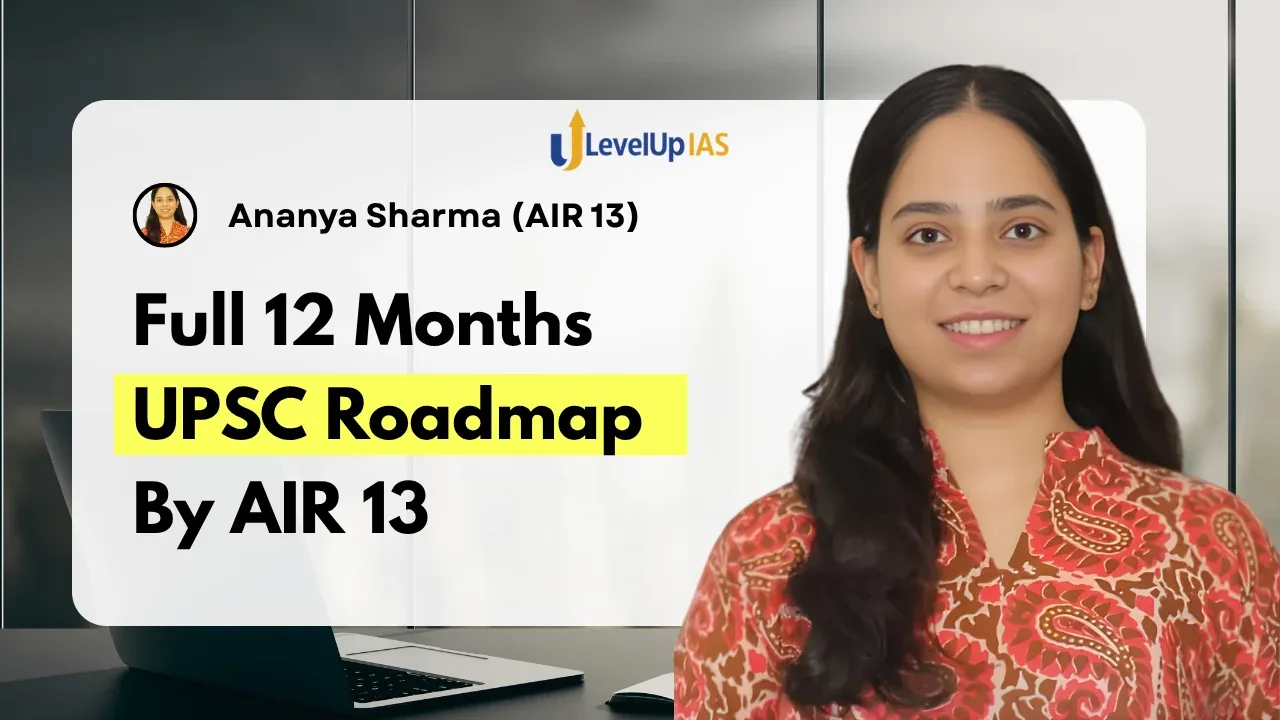
Intro - Ananya Sharma
UPSC Rank: Secured All India Rank (AIR) 13 in the UPSC Civil Services Examination 2025
Optional Subject: Sociology
Place of Study: Completed schooling at Daly College, Indore, Madhya Pradesh.
Graduation: B.A. (Hons.) in Economics.
University/College: Graduated from Hindu College, Delhi.
Background: Economics graduate who transitioned into full-time UPSC preparation. Her success has been attributed to disciplined self-study, structured mentorship, consistent answer-writing practice, and conceptual clarity across all stages of the examination.
Clearing the UPSC Civil Services Examination in a single year is a goal many set, but few navigate correctly. For Ananya Sharma (AIR 13), the secret to success isn't just about hard work; it’s about breaking the "artificial separation" between Prelims and Mains. If she were starting her journey today for the 2027 or 2028 cycle, she would focus on a highly integrated, phase-wise approach that ensures no subject is left to the last minute.
While 12 months is a relatively ambitious timeline, it is entirely possible if you follow a disciplined, logical framework. Here is the full month-by-month roadmap based on Ananya’s own successful strategy.
The Core Philosophy: The Integrated Approach
The most common mistake aspirants make is treating Prelims and Mains as separate exams. Ananya insists that you should never wait to clear Prelims before starting your Mains preparation. In fact, 60% to 70% of the General Studies (GS) syllabus is common to both. By covering the syllabus in the depth required for Mains, you naturally build the foundational knowledge needed for Prelims.
Her formula for success is simple: 60% Knowledge and 40% Confidence. Knowledge comes from the syllabus, while confidence comes from practice and self-belief.
Phase 1: Months 1 to 6 (Building the Foundation)
The first six months are dedicated to building the "intellectual infrastructure" required to even understand the daily news.
1. Foundational Subjects Start with core subjects like Polity, Economy, and Geography. These are essential because, without them, the newspaper will not make sense. If you don't understand the basics of the Constitution or how the economy operates, you will struggle to link current events to the syllabus.
2. The Subject-Pairing Strategy Ananya suggests picking up two subjects at a time to maintain a balance:
- One Core Subject: (e.g., Polity or Economy) which is relevant for both Prelims and Mains.
- One Mains-Oriented Subject: (e.g., Governance, Social Justice, or Internal Security).
By pairing a heavy subject like Polity with a Mains-specific topic like Governance, you cover more ground without getting overwhelmed.
3. Don't Delay the Optional A fatal error many make is delaying the Optional subject. During these first six months, you should aim to cover at least 30% to 40% of your Optional syllabus. For humanity-based optionals like Sociology, Paper 1 often has a high degree of repetition, making it easier to gain a strong foothold early on.
Phase 2: Months 7 to 10 (Deepening the Roots and Answer Writing)
Once the foundations are laid, the focus shifts toward the Mains-exclusive topics and the "Four Parallel Tracks."
1. The Mains-Exclusive Sprint Use this period to finish subjects that are rarely tested in Prelims but are critical for Mains: World History, Ethics (GS 4), Disaster Management, and International Security.
2. The "Four Parallel Tracks" System By month seven, four things should be running simultaneously every day:
- Static GS: Revising and completing your core subjects.
- Optional Subject: Completing the remaining 60-70% of the syllabus.
- Current Affairs: Reading the newspaper (like the Indian Express) and a monthly magazine.
- Answer Writing and Testing: Start writing. Don't wait until you feel "ready" because that feeling never comes. Enroll in a test series and use your base notes to write answers. Even if you start with 100-200 words, just start.
3. The Ethics and Governance Link Ananya highlights a smart "overlap strategy." When you study Governance and Social Justice for GS 2, study Ethics (GS 4) alongside it. There is a massive overlap between the two, and studying them together saves time and improves your conceptual depth.
Phase 3: Months 11 to 12 (The Prelims Pivot)
Around January or February, you must shift into "Prelims Mode." This doesn't mean you stop learning; it means you change how you digest information.
1. Shifting the Focus to Retentive Subjects Start focusing heavily on GS 1 subjects: History, Art & Culture, Geography, and Mapping, closer to the Prelims date. These subjects require high factual retention, so studying them in the final months ensures the facts are fresh in your mind.
2. The Mock Test Marathon Confidence for Prelims comes from practicing MCQs. Ananya suggests:
- High Attempt Strategy: She found that attempting too few questions (72-74) led to failure. In her successful attempt, she attempted 92 questions.
- Language Familiarity: Follow mocks from at least two different institutes so you don't get too comfortable with just one style of option-setting.
- Center-Based Mocks: Go to actual centers to give "Open Mocks." This removes the "special day" anxiety of the actual exam and makes it feel like just another practice session.
The Daily and Weekly Routine: Discipline Over Motivation
The 8-Hour Rule For a beginner, a steady 8 hours of study is the baseline. Between Prelims and Mains, this may increase to 11 or 12 hours, but for the majority of the year, consistency is more important than extreme hours.
The "5+2" Revision System Revision is the "necessary evil" of UPSC. Ananya’s method is:
- Monday to Friday: Learn new content.
- Saturday and Sunday: Reserved exclusively for revision and Essay writing.
- The 15-Minute Recap: Every morning, spend 15 minutes reviewing the notes you made the previous day. This builds familiarity and makes long-term recall much easier.
Note-Making Strategy Your notes for GS should be ready by December or January at the latest. Use newspapers primarily for Value Addition. Look for recent data, Supreme Court judgments, or unique case studies that you can add to your static notes. Do not make separate, extensive notes for every news article; use monthly magazines to fill the gaps.
Final Advice: Taking Ownership
UPSC is a voluntary choice. Ananya reminds aspirants to take ownership of this decision. There will be stress, and you will see friends moving ahead in other careers, but you must focus on your own timeline. Give yourself two to three best shots with a clear heart and a structured plan.
If you have your notes ready by January, have practiced answer writing, and have analyzed your mock test mistakes, you aren't just an aspirant, you are a serious contender. Trust the process, follow the phases, and remember that the exam rewards those who can put information into a flow, not just those who memorize it.
Related reads.
Mastering Anthropology: The 292-Mark Roadmap By AIR 521
21 Aug 2026 6 min
Mastering UPSC Answer Writing by AIR 255
17 Aug 2026 5 min
GS & Optional Balancing Strategy By AIR 48
13 Aug 2026 5 min
AIR 49’s Brutally Honest UPSC Strategy Session
10 Aug 2026 4 min
Scientific Revision System By AIR 341 Vishal Pattanayak
05 Aug 2026 5 min
Efficient Time Management Strategy by AIR 87
03 Aug 2026 5 min
Put it into practice
Reading is step one.
Turn what you've just read into exam-ready answers with mentor-led practice and our structured test series.