
General
Scientific Revision System By AIR 341 Vishal Pattanayak
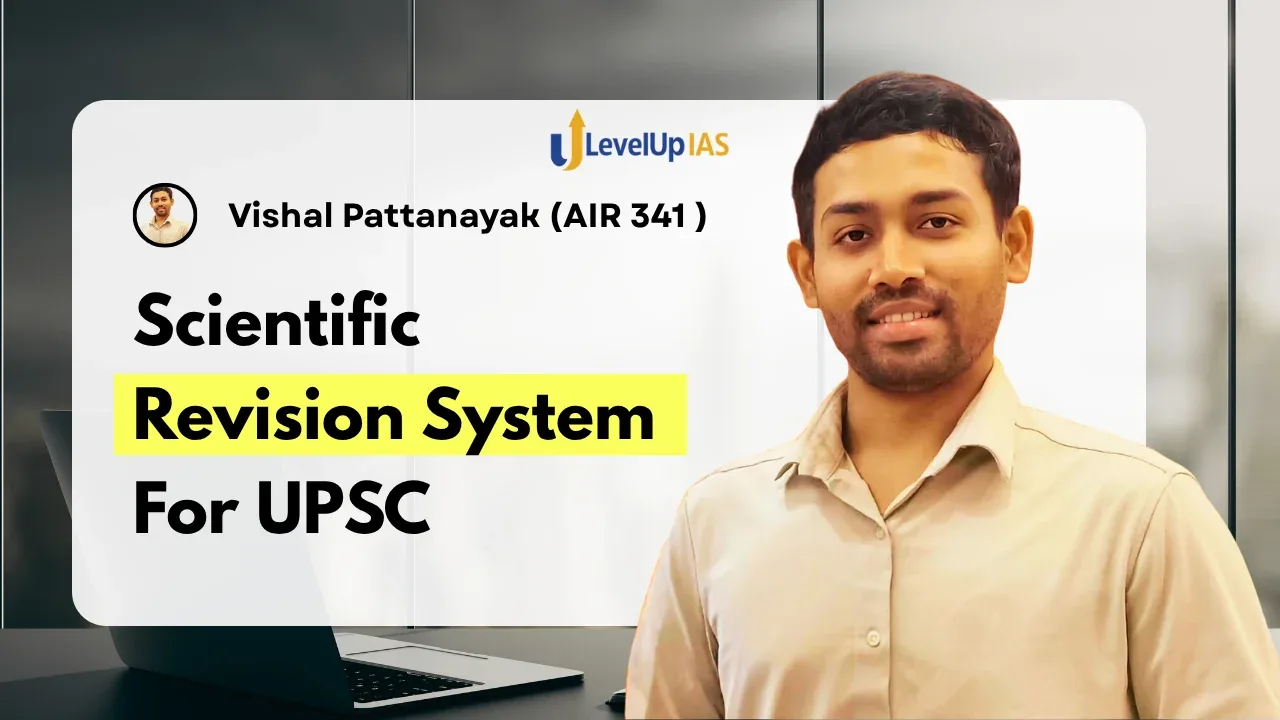
Intro - Vishal Pattanayak
UPSC Rank: Secured All India Rank (AIR) 341 in the UPSC Civil Services Examination 2025
Place of Birth: Bhubaneswar, Odisha
Place of Study: Completed schooling and higher education in Odisha
Graduation: B.Tech in Electrical Engineering
University/College: College of Engineering and Technology (CET), Bhubaneswar
Post-Graduation: MBA in Human Resource Management
University/College: Xavier Institute of Management, Bhubaneswar (XIMB)
Background: Worked as a Senior HR Manager at ICICI Bank before clearing the Odisha Public Service Commission (OPSC) examination in 2023. Served as Assistant Commissioner of CT & GST in the Odisha Finance Service and later secured AIR 341 in UPSC CSE 2025 with Anthropology as his optional subject.
For the average UPSC aspirant, revision is often treated as a "monolith", a straightforward, albeit tedious, process of reading the same material over and over until something sticks. However, Vishal Pattanayak (AIR 341), who cleared the examination in his fifth attempt, argues that this approach is not revision, but mere repetition. True revision is a technical and scientific process that requires "vision" before the "re-vision" even begins.
Having navigated the peaks and valleys of the UPSC cycle, Vishal emphasises that even if you finish the syllabus three times, a lack of structured revision will lead to failure. His system is designed to move information from superficial awareness into deep, structured understanding through a repertoire of active and passive techniques.
The Psychology of Revision: Identifying Your "Recall Period"
One of the most critical aspects of Vishal’s system is understanding that revision is not a straight-jacketed formula; it is different for every subject and every individual. The first step in a scientific revision plan is identifying your personal recall period.
For Vishal, this period was approximately seven days for factual Prelims data. This meant he had to regiment his final week before the exam to consolidate and revise high-volatility subjects. He categorises subjects based on how they should be revised:
- Factual/Volatile (High Proximity): Subjects like Ancient and Medieval History, Art and Culture, Maps, and Environment (specifically lists of National Parks, Biosphere Reserves, and Tiger Reserves) must be revised very close to the exam,,.
- Conceptual/Static (Long-Term Anchors): Subjects like Economy, Ethics, and History timelines should be built organically in your head through "anchors" or heuristics,. These concepts are driven by logic rather than rote details and do not need the same level of proximal revision.
The Active Testing Circle: Plugging the Lacunas
A standout technique in Vishal’s repertoire is the Active Testing Circle, which he utilised specifically to master Polity. Instead of passively re-reading Laxmikanth, he followed a rigorous four-step loop:
- Read: Complete one specific chapter (e.g. Parliament).
- Test: Immediately solve 40-60 chapter-specific MCQs. This forces you to experience hundreds of statements and highlights what you actually retained.
- Analyze: Read the solutions to identify "lacunas", parts of the book you may have dismissed as "fillers" but are actually sources of questions.
- Refill: Re-read the same chapter with new keenness, specifically plugging the gaps identified by the test.
By completing this circle within a day or two, you ensure that your revision is pinpointed and scientific, rather than a generic read-through.
The Feynman Drill: Framework Building through Teaching
One of Vishal’s most recommended techniques is the Feynman Drill, a fancy name for the act of teaching. He warns against the "myopic" worldview of hiding knowledge; instead, explaining a difficult concept to someone else or even to a phone camera is the best way to master it,.
When you explain a concept like Judicial Review, your brain is forced to create a structured framework:
- An introduction and relevant Constitutional Articles.
- Logical transitions between the body and conclusion.
- An analysis of various facets, examples, and limitations.
This process "reduces the pain" of the subject for you and ensures the information is organised lucidity in your head. If you find yourself struggling to explain a topic simply, you have identified a gap that needs further study.
Peer Sessions and Information Bombardment
While the Feynman Drill focuses on depth, Peer Sessions are designed for speed and volume. Close to the Prelims, Vishal and a partner would sit for eight hours a day and "read out" current affairs magazines extensively.
This method creates an "information bombardment" that pushes facts into the superficial memory. For the Prelims, you don't always need long-term retention; you often just need the information to be reproducible on the day of the exam. He cautions, however, to keep these groups small (no more than 2-3 people) to avoid the logistical burden of group management.
Dimensional Brainstorming: Training the Brain for Essays
For the Mains, particularly the Essay paper, revision takes the form of Brainstorming. Since it is impossible to write an essay every day, brainstorming acts as a training exercise for the brain to "churn" and digest philosophical topics.
Vishal suggests moving beyond the standard PESTL (Political, Economic, Social, Technological, Legal) framework, which has become boring for evaluators,. Instead, he advocates for Dimensional Brainstorming to ensure a lucid and natural flow. He personally performed at least 30 essay brainstormings, which helped him collect diverse examples such as linking a geographical concept like metamorphosis to a philosophical theme of change, making his writing look natural rather than artificial,.
Passive Reinforcement: Using Audio-Visual Anchors
A unique aspect of the scientific revision system is leveraging "low-energy" hours through Passive Reinforcement. Vishal observed that successful candidates often use podcasts, documentaries, and audiobooks even while resting or traveling,.
- Audio Notes: Listening to geography or anthropology audiobooks before sleep helps "ingrain" concepts gradually,.
- Podcasts: Leveraging platforms like Rajya Sabha TV or specialised history/democracy podcasts provides strong frameworks and "cheat codes" for the exam,.
These passive sessions act as anchors, providing a reference point that makes your active study sessions much more effective.
Consolidation: The Rule of One Source
The fundamental rule of this entire system is consolidation. Vishal warns against becoming a "notes collector" who makes notes from other notes,. You must have one primary source for every subject that is repeated and revised.
While you can add new details to this source, the revision process fails if you start creating multiple, disconnected sets of notes. In Anthropology, for instance, he recommends a chapter-wise revision paired with sectional tests to gain a "hold" on the subject through concurrent writing and revising,.
Conclusion: The Three-Reading Rule
Finally, Vishal reminds aspirants not to pressurise themselves to remember everything on the first try. A scientific approach requires phased spacing:
- Reading 1: Close to your classes for initial retention (approx. 20-30%).
- Reading 2: More active, preferably attached to a mock test.
- Reading 3: Focused specifically on identifying and fixing your weak points.
By the third reading, you will naturally retain more than 50-60% of the material. Clearing UPSC is not about being an "explorer" of endless materials; it is about the disciplined, technical revision of a consolidated core
Related reads.
Mastering Anthropology: The 292-Mark Roadmap By AIR 521
21 Aug 2026 6 min
Mastering UPSC Answer Writing by AIR 255
17 Aug 2026 5 min
GS & Optional Balancing Strategy By AIR 48
13 Aug 2026 5 min
AIR 49’s Brutally Honest UPSC Strategy Session
10 Aug 2026 4 min
Full 12 Months UPSC Roadmap By AIR 13
07 Aug 2026 5 min
Efficient Time Management Strategy by AIR 87
03 Aug 2026 5 min
Put it into practice
Reading is step one.
Turn what you've just read into exam-ready answers with mentor-led practice and our structured test series.