
GS-I (History, Geography, Society)
Ancient Indian Literature
Introduction
Ancient Indian literature represents a vast and diverse intellectual tradition developed over several centuries through oral transmission, religious teachings, philosophical inquiry, poetry, drama, grammar, medicine, astronomy, statecraft and social thought. It was composed in several languages, including Sanskrit, Pali, Prakrit and Tamil. The tradition ranges from the Vedic corpus and the great epics to Buddhist and Jain texts, Classical Sanskrit literature and Sangam poetry.
For UPSC, ancient literature is important not only for its literary value but also because it provides valuable evidence for reconstructing the religious, social, political, economic and cultural history of ancient India.
Vedic Literature
Vedic literature forms the earliest major layer of Indian literary tradition. It was transmitted orally for centuries before being committed to writing. The four Vedas are:
- Rig Veda: The oldest Veda, containing 1,028 hymns arranged in ten Mandalas. It provides valuable information about early Vedic society, religious practices and political institutions.
- Sama Veda: Primarily a collection of verses adapted for musical chanting during rituals and is closely associated with the development of Indian musical traditions.
- Yajur Veda: Contains sacrificial formulas and ritual instructions used by priests during yajnas.
- Atharva Veda: Deals with prayers, healing, domestic rituals, protection and aspects of everyday life.
The Vedic corpus also includes Brahmanas, Aranyakas and Upanishads. Brahmanas explain ritual practices; Aranyakas discuss ritual and philosophical ideas associated with forest-dwelling traditions; and the Upanishads focus increasingly on questions of Brahman, Atman, knowledge, karma and liberation.
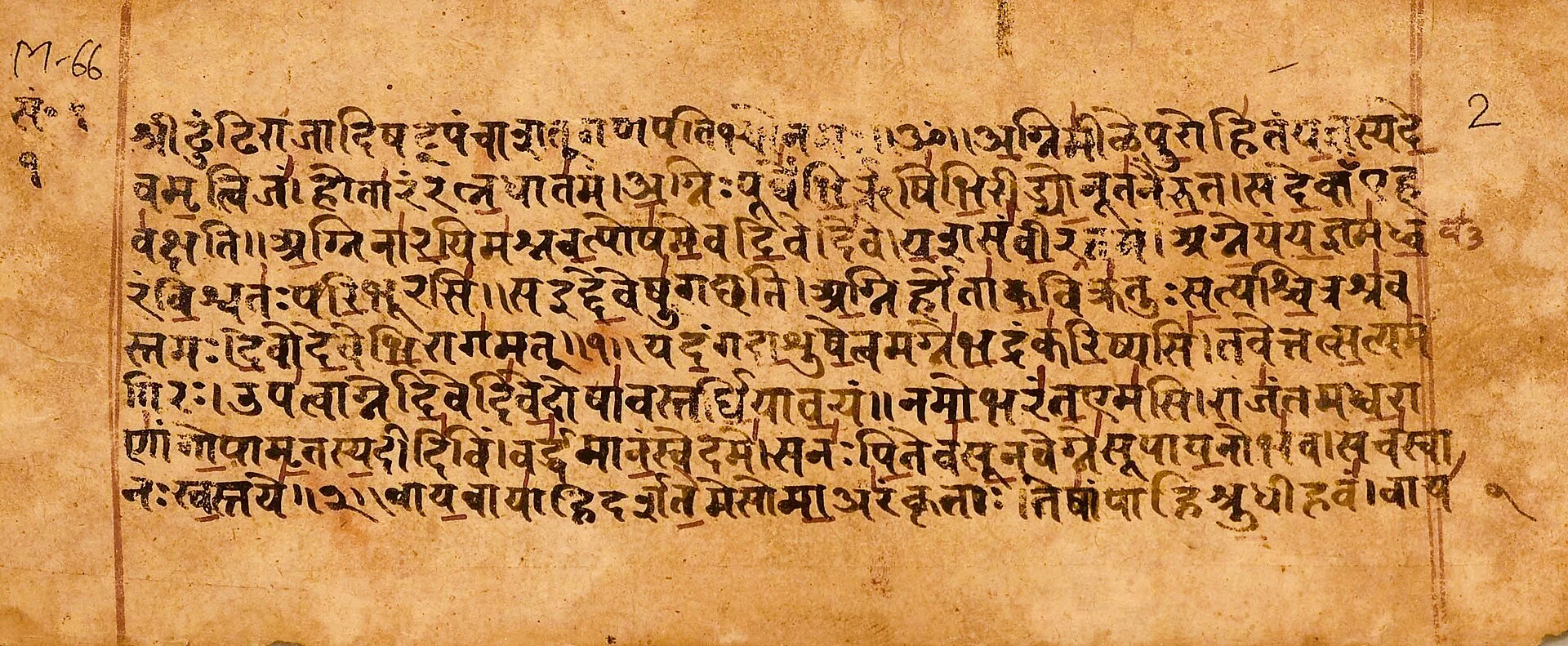
Vedic literature is traditionally classified into Shruti and Smriti. Shruti primarily includes the Vedas and their associated literature, while Smriti encompasses later remembered and composed traditions such as the epics, Puranas, Dharmashastras and Vedangas.
Epics and Puranic Literature
The two great Sanskrit epics are the Ramayana and Mahabharata.
The Ramayana, traditionally attributed to Valmiki, narrates the life of Rama and explores themes such as dharma, kingship, family relationships and ethical conduct.
The Mahabharata, traditionally associated with Vyasa, is considerably larger and combines the narrative of the Kuru conflict with extensive discussions on politics, ethics, philosophy and social duties. The Bhagavad Gita, a philosophical dialogue between Krishna and Arjuna, forms an important part of the Mahabharata.
The Puranas contain narratives concerning gods, genealogies, cosmology, legends, sacred geography and traditions associated with different religious communities. They became important instruments in transmitting religious and cultural traditions through narrative and oral storytelling.
Buddhist and Jain Literature
The emergence of Buddhism and Jainism expanded India's literary traditions beyond Sanskrit and contributed significantly to the development of Pali and Prakrit literature.
Buddhist Literature
The Tripitaka or Tipitaka forms the principal canonical literature of Buddhism and is traditionally divided into:
- Vinaya Pitaka: Rules and discipline for the monastic community.
- Sutta Pitaka: Discourses and teachings attributed primarily to the Buddha.
- Abhidhamma Pitaka: Philosophical and analytical treatment of Buddhist teachings.
The Jataka stories, describing the previous births of the Buddha, are particularly valuable for understanding social and economic life. Buddhist literature also developed in Sanskrit, particularly through later Mahayana traditions.
Jain Literature
Early Jain teachings were preserved mainly in Prakrit, particularly Ardhamagadhi, before Sanskrit became increasingly important for later Jain scholarship.
The Agamas constitute the major canonical body of Jain literature. Jain texts are important sources for understanding Jain philosophy, ethics and religious practices, while also providing information about contemporary society and political conditions.
The distinction between Buddhist, Jain and Brahmanical textual traditions is important because several texts were produced in overlapping historical periods but in different linguistic and religious contexts.
Classical Sanskrit Literature
The Gupta and post-Gupta periods witnessed significant development of Classical Sanskrit literature. Sanskrit became a major medium for poetry, drama, prose, philosophy and scholarly writing.
Poetry and Drama
Kalidasa is among the most celebrated Sanskrit poets and dramatists. His important works include:
- Abhijnanasakuntalam (drama)
- Malavikagnimitram (drama)
- Vikramorvashiyam (drama)
- Meghaduta (lyrical poem)
- Raghuvamsha (epic poem)
- Kumarasambhava (epic poem)
Other important dramatists include Bhasa, Shudraka, Vishakhadatta and Bhavabhuti. Shudraka's Mrichchhakatika and Vishakhadatta's Mudrarakshasa are significant examples of Sanskrit drama.
The Natyashastra, traditionally attributed to Bharata Muni, is a foundational treatise on drama, dance, music and aesthetics. Its concepts of rasa and bhava have had a lasting influence on Indian performing arts.
Prose and Narrative Literature
Sanskrit prose developed through works such as Banabhatta's Harshacharita and Kadambari, while Dandin's Dashakumaracharita represents an important prose narrative tradition.
The Panchatantra, a collection of animal fables centred on niti or practical wisdom, became one of India's most widely transmitted narrative traditions and was translated into several foreign languages.
Scientific and Technical Literature
Ancient Indian literature was not restricted to religion and poetry. Important works addressed statecraft, medicine, mathematics, astronomy, grammar and linguistics.
Kautilya's Arthashastra deals with statecraft, administration, taxation, diplomacy, economy and military organisation.
In medicine, the Charaka Samhita focuses primarily on internal medicine and the Sushruta Samhita contains extensive discussions of surgery and medical practice.
In mathematics and astronomy, Aryabhata's Aryabhatiya and Varahamihira's Brihat Samhita represent important achievements. The grammatical tradition associated with Panini's Ashtadhyayi is particularly significant for the systematic study of Sanskrit.
Thus, ancient Indian literature provides evidence of a sophisticated intellectual tradition extending beyond religious texts.
Sangam Literature
Sangam literature represents the earliest major body of Tamil literary tradition and is associated broadly with the period from around the 3rd century BCE to the 3rd century CE. It provides valuable evidence about the political, social and economic life of ancient South India.
The major components include Tolkappiyam, Ettutogai (Eight Anthologies), Pattuppattu (Ten Idylls) and later works associated with the Pathinenkilkanakku tradition.
A central feature of Sangam poetry is the division between:
Akam: Concerns the inner world, particularly love and personal emotions.
Puram: Concerns the external world, including war, kingship, heroism, generosity and public life.
The Tamil epic tradition includes Silappadikaram, attributed to Ilango Adigal, and Manimekalai, associated with the Buddhist tradition. These works provide insights into urban life, trade, religion and social practices in ancient South India.
Literature as a Historical Source
Ancient Indian literary texts are important historical sources, but they need to be interpreted critically. Religious and literary works often contain mythological, symbolic and normative elements, and therefore cannot always be treated as direct descriptions of historical reality.
However, when studied alongside archaeological evidence, inscriptions, coins and foreign accounts, literature can provide valuable information about political institutions, social groups, economic activities, religious practices, trade and cultural life.
Sangam literature, for instance, has been particularly useful in reconstructing aspects of early South Indian society and economy, while Buddhist and Jain texts provide perspectives that complement Brahmanical sources.
Conclusion
Ancient Indian literature reflects the intellectual diversity of the subcontinent, encompassing religion and philosophy as well as poetry, drama, science, medicine, grammar and statecraft. Its development across Sanskrit, Pali, Prakrit and Tamil traditions demonstrates the plurality of India's literary heritage.
FAQs
1. What is Ancient Indian Literature?
Ancient Indian literature encompasses texts composed in Sanskrit, Pali, Prakrit, Tamil and other early Indian languages, covering religion, philosophy, history, ethics, science and social life.
2. What are the major categories of Vedic literature?
Vedic literature broadly includes:
- Four Vedas – Rigveda, Samaveda, Yajurveda and Atharvaveda
- Brahmanas – ritual explanations
- Aranyakas – philosophical and ritual reflections
- Upanishads – philosophical teachings
3. What are the major Sanskrit epics?
The two major Sanskrit epics are the Ramayana, traditionally attributed to Valmiki, and the Mahabharata, traditionally attributed to Vyasa. They contain extensive narratives dealing with religion, ethics, politics, society and human conduct.
4. What is the significance of Buddhist literature?
Early Buddhist literature was largely preserved in Pali and other Middle Indo-Aryan languages. The Tripitaka (Tipitaka) is a major body of Buddhist canonical literature, comprising the Vinaya, Sutta and Abhidhamma Pitakas.
5. What is Jain literature?
Jain literature was composed mainly in Prakrit languages, along with Sanskrit and other languages in later periods. The Agamas constitute an important body of canonical Jain texts and preserve teachings associated with Jainism.
Related reads.

Ocean Currents
26 Sep 2026 7 min

Salinity Distribution in Oceans
25 Sep 2026 6 min
Folk Theatre of India
25 Sep 2026 5 min
Indian Classical Music
24 Sep 2026 7 min

Indian Classical Dance Forms
23 Sep 2026 6 min
Indian Paintings: Prehistoric to Modern Times
21 Sep 2026 11 min
Put it into practice
Reading is step one.
Turn what you've just read into exam-ready answers with mentor-led practice and our structured test series.