
GS-I (History, Geography, Society)
Non-Aligned Movement (NAM)
The Non-Aligned Movement (NAM) is a group of countries that emerged during the Cold War to protect their independence in foreign policy and avoid formal alignment with either of the two rival power blocs led by the United States and the Soviet Union.
It provided newly independent countries, particularly in Asia and Africa, with a common platform to raise issues such as colonialism, sovereignty, racial discrimination, disarmament and economic inequality.
NAM was formally established in 1961 at the first summit in Belgrade, Yugoslavia. India was one of its founding members, with Jawaharlal Nehru playing an important role in shaping its principles.
Today, NAM has 121 member countries and remains an important platform for the collective voice of developing nations.
Historical Background of NAM
The emergence of NAM was closely connected with the Cold War and the wave of decolonisation that followed the Second World War.
After 1945, the world became divided into two major power blocs:
- Western Bloc: Led by the United States and supported by its allies through military and political arrangements such as NATO.
- Eastern Bloc: Led by the Soviet Union, which developed its own network of political and military alliances.
Newly independent countries did not want their foreign policies to be dictated by either superpower. They sought to preserve their sovereignty and focus on economic development, national reconstruction and the completion of decolonisation.
The major developments leading to the formation of NAM were:
1. Bandung Conference (1955)
The Asian-African Conference was held in Bandung, Indonesia, from 18 to 24 April 1955. It was attended by representatives of 29 countries.
The conference discussed colonialism, racial discrimination, economic cooperation, peace and the importance of independent foreign policies. It laid the ideological foundation for the Non-Aligned Movement.
2. Brijuni Declaration (1956)
Jawaharlal Nehru, Josip Broz Tito and Gamal Abdel Nasser met at Brijuni, Yugoslavia, in July 1956. Their discussions helped develop the idea of non-alignment as an independent approach to international relations.
3. Belgrade Summit (1961)
The first Conference of Heads of State or Government of Non-Aligned Countries was held in Belgrade from 1 to 6 September 1961.
It was attended by 25 countries and formally established NAM as an international political movement.
Founding Leaders of NAM
The movement was shaped by five prominent leaders who advocated an independent approach to international affairs.
Leader | Country |
| Jawaharlal Nehru | India |
| Josip Broz Tito | Yugoslavia |
| Gamal Abdel Nasser | Egypt |
| Sukarno | Indonesia |
| Kwame Nkrumah | Ghana |
These leaders sought to ensure that newly independent nations could pursue their national interests without becoming instruments of superpower rivalry.
Objectives and Principles of NAM
NAM was established to protect the political independence of its members and promote cooperation among developing countries.
Its major objectives include:
- Protection of sovereignty: Respect the independence and territorial integrity of all nations.
- Opposition to colonialism: Support decolonisation and oppose imperialism, apartheid and racial discrimination.
- World peace: Promote peaceful coexistence and discourage the use of force in international relations.
- Disarmament: Advocate nuclear disarmament and reduction of global military tensions.
- Economic cooperation: Address the economic inequalities between developed and developing countries.
- Independent foreign policy: Allow countries to take decisions based on their national interests rather than external pressure.
The principles of NAM are closely associated with the Panchsheel principles and the Ten Principles of the Bandung Conference. These include mutual respect for sovereignty, non-aggression, non-interference in internal affairs, equality and peaceful coexistence.
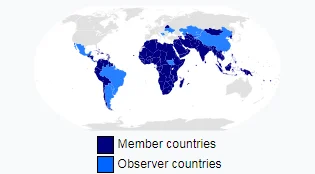
India's Role in the Non-Aligned Movement
India played a central role in the formation and development of NAM under the leadership of Prime Minister Jawaharlal Nehru. For India, non-alignment was not simply a foreign policy position but a means of protecting its newly acquired independence and pursuing an independent role in world affairs.
India's contribution can be understood through the following developments:
1. Promoting Independent Foreign Policy
After Independence in 1947, India sought to maintain friendly relations with both the United States and the Soviet Union without formally joining either bloc. Nehru believed that international decisions should be based on national interests and independent judgement.
2. Supporting Decolonisation
India consistently supported the freedom struggles of Asian and African countries. It opposed colonial rule, racial discrimination and apartheid, and used international platforms to raise these concerns.
3. Advocating Peaceful Coexistence
India promoted dialogue and peaceful resolution of international disputes. The Panchsheel principles, agreed upon by India and China in 1954, became an important influence on the later development of NAM.
4. Supporting Disarmament
India advocated nuclear disarmament and opposed the growing arms race between the superpowers. It argued that global security should not depend on the accumulation of nuclear weapons.
5. Strengthening the Voice of Developing Countries
India used NAM to raise issues concerning economic development, international trade, sovereignty and unequal global institutions. It also supported greater cooperation among developing countries.
Major Developments in NAM After Its Formation
After the first summit in 1961, NAM expanded beyond its original focus on Cold War politics and became a platform for wider political and economic cooperation.
Some important developments include:
- 1961 - Belgrade: First NAM Summit, which formally established the movement.
- 1964 - Cairo: Second Summit, which strengthened the movement's opposition to colonialism and imperialism.
- 1973 - Algiers: Fourth Summit, which gave greater attention to economic cooperation and the demand for a New International Economic Order.
- 1983 - New Delhi: Seventh Summit, hosted by India under Prime Minister Indira Gandhi. It emphasised disarmament, international peace and economic justice.
- 1992 - Jakarta: Tenth Summit, held after the end of the Cold War, when NAM began reconsidering its role in the changing international order.
- 2019 - Baku: Eighteenth Summit, which focused on strengthening international cooperation and multilateralism.
- 2024 - Kampala: Nineteenth Summit, held in Uganda, with an emphasis on cooperation, sustainable development and shared prosperity.
India and NAM After the Cold War
The end of the Cold War in 1991 changed the international environment in which NAM had originally emerged. With the dissolution of the Soviet Union, the bipolar structure of global politics came to an end.
India also began to adjust its foreign policy in response to changing economic and strategic conditions.
The economic reforms of 1991, growing engagement with the United States, closer relations with major powers and participation in new international groupings gradually changed India's approach to NAM.
India did not abandon the principles of non-alignment, but increasingly used the term strategic autonomy to describe its foreign policy approach. This allows India to maintain relations with different countries and participate in multiple international groupings according to its national interests.
India did not participate at the level of its Prime Minister or External Affairs Minister in the 2016 NAM Summit in Venezuela, which was seen as a decline in the movement's earlier diplomatic priority. However, India has continued to participate in NAM forums and reaffirm its commitment to its founding principles.
Organisational Structure of NAM
Unlike formal international organisations, NAM does not have a founding charter, a permanent secretariat or a permanent headquarters.
Its functioning is based on cooperation and coordination among member countries.
- Summit Conference: The highest decision-making forum, attended by Heads of State or Government.
- Chairmanship: The chairmanship rotates among member countries and is generally held by the country hosting the summit.
- Coordinating Bureau: Based at the United Nations in New York, it coordinates the movement's activities between summits.
- Ministerial Meetings: Provide opportunities for member countries to discuss common political, economic and international issues.
- Working Groups: Address specific subjects such as disarmament, human rights, UN reform and peacekeeping.
Uganda assumed the chairmanship following the 19th NAM Summit in 2024 for the 2024-2027 period.
Relevance of NAM in the Contemporary World
Although NAM emerged during the Cold War, several of the concerns that led to its formation continue to influence international relations.
The movement provides developing countries with a platform to raise concerns about unequal global institutions, economic dependence, geopolitical pressure and the need for a more representative international order.
Its continued relevance can be understood through the following areas:
- Strategic autonomy: The principle of independent decision-making remains important as countries navigate competing geopolitical interests.
- Global South cooperation: NAM provides a platform for developing countries to discuss shared concerns relating to trade, debt, climate change and development.
- UN reforms: It supports reforms in international institutions, particularly the United Nations Security Council, to improve representation of developing countries.
- Peace and disarmament: Its traditional emphasis on peaceful coexistence and nuclear disarmament remains relevant amid continuing international conflicts.
- Multilateralism: NAM advocates dialogue and cooperation rather than unilateral decisions by powerful countries.
Challenges Faced by NAM
Despite its large membership, NAM faces difficulties in maintaining a common position on major international issues.
- Loss of Cold War context: The end of the bipolar world order reduced the original purpose of avoiding alignment between two superpower blocs.
- Differences among members: Political systems, economic interests and foreign policy priorities vary significantly among member countries.
- Limited institutional structure: The absence of a permanent secretariat and binding enforcement mechanisms affects coordination and implementation.
- Changing geopolitical alignments: Many member countries maintain close strategic or military partnerships with major powers, making collective positions difficult.
- Emergence of other platforms: Groupings such as BRICS, G20 and regional organisations have created additional forums for developing countries to pursue their interests.
Conclusion
Although the international situation has changed since 1991, the concerns of sovereignty, strategic autonomy, disarmament and equitable global representation remain relevant. NAM's future role will depend on its ability to build consensus among members and translate its shared principles into meaningful cooperation.
FAQs
1. What is the Non-Aligned Movement (NAM)?
The Non-Aligned Movement is an international forum of developing countries that sought to maintain independent foreign policies rather than formally align with either the US-led Western bloc or the Soviet-led Eastern bloc during the Cold War.
2. When and where was the Non-Aligned Movement established?
NAM was formally established at its First Summit in Belgrade, Yugoslavia, from 1-6 September 1961. The summit was attended by 25 countries.
3. Who were the five founding leaders of NAM?
The five prominent founding leaders, often referred to as the founding fathers of NAM, were:
- Jawaharlal Nehru – India
- Josip Broz Tito – Yugoslavia
- Gamal Abdel Nasser – Egypt
- Kwame Nkrumah – Ghana
- Ahmed Sukarno – Indonesia
4. What was the significance of the Bandung Conference of 1955?
The Bandung Conference was held in Indonesia from 18-24 April 1955, with representatives from 29 Asian and African countries. It promoted Afro-Asian solidarity, peaceful coexistence, decolonisation and independence from Cold War bloc politics. It laid the foundation for NAM.
5. What were the main objectives of the Non-Aligned Movement?
- Maintaining independent foreign policies.
- Opposing colonialism, imperialism and racial discrimination.
- Promoting national sovereignty and territorial integrity.
- Supporting peaceful coexistence and non-interference.
- Advocating nuclear disarmament and world peace.
- Promoting economic cooperation and development among developing countries.
Related reads.

Coral Reefs
22 Oct 2026 7 min

Ocean Pollution
21 Oct 2026 7 min

Thermohaline Circulation
21 Oct 2026 7 min

Ocean Waves
19 Oct 2026 7 min
Decolonisation in Asia and Africa
18 Oct 2026 8 min

Temperature Distribution in Oceans
10 Oct 2026 9 min
Put it into practice
Reading is step one.
Turn what you've just read into exam-ready answers with mentor-led practice and our structured test series.