
GS-I (History, Geography, Society)
India’s Relations with Neighbouring Countries (1947-1964)
Introduction
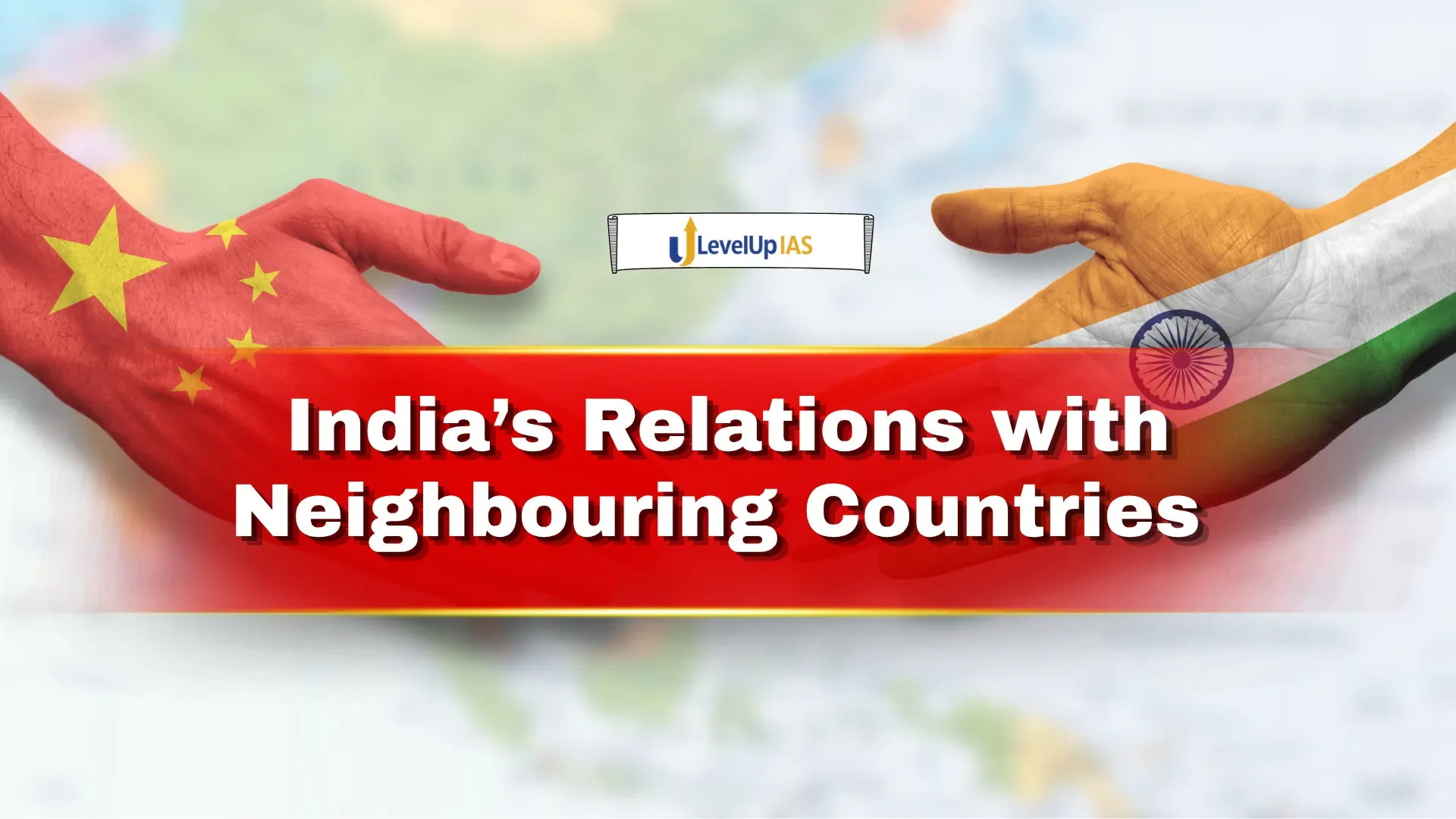
After independence in 1947, India faced the challenge of establishing stable relations with its neighbouring countries in a region undergoing major political and territorial changes. Partition created a new border with Pakistan, several neighbouring countries were emerging from colonial rule, and the changing political situation in Tibet introduced new security concerns along the Himalayan frontier.
Under Prime Minister Jawaharlal Nehru, India sought to maintain friendly relations with its neighbours through peaceful coexistence, non-interference, cooperation and respect for sovereignty. However, differences over territory, security, migration and political influence often complicated these efforts.
The period from 1947 to 1964 was therefore crucial in shaping the foundations of India's neighbourhood policy.
India-Pakistan Relations
India's relations with Pakistan were strained from the beginning due to the communal violence and mass migration accompanying Partition in 1947. Disputes over the division of assets, refugee rehabilitation and the status of princely states further complicated the relationship.
The most significant issue was the Kashmir dispute. Maharaja Hari Singh initially wanted Jammu and Kashmir to remain independent. However, in October 1947, tribal forces backed by Pakistan entered the state. The Maharaja sought India's military assistance and signed the Instrument of Accession on 26 October 1947. India accepted the accession, and Indian troops were airlifted to Srinagar on 27 October.
The conflict continued until a ceasefire came into effect on 1 January 1949, following India's approach to the United Nations. The state was subsequently divided by a ceasefire line, leaving the Kashmir issue unresolved.
Another important territorial dispute concerned Junagadh, a princely state in present-day Gujarat. Its Muslim ruler, Nawab Mahabat Khan, announced accession to Pakistan in 1947 despite the state's Hindu-majority population and geographical separation from Pakistan. India opposed the decision, took over the administration in November 1947 and conducted a plebiscite in February 1948, in which the overwhelming majority voted in favour of joining India.
Despite these tensions, both countries attempted to address humanitarian concerns. The Liaquat-Nehru Pact (1950), signed on 8 April 1950, aimed to protect religious minorities in both countries. It provided for the protection of life, property and religious freedom, the return of abducted women and looted property, and measures to facilitate refugee rehabilitation.
However, continuing communal tensions and the Kashmir dispute prevented lasting improvement in bilateral relations.
India-China Relations
In the initial years after independence, India attempted to establish friendly relations with China. India recognised the People's Republic of China in 1949 and formally established diplomatic relations with it on 1 April 1950.
However, the Chinese takeover of Tibet in 1950 significantly altered the strategic situation along India's northern borders. Tibet had historically acted as a geographical buffer between India and China. Its incorporation into the People's Republic of China brought the two countries into closer territorial contact and raised concerns about border security.
In 1954, India and China signed the Agreement on Trade and Intercourse between the Tibet Region of China and India, which incorporated the Five Principles of Peaceful Coexistence, popularly known as Panchsheel:
- Mutual respect for each other's territorial integrity and sovereignty.
- Mutual non-aggression.
- Mutual non-interference in internal affairs.
- Equality and mutual benefit.
- Peaceful coexistence.
The agreement reflected Nehru's belief that Asian countries could resolve differences through peaceful cooperation. The slogan Hindi-Chini Bhai-Bhai came to symbolise the period of friendship.
However, differences over the boundary gradually emerged. In the western sector, China constructed a strategic road through Aksai Chin, connecting Xinjiang with Tibet. India considered the region part of Ladakh, while China maintained its own territorial claims.
In the eastern sector, China rejected the McMahon Line, which India regarded as the boundary established through the 1914 Simla Convention. These disagreements, along with growing tensions over Tibet, weakened bilateral relations.
The situation deteriorated further after the Tibetan uprising of 1959. India granted asylum to the Dalai Lama, who fled Tibet, causing additional friction with China. Border clashes and diplomatic exchanges intensified, eventually leading to the Sino-Indian War of 1962.
The war exposed India's military preparedness and led to a major reassessment of its defence and foreign-policy priorities. It marked a turning point in India's relations with China and weakened the earlier vision of Asian solidarity.
India-Nepal Relations
India and Nepal shared close historical, cultural, religious and geographical ties. After independence, India sought to maintain friendly relations with Nepal, particularly because of its strategic location along the Himalayan frontier.
The most important development was the signing of the Indo-Nepal Treaty of Peace and Friendship on 31 July 1950. The treaty established a special relationship between the two countries and provided for mutual recognition of sovereignty, territorial integrity and independence. It also facilitated close economic and social relations, including reciprocal privileges for citizens of both countries.
The treaty was accompanied by an agreement concerning trade and transit, which allowed Nepal access to international trade through Indian territory. The open border also enabled people from both countries to travel, reside and work across the border with considerable freedom.
However, Nepal gradually became concerned about the extent of India's influence in its domestic and foreign affairs. The end of Rana rule in 1951 and the political changes under King Mahendra altered Nepal's approach to foreign relations.
Nepal also sought to diversify its external partnerships. It established diplomatic relations with China in 1955, signed a Treaty of Peace and Friendship with China in 1960 and entered into an agreement for the construction of a road connecting Kathmandu with the Tibet border in 1961.
Thus, while India and Nepal maintained close relations, Nepal increasingly sought to preserve its independent foreign-policy choices.
India-Bhutan Relations
India's relationship with Bhutan developed on the basis of geographical proximity, mutual security concerns and historical ties. Before independence, Bhutan's external relations had been influenced by the British through the Treaty of Punakha (1910).
After independence, India sought to establish a friendly relationship while recognising Bhutan's distinct identity and sovereignty.
The most significant development was the signing of the Treaty of Friendship between India and Bhutan on 8 August 1949. Under the treaty, both countries committed themselves to maintaining peace and friendship. India agreed not to interfere in Bhutan's internal administration, while Bhutan agreed to be guided by India's advice in its external relations.
The treaty also provided for closer economic cooperation, trade relations and financial assistance from India. India supported Bhutan's development through infrastructure projects, including road construction and cooperation in the hydropower sector.
China's growing influence in Tibet after 1950 further increased the strategic importance of India–Bhutan relations. Nehru's visit to Bhutan in 1958 reaffirmed India's support for Bhutan's independence and territorial integrity.
During this period, Bhutan gradually began expanding its international engagement while maintaining close relations with India. The relationship established a foundation for long-term cooperation between the two countries.
India-Sri Lanka Relations
India and Sri Lanka, then known as Ceylon, shared historical, cultural and religious connections. Sri Lanka gained independence from British rule on 4 February 1948. Initially, relations between the two countries remained cordial, but the question of Indian-origin Tamils became a major source of disagreement.
During British rule, a large number of Indian Tamils had been brought to Ceylon to work on tea, coffee and rubber plantations. Following independence, the Ceylon government introduced citizenship legislation in 1948 that left a large section of this population without citizenship. The subsequent legislation further restricted their political rights, making the issue a major concern for India.
The matter was addressed through diplomatic negotiations. In 1954, Prime Minister Jawaharlal Nehru and Ceylon Prime Minister John Kotelawala reached an understanding on the citizenship issue, although the problem remained unresolved.
A major agreement was signed in 1964 between Indian Prime Minister Lal Bahadur Shastri and Ceylon Prime Minister Sirimavo Bandaranaike. Known as the Sirima-Shastri Pact, it provided for the allocation of citizenship to a large number of people of Indian origin. India agreed to accept 525,000 persons for repatriation, while Ceylon agreed to grant citizenship to 300,000. The status of the remaining 150,000 was left for future negotiations.
The agreement reflected India's efforts to resolve bilateral problems through peaceful negotiations.
India-Burma Relations
Burma, now known as Myanmar, became independent on 4 January 1948. India and Burma maintained friendly relations based on their shared experience of colonial rule, geographical proximity and historical connections.
Both countries supported anti-colonial movements and the principles of Asian solidarity. India also extended assistance to Burma during its early years of independence, particularly when the country faced internal political and security challenges.
The two countries signed the Treaty of Friendship in 1951, providing a framework for closer diplomatic and economic cooperation. Prime Minister Nehru and Burmese Prime Minister U Nu shared an interest in peaceful coexistence and cooperation among newly independent Asian countries.
However, the presence of a large Indian-origin population in Burma and issues relating to migration and property created occasional difficulties. Despite these concerns, relations remained broadly cordial during the early post-independence period.
Overall Assessment of India's Neighbourhood Policy (1947-1964)
India's relations with its neighbours during the Nehruvian period reflected an attempt to combine peaceful coexistence with strategic security concerns. India supported the sovereignty of newly independent countries, promoted regional cooperation and generally preferred diplomatic negotiations over military confrontation.
However, the experience was not uniform. Relations with Pakistan remained troubled by Partition and Kashmir, while the 1962 war with China exposed the limitations of India's approach towards border security. At the same time, relations with Nepal and Bhutan demonstrated India's effort to maintain close ties with its Himalayan neighbours, while the agreements with Sri Lanka and Burma reflected the importance of diplomatic engagement in resolving regional issues.
Conclusion
The period between 1947 and 1964 laid the foundations of India's relations with its immediate neighbours. Nehru's approach was shaped by anti-colonial solidarity, peaceful coexistence, non-alignment and respect for national sovereignty. However, unresolved territorial disputes, security concerns and differences over political influence revealed the complexities of regional diplomacy. The developments of this period, particularly the 1962 war with China, significantly influenced the subsequent direction of India's foreign and security policies.
FAQs
1. What guided India's foreign policy between 1947 and 1964?
Peaceful coexistence, non-alignment, respect for sovereignty, non-interference and regional cooperation guided India's foreign policy under Jawaharlal Nehru.
2. How did India-Pakistan relations evolve during this period?
Relations were shaped by the Kashmir dispute and Partition-related tensions. Key developments included the Nehru-Liaquat Pact (1950) and Indus Waters Treaty (1960).
3. What were the major developments in India-China relations?
India recognised the People's Republic of China in 1949, signed the Panchsheel Agreement in 1954 and fought a border war with China in 1962.
4. What were the five principles of Panchsheel?
- Mutual respect for sovereignty and territorial integrity.
- Mutual non-aggression.
- Mutual non-interference.
- Equality and mutual benefit.
- Peaceful coexistence.
5. What was the significance of the India-Nepal Treaty of 1950?
The Treaty of Peace and Friendship established a framework for close diplomatic, economic and security relations between India and Nepal.
Related reads.
Naxal Movement in India: Origins, Evolution and Impact
05 Nov 2026 6 min

Indian Sculpture (Ancient to Medieval)
03 Nov 2026 11 min

Non-Aligned Movement (NAM)
02 Nov 2026 8 min

Coral Reefs
22 Oct 2026 7 min

Ocean Pollution
21 Oct 2026 7 min

Thermohaline Circulation
21 Oct 2026 7 min
Put it into practice
Reading is step one.
Turn what you've just read into exam-ready answers with mentor-led practice and our structured test series.