
GS-I (History, Geography, Society)
Independence and Partition of India
Introduction
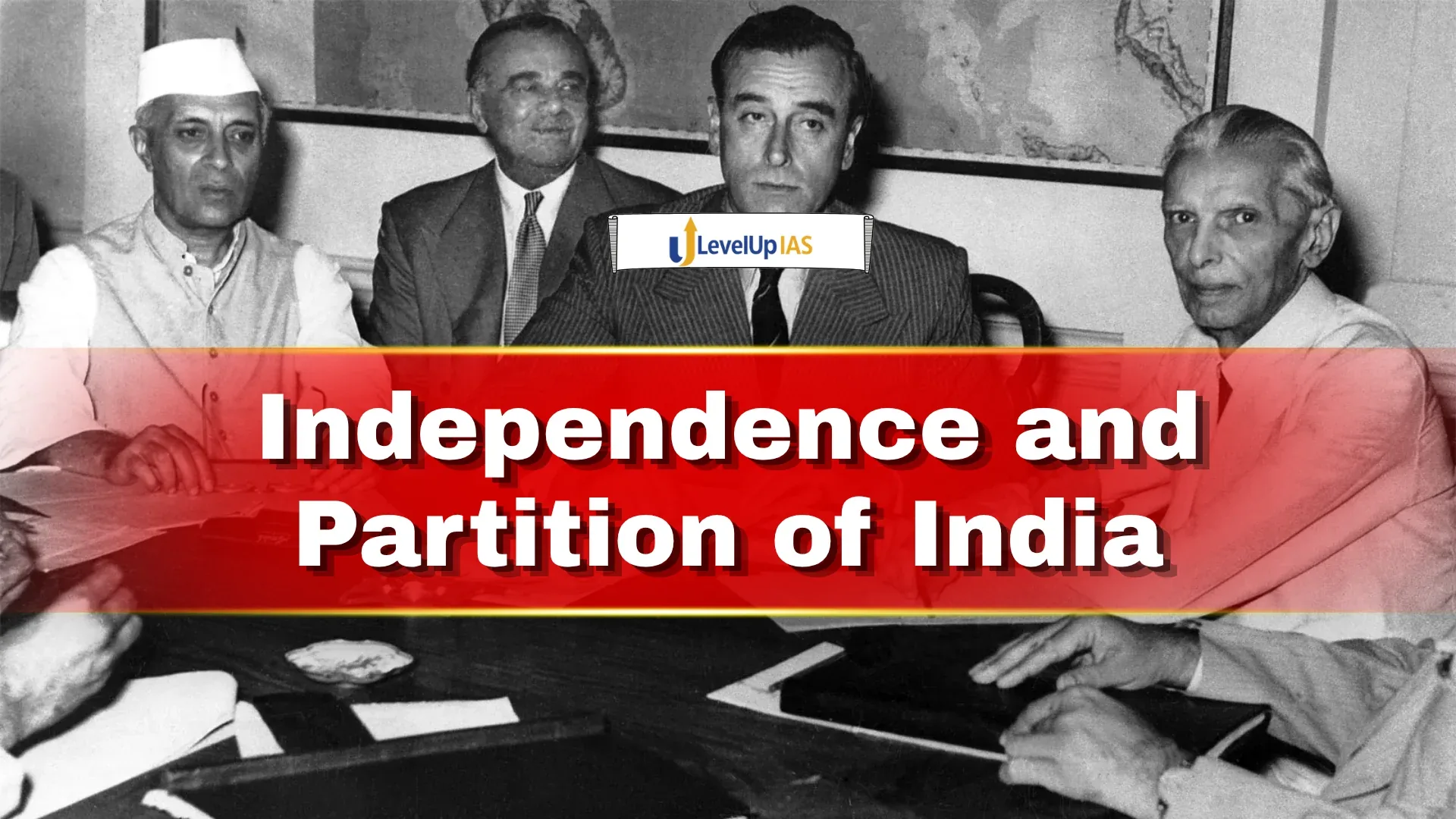
The year 1947 marked both the achievement of Indian independence and the partition of the Indian subcontinent. After nearly two centuries of British colonial rule and decades of nationalist mobilisation, India became independent on 15 August 1947. However, independence came with the division of British India into two dominions, India and Pakistan.
Partition was not the result of a single event or decision. It emerged from a complex combination of communal politics, socio-economic concerns, the growth of the Two-Nation Theory, British constitutional policies, political differences between the Congress and the Muslim League, and the developments of the 1940s. The process culminated in the acceptance of partition in 1947 and the subsequent division of Punjab and Bengal along communal lines.
Growth of Communalism and the Roots of Partition
The roots of partition can be traced to the growth of communal politics during the late nineteenth and early twentieth centuries. British policies increasingly treated religious communities as separate political constituencies. The introduction of separate electorates under the Morley-Minto Reforms of 1909, their continuation under later constitutional reforms and the Communal Award of 1932 institutionalised communal representation.
The Partition of Bengal in 1905, although presented by the British as an administrative reorganisation, had important political consequences because it created a Hindu-majority western Bengal and a Muslim-majority eastern Bengal. The All-India Muslim League was established in 1906, initially representing the political interests of sections of the Muslim elite.
The Lucknow Pact of 1916 brought the Congress and Muslim League together temporarily, with Congress accepting separate electorates as part of an effort to secure Muslim League cooperation. However, communal political identities continued to develop over subsequent decades. The formation of organisations representing different communal interests and increasing competition over political representation further complicated the nationalist movement.
Socio-Economic Factors and the Two-Nation Theory
Partition was also influenced by socio-economic factors. Sections of the Muslim middle class and landed elites feared that political independence in a Hindu-majority country might leave them economically and politically disadvantaged. Concerns about representation in government services, education, commerce and political institutions contributed to the perception among sections of the Muslim population that their interests required separate political safeguards.
The Hindi-Urdu controversy also contributed to the sharpening of communal identities. Over time, political differences increasingly came to be expressed in terms of separate religious interests.
The ideological foundation of the demand for Pakistan was provided by the Two-Nation Theory, which argued that Hindus and Muslims constituted distinct nations whose political interests could not be adequately accommodated within a single state. Muhammad Iqbal had articulated ideas concerning Muslim political autonomy, while Muhammad Ali Jinnah and the Muslim League eventually transformed the demand for safeguards into a demand for a separate state.
The decisive political development came with the Lahore Resolution of 1940, moved by A.K. Fazlul Huq at the Muslim League's Lahore session. It called for geographically contiguous Muslim-majority areas to be constituted into independent political units. The demand subsequently became closely associated with the creation of Pakistan.
Developments During the Second World War
The Second World War intensified the constitutional and political crisis in India. Britain needed Indian cooperation for the war, while the Congress continued to demand substantial political freedom. The British government increasingly treated the Muslim League as an important political counterweight to the Congress.
The Cripps Mission of 1942 proposed Dominion Status after the war and the creation of a Constituent Assembly to frame India's constitution. Importantly, provinces unwilling to join the proposed Indian Union were allowed to form separate unions. Congress rejected the proposals, particularly because they did not provide immediate independence and contained provisions that could encourage the fragmentation of India. The Muslim League also rejected the offer because it did not explicitly concede Pakistan.
Further efforts at political compromise also failed. The Rajagopalachari Formula of 1944 attempted to bring the Congress and Muslim League together by proposing a post-war mechanism to determine the wishes of Muslim-majority areas. The subsequent Gandhi-Jinnah talks failed to produce an agreement.
The Wavell Plan and Shimla Conference of 1945 represented another attempt to resolve the political deadlock. The principal dispute centred on the Muslim League's claim to be the sole representative of Indian Muslims. The conference therefore failed to reach an agreement.
Elections of 1945-46 and the Cabinet Mission
The elections of 1945-46 demonstrated the growing political strength of the Muslim League among Muslim voters. The League won all 30 Muslim seats in the Central Legislative Assembly and a large majority of Muslim provincial seats, while Congress dominated the general constituencies. These results strengthened the League's claim that it represented the political aspirations of India's Muslims.
The Cabinet Mission of 1946 attempted to preserve Indian unity while accommodating Muslim League demands. It rejected the creation of a separate Pakistan and proposed an Indian Union consisting of British Indian provinces and princely states, with provinces grouped into sections enjoying substantial autonomy.
The plan initially appeared to offer a possible compromise, but disagreements over the interpretation and functioning of the grouping arrangement deepened the political crisis. The Muslim League ultimately refused to participate in the constitutional process in the manner envisaged by Congress, and the situation deteriorated rapidly.
Direct Action and Communal Violence
On 16 August 1946, Muhammad Ali Jinnah called for Direct Action Day to press the demand for Pakistan. The day was followed by severe communal violence, beginning in Calcutta and subsequently spreading to other parts of the country, including Noakhali and Bihar.
The violence of 1946 had a profound impact on political decision-making. The possibility of maintaining a united India appeared increasingly difficult as communal tensions escalated. Partition, which had previously been opposed by many nationalist leaders, gradually came to be viewed by sections of the Congress leadership as a means of ending the political deadlock and preventing further bloodshed.
Mountbatten Plan and Partition
Lord Mountbatten became the last Viceroy of India in March 1947. On 3 June 1947, he announced the plan for the transfer of power, popularly known as the Mountbatten Plan or June 3 Plan.
The plan accepted the principle of partition. The legislative assemblies of Punjab and Bengal were allowed to decide whether their provinces should be divided. Sindh's legislature chose to join Pakistan, while a referendum was held in the North-West Frontier Province. The Radcliffe Commission, headed by Sir Cyril Radcliffe, was appointed to demarcate the boundaries between India and Pakistan.
The British Parliament subsequently passed the Indian Independence Act, 1947. It created two independent dominions, India and Pakistan, and ended British sovereignty over the subcontinent. The office of Viceroy was abolished, with each dominion receiving its own Governor-General.
India became independent on 15 August 1947, while Pakistan came into existence on 14 August 1947.
Congress and the Acceptance of Partition
The Congress had consistently opposed the division of India on religious lines. Mahatma Gandhi remained opposed to partition until the final stages. However, the political circumstances of 1946-47, particularly the continuing communal violence and the failure of negotiations with the Muslim League, changed the calculations of several Congress leaders.
Leaders such as Sardar Vallabhbhai Patel and Jawaharlal Nehru ultimately accepted partition as the most practical way of bringing the political deadlock and widespread violence to an end. Gandhi continued to oppose the idea but eventually accepted the decision.
Khan Abdul Ghaffar Khan and Maulana Abul Kalam Azad were among those who strongly disagreed with the acceptance of partition. Importantly, Congress accepted partition as a political settlement but did not accept the Two-Nation Theory as the basis of independent India's political identity. Independent India adopted a secular constitutional framework.
Consequences of Partition
Partition produced one of the largest and most traumatic episodes of forced migration in modern history. Approximately 15 million people moved across the newly created borders. Muslims largely migrated towards Pakistan, while large numbers of Hindus and Sikhs moved towards India.
The migration was accompanied by widespread communal violence, killings and destruction of property. Women suffered particularly severe forms of violence, including abduction and sexual assault. Both India and Pakistan faced enormous challenges of refugee rehabilitation, housing, employment and resettlement.
Partition also disrupted economic networks and separated agricultural and industrial regions from their traditional markets and sources of raw materials. Punjab and Bengal, which had developed integrated economic systems, were divided by the new international boundary.
The political consequences extended beyond 1947. Partition contributed to long-term hostility and suspicion between India and Pakistan, while the Kashmir issue further complicated relations between the two newly independent states. At the social level, the memory of communal violence left a deep imprint on the collective consciousness of the subcontinent.
Conclusion
The independence of India in 1947 was the culmination of a long and complex anti-colonial struggle, but it came at the enormous cost of partition. The division was shaped by the interaction of British policies, communal politics, socio-economic anxieties, the Muslim League's demand for Pakistan, Congress-League differences and the rapidly deteriorating communal situation in the 1940s.
Partition brought political freedom but also unprecedented displacement, violence and human suffering. Its legacy continues to influence the political and social history of South Asia. For understanding modern India, therefore, Independence and Partition must be studied together, as the simultaneous culmination and tragedy of the Indian national movement.
FAQs
Q1. When did India become independent?
India became independent on 15 August 1947 following the enactment of the Indian Independence Act, 1947, which created the two dominions of India and Pakistan.
Q2. What was the Mountbatten Plan?
The 3 June Plan of 1947, announced by Lord Mountbatten, provided the framework for the transfer of power and the partition of British India into India and Pakistan.
Q3. Why was India partitioned in 1947?
Partition resulted from several factors, including communal tensions, the growth of the Muslim League's demand for Pakistan, disagreements between major political parties and the failure of attempts to establish an acceptable constitutional arrangement for a united India.
Q4. What was the Indian Independence Act, 1947?
Passed by the British Parliament in July 1947, the Act provided for the creation of India and Pakistan as two independent Dominions from 15 August 1947 and ended British sovereignty over British India.
Q5. What was the role of the Radcliffe Commission?
The Boundary Commissions headed by Sir Cyril Radcliffe were established to demarcate the boundaries between India and Pakistan, particularly in Punjab and Bengal.
Related reads.

Revolutionary Nationalism in India
12 Sep 2026 10 min
Indian National Movement – II (1918-1929)
10 Sep 2026 10 min
Regional States of North and South India
09 Sep 2026 9 min

Wind System, UPSC Geography
08 Sep 2026 9 min
Indian National Movement (Extremists) - I (1905-1918)
07 Sep 2026 10 min
Temple Architecture in India
04 Sep 2026 9 min
Put it into practice
Reading is step one.
Turn what you've just read into exam-ready answers with mentor-led practice and our structured test series.