
GS-I (History, Geography, Society)
Indian Classical Dance Forms
Introduction
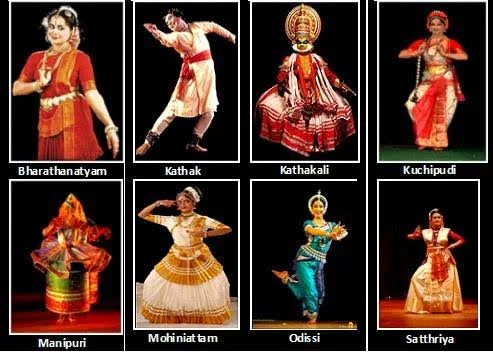
Indian classical dance represents a long tradition of combining movement, music, expression and storytelling. Its theoretical foundations are closely associated with texts such as the Natyashastra and Abhinaya Darpana, while individual forms developed through temples, courts, monasteries and regional performance traditions. India currently recognises eight classical dance forms: Bharatanatyam, Kathak, Kathakali, Kuchipudi, Manipuri, Mohiniyattam, Odissi and Sattriya.
Classical Dance: Theoretical Foundations
The Natyashastra, traditionally attributed to Bharata Muni, provides the foundational framework for Indian performing arts. It discusses dance, drama, music, stagecraft and aesthetics. Another important text, Abhinaya Darpana of Nandikesvara, deals extensively with gestures, expressions and bodily movements.
Classical Indian dance is generally understood through three broad categories. Nritta refers to pure dance movements without an explicit narrative; Nritya combines movement with expression to communicate meaning; and Natya incorporates dramatic representation and storytelling. The aesthetic experience is built around rasa, while bhava refers to the emotional state expressed by the performer.
Hand gestures or mudras, facial expressions, eye movements, rhythmic footwork and controlled body movements form important components of the classical vocabulary. However, each dance developed its own technique, repertoire, music, costume and performance conventions.
The Eight Classical Dance Forms
Dance Form | Principal Region | Distinctive Feature |
| Bharatanatyam | Tamil Nadu | Geometric movements, strong footwork and abhinaya |
| Kathak | North India | Spins, rhythmic footwork and storytelling |
| Kathakali | Kerala | Dance-drama, elaborate makeup and facial expression |
| Kuchipudi | Andhra Pradesh | Dance-drama and expressive storytelling |
| Manipuri | Manipur | Graceful movements and Vaishnava themes |
| Mohiniyattam | Kerala | Lasya, gentle movements and subtle expressions |
| Odissi | Odisha | Tribhanga, Chauka and sculptural poses |
| Sattriya | Assam | Vaishnavite monastic tradition and dance-drama |
Bharatanatyam
Bharatanatyam, associated primarily with Tamil Nadu, is among India's oldest surviving classical dance traditions. Its technique is marked by precise postures, rhythmic footwork and geometric body movements. The form draws upon the Natyashastra and Abhinaya Darpana, while temple sculptures provide important visual evidence of its movement vocabulary.
The modern repertoire was significantly shaped by the Tanjore Quartet in the 19th century. A traditional performance includes components such as alarippu, jatiswaram, varnam, padam and tillana. The dancer is accompanied by Carnatic music, with the nattuvanar playing a key role in conducting the rhythmic aspect of the performance.
Kathak
Kathak developed primarily in North India and is closely associated with the tradition of travelling storytellers or Kathakars. Over time, it absorbed influences from the Bhakti tradition as well as Mughal and later court cultures.
Its characteristic features include rapid footwork, rhythmic compositions, spins or chakkars, expressive storytelling and intricate interaction with the tabla and other instruments. Important gharanas include Lucknow, Jaipur and Banaras. The Lucknow tradition is particularly associated with expressive abhinaya, while Jaipur is known for its emphasis on rhythm and complex footwork.
Kathakali
Kathakali emerged in Kerala as a highly stylised dance-drama combining dance, music, acting and elaborate visual presentation. Its stories are largely drawn from the Ramayana, Mahabharata and other Indian traditions.
The form is particularly recognised for its elaborate costumes, painted facial makeup and powerful facial expressions. Different makeup patterns indicate the nature of characters, making visual symbolism an integral part of the performance. Kathakali also developed through Kerala's earlier theatrical and ritual traditions.
Kuchipudi
Kuchipudi originated in Andhra Pradesh and developed from a tradition of dance-drama. Its evolution is particularly associated with Siddhendra Yogi, a 17th-century Vaishnava poet who shaped the form's repertoire.
A Kuchipudi performance combines nritta, nritya and natya, with strong emphasis on dramatic interpretation. It traditionally includes dance-drama elements and expressive representations of mythological narratives.
Manipuri
Manipuri, from Manipur, is known for its graceful and relatively restrained movements. Its development was strongly influenced by Vaishnavism, particularly the worship of Radha and Krishna.
The Ras Lila tradition is central to Manipuri dance. Unlike forms that emphasise sharp rhythmic footwork, Manipuri generally uses soft, rounded movements. The Pung Cholom, in which performers dance while playing the pung or Manipuri drum, is another important associated tradition.
Mohiniyattam
Mohiniyattam is the classical solo dance tradition of Kerala. The name refers to Mohini, the female form assumed by Vishnu in Hindu mythology.
The dance is associated with the lasya tradition and is characterised by gentle, swaying movements, subtle facial expressions and controlled footwork. The movements are often compared with the rhythm of waves and the swaying of coconut palms. The form was significantly shaped under the patronage of the Travancore rulers, particularly Maharaja Swati Tirunal, and was revived in the 20th century with institutions such as Kerala Kalamandalam playing an important role.
Odissi
Odissi, originating in Odisha, is distinguished by its sculptural quality and characteristic body positions. Two important postures are Chauka, a square-like stance associated with stability, and Tribhanga, in which the body bends at three points.
The dance has connections with Odisha's temple traditions and sculptures. Its repertoire includes both pure dance and expressive pieces, with Jayadeva's Gita Govinda becoming particularly important to its devotional repertoire. CCRT notes links between Odissi and the classical traditions described in the Natyashastra and Abhinaya Darpana.
Sattriya
Sattriya developed in Assam within the Sattras, the Vaishnavite monasteries established through the religious movement of Srimanta Sankardeva in the 15th-16th centuries.
Initially performed as part of the Ankiya Naat tradition and devotional practices of the Sattras, it later developed into a recognised classical dance form performed on wider stages. Its repertoire combines rhythmic movement, expressive acting and devotional narratives.
Classical Dance and Cultural Continuity
The development of these forms demonstrates that Indian classical dance is not a static continuation of ancient practices. Many traditions underwent substantial changes as temple institutions, royal patronage, colonial rule, social reform and modern cultural institutions altered the conditions in which they were performed.
The 20th century was particularly important for their revival and institutionalisation. Organisations such as the Sangeet Natak Akademi, established in 1953, have played a major role in preserving and promoting India's performing arts. The Akademi functions as an autonomous body under the Ministry of Culture and works with cultural institutions across the country.
Contemporary Relevance and Government Initiatives
Classical dance remains relevant not only as a heritage tradition but also as part of India's cultural diplomacy, education and cultural economy.
In 2026, the Ministry of Culture highlighted the integration of Indian classical dance into school education in line with the National Education Policy (NEP), 2020, which promotes art-integrated and experiential learning. The Kalakshetra Foundation teaches Bharatanatyam to school students, while the Sangeet Natak Akademi conducts the Kala Dharohar series of lectures, workshops and performances for students.
The government also supports young practitioners through the Cultural Talent Search Scholarship Scheme, which provides specialised training opportunities to talented children. According to the Ministry of Culture, scholarships in Indian classical dance under this scheme increased to 313 in 2025-26, compared with 225 in 2021-22.
Recent cultural events also demonstrate the continuing public and institutional interest in classical traditions. The 17th Kathakali Festival, organised by the Kalakshetra Foundation in September 2026, brought together institutions including Kerala Kalamandalam, Sadanam Academy and Margi Theatre.
At the international level, classical dance is also used in Festivals of India abroad and other cultural programmes, making it an instrument of India's cultural diplomacy and soft power. The Ministry of Culture's programmes explicitly include classical and traditional dance among the performing arts showcased internationally.
Conclusion
India's eight classical dance forms represent diverse regional traditions within a broader shared aesthetic framework. Their continued evolution through education, institutional support, festivals and cultural diplomacy shows that classical dance is not merely a historical inheritance but a living component of India's cultural identity and soft power.
FAQs
1. What are Indian classical dance forms?
Indian classical dances are traditional dance systems characterised by codified techniques, expressive gestures, rhythmic patterns, music and established performance traditions.
2. How many classical dance forms are recognised in India?
India has eight major classical dance forms commonly recognised in the context of the Sangeet Natak Akademi:
- Bharatanatyam
- Kathak
- Kathakali
- Kuchipudi
- Odissi
- Manipuri
- Mohiniyattam
- Sattriya
3. Which classical dance form originated in Tamil Nadu?
Bharatanatyam originated in Tamil Nadu. It is known for its geometric body movements, intricate footwork, hand gestures and expressive storytelling.
4. Which classical dance form is associated with Uttar Pradesh?
Kathak is traditionally associated with North India, particularly Uttar Pradesh. It is noted for rhythmic footwork, spins, expressive gestures and storytelling traditions.
5. Which classical dances are associated with Kerala?
Kathakali and Mohiniyattam are associated with Kerala. Kathakali is known for elaborate costumes and dramatic storytelling, while Mohiniyattam is characterised by graceful and flowing movements.
Related reads.
Indian Paintings: Prehistoric to Modern Times
21 Sep 2026 11 min
Independence and Partition of India
14 Sep 2026 8 min

Revolutionary Nationalism in India
12 Sep 2026 10 min
Indian National Movement – II (1918-1929)
10 Sep 2026 10 min
Regional States of North and South India
09 Sep 2026 9 min

Wind System, UPSC Geography
08 Sep 2026 9 min
Put it into practice
Reading is step one.
Turn what you've just read into exam-ready answers with mentor-led practice and our structured test series.