
GS-I (History, Geography, Society)
Indian Classical Music
Introduction
Indian classical music, or Shastriya Sangeet, is a highly developed musical tradition centred on raga (melodic framework) and tala (rhythmic cycle). Its evolution can be traced through ancient musical and performing-arts traditions, Sanskrit texts and centuries of temple, court and community patronage. Over time, two major systems emerged: Hindustani music, predominant in northern and central India, and Carnatic music, associated mainly with southern India. Despite their differences, both share fundamental concepts such as swara, raga, tala and guru-shishya transmission.
Historical Evolution of Indian Classical Music
The roots of Indian music are traditionally associated with the Vedic tradition, particularly the Samaveda, in which hymns were rendered through prescribed musical tones. The development of music as a systematic discipline can be seen in ancient treatises such as the Natyashastra, traditionally attributed to Bharata Muni. It discusses music along with drama, dance, aesthetics and performance.
Later texts such as Dattilam, Brihaddeshi and Sangita Ratnakara contributed to the development of musical theory. The Sangita Ratnakara, written by Sharngadeva in the 13th century, is particularly significant because it belongs to a period when the musical traditions that eventually developed into the northern and southern systems were still closely connected.
The medieval period brought several changes through Bhakti traditions, temple institutions, royal courts and cultural interaction. In northern India, interaction with Persian and Central Asian musical traditions contributed to the evolution of new forms, instruments and performance practices. Court patronage, particularly under several medieval kingdoms and Mughal rulers, played an important role in the development of Hindustani traditions.
In southern India, devotional traditions and temple culture remained major influences on the development of Carnatic music. The system was progressively organised through the work of musicians and composers, particularly Purandara Dasa, followed later by the celebrated Trinity of Carnatic Music: Tyagaraja, Muthuswami Dikshitar and Syama Sastri.
Fundamental Concepts
Indian classical music is built around several interconnected concepts.
Swara refers to a musical note. The basic seven swaras are Sa, Re, Ga, Ma, Pa, Dha and Ni. The concept of shruti represents subtle divisions of pitch and is traditionally associated with 22 microtonal divisions within the octave.
A raga is not simply a scale. It is a structured melodic framework defined by characteristic combinations, movements and treatment of notes. A raga provides the framework within which the musician develops a musical expression.
Tala is the rhythmic cycle that organises time in a musical performance. Different tala systems contain specific patterns of beats and subdivisions.
A distinctive feature of Indian classical music is the balance between fixed compositions and improvisation. The performer follows the rules of a raga and tala while developing the performance creatively. This combination allows individual interpretation without abandoning the underlying musical framework.
Hindustani Classical Music
Hindustani classical music developed primarily in northern and central India. While rooted in older Indian musical traditions, it was shaped over centuries by regional courts, devotional traditions and cultural interaction with Persian and Central Asian musical traditions.
Improvisation occupies an important position in Hindustani performance. A musician may gradually develop a raga through sections such as alap, jor and jhala, particularly in instrumental performances, before moving into a rhythmic composition.
Major Vocal Forms
Dhrupad is among the oldest surviving forms of Hindustani classical vocal music. It is characterised by a serious and disciplined treatment of raga and has strong historical links with devotional and court traditions.
Khayal became the dominant form of Hindustani classical vocal music. Compared with Dhrupad, it provides greater scope for improvisation and varied melodic expression. A performance generally includes a slower bada khayal followed by a faster chhota khayal.
Thumri is a semi-classical form known for its lyrical and expressive character, while Tarana uses rhythmic syllables and is generally presented at a faster tempo.
Gharana Tradition
One of the distinctive institutional features of Hindustani music is the gharana system. A gharana represents a school or lineage with a distinctive approach to raga interpretation, voice production, ornamentation, rhythm and pedagogy.
Important gharanas include Gwalior, Kirana, Agra, Jaipur-Atrauli, Patiala and Lucknow. Although historically associated with particular regions and lineages, modern musicians often learn from and incorporate techniques belonging to more than one gharana.
Instruments
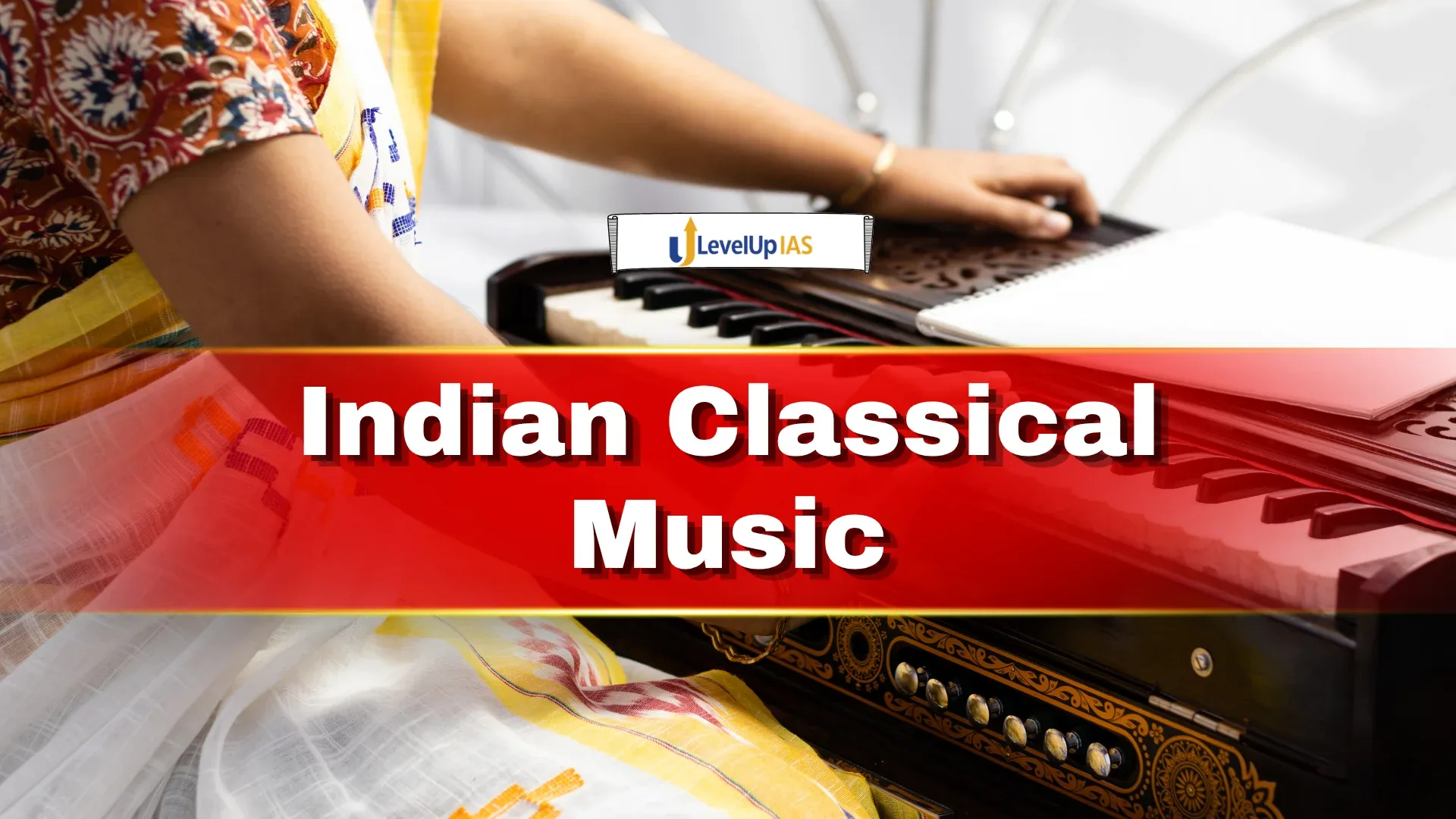
Important instruments associated with Hindustani music include the sitar, sarod, sarangi, santoor, tabla, bansuri and tanpura. The tanpura provides the continuous tonal drone against which the melody is developed.
Carnatic Classical Music
Carnatic music is the classical music tradition of southern India, particularly associated with Tamil Nadu, Karnataka, Andhra Pradesh, Telangana and Kerala. It has maintained strong links with devotional, temple and literary traditions.
Compared with Hindustani music, Carnatic performance is generally more strongly centred on composed pieces, although improvisation remains an important component.
Purandara Dasa and the Carnatic Tradition
Purandara Dasa is traditionally regarded as the Pitamaha or foundational figure of Carnatic music pedagogy because of his systematic approach to musical training. His contribution helped establish graded exercises through which students could progressively develop their understanding of swaras and musical patterns.
The mature Carnatic tradition was greatly enriched by the Trinity of Tyagaraja, Muthuswami Dikshitar and Syama Sastri, whose compositions remain central to the repertoire.
Major Features
The kriti is one of the most important forms of Carnatic composition. It generally contains sections such as Pallavi, Anupallavi and Charanam and combines lyrics, melody and rhythm.
The varnam is another important composition, frequently used in training as well as concert performance. It introduces important characteristics of a raga while demanding considerable technical control from the performer.
Carnatic music also has a sophisticated system of rhythmic and melodic organisation. Its 72 Melakarta system classifies fundamental parent scales, from which numerous janya ragas are derived.
Improvisational forms include Ragam, Tanam and Pallavi (RTP), which provide considerable scope for exploring a raga and demonstrating rhythmic skill.
Instruments
The veena, violin, mridangam, ghatam, kanjira and flute are important instruments in Carnatic music. The violin, introduced into the Carnatic tradition during the colonial period, has become an important accompanying instrument.
Hindustani and Carnatic Music: Key Differences
Basis | Hindustani Music | Carnatic Music |
| Principal region | North and Central India | South India |
| Melodic organisation | Raga; commonly classified through Thaat system | Raga; organised through 72 Melakarta parent scales |
| Major vocal forms | Dhrupad, Khayal, Thumri, Tarana | Kriti, Varnam, Ragam-Tanam-Pallavi |
| Improvisation | Highly prominent | Prominent but closely integrated with compositions |
| Major percussion | Tabla, Pakhawaj | Mridangam, Ghatam, Kanjira |
| Important instruments | Sitar, Sarod, Sarangi, Santoor | Veena, Violin, Flute |
| Institutional lineage | Gharana system | Strong composer and teacher-performer traditions |
| Major influence | Court, devotional and Persian-Central Asian interaction | Temple, devotional and literary traditions |
The distinction should not be understood as a complete separation. Both systems share the foundational principles of raga, tala, swara and guru-shishya parampara, while musicians across traditions continue to experiment and interact.
Guru-Shishya Parampara and Transmission
Indian classical music historically developed through an oral and practice-based system of transmission. Students learned directly from a guru through prolonged training, observation, repetition and performance. This method transmitted not only compositions but also subtle aspects of intonation, ornamentation, improvisation and performance etiquette that could not always be captured through notation.
Modern institutions, universities, recordings and digital platforms have expanded access to this knowledge, but the guru-shishya relationship remains important in advanced training.
Conclusion
Indian classical music represents a continuous interaction between tradition and innovation. Hindustani and Carnatic music developed distinct regional identities and performance practices, yet remain connected through shared foundations of raga, tala, swara and oral transmission. Their survival in the contemporary period depends on the continued interaction of gurus, institutions, performers, audiences and new forms of cultural dissemination, making classical music a living rather than merely historical component of India's cultural heritage.
FAQs
1. What are the two major traditions of Indian classical music?
Indian classical music has two major traditions:
- Hindustani Classical Music: mainly associated with North and Central India.
- Carnatic Classical Music: mainly associated with South India.
2. What is the origin of Indian classical music?
Indian musical traditions have ancient roots in the Vedas, particularly the Samaveda. The Natya Shastra of Bharata is an important early text on music, dance and theatre, while later works such as Sangita Ratnakara further developed Indian music theory.
3. What is a Raga?
A Raga is a melodic framework consisting of a specific arrangement and treatment of musical notes used to create a particular musical mood or aesthetic experience.
4. What is Tala?
Tala refers to the rhythmic cycle in Indian classical music. It provides the rhythmic framework within which a musical performance is organised.
5. What are the major forms of Hindustani classical music?
Major forms include Dhrupad, Khayal, Thumri, Tappa and Tarana. Among these, Khayal is one of the most prominent contemporary forms of Hindustani vocal music.
Related reads.
Indian Classical Dance Forms
23 Sep 2026 6 min

Indian Paintings: Prehistoric to Modern Times
21 Sep 2026 11 min
Independence and Partition of India
14 Sep 2026 8 min

Revolutionary Nationalism in India
12 Sep 2026 10 min
Indian National Movement – II (1918-1929)
10 Sep 2026 10 min
Regional States of North and South India
09 Sep 2026 9 min
Put it into practice
Reading is step one.
Turn what you've just read into exam-ready answers with mentor-led practice and our structured test series.