
GS-I (History, Geography, Society)
Indian National Movement (Extremists) - I (1905-1918)
The beginning of the twentieth century marked an important transformation in the character of Indian nationalism. The early phase of the Indian National Congress had been dominated by the Moderates, who relied mainly on constitutional methods such as petitions, prayers, representations and appeals to British public opinion. However, growing political dissatisfaction and the failure of these methods to secure substantial concessions encouraged the emergence of a younger and more assertive nationalist leadership.
This new trend came to be associated with the Extremists or Nationalists, who sought to transform Indian nationalism from a movement of constitutional demands into a more vigorous struggle based on Swaraj, Swadeshi, boycott, national education and passive resistance. The Partition of Bengal in 1905 acted as the immediate catalyst for the growth of this radical nationalism, although its intellectual and political foundations had been developing for several decades.
Background to the Rise of Extremism
The rise of Extremism was not simply a reaction to one particular British policy. It represented the cumulative impact of political, economic, social and international developments that gradually created dissatisfaction with the existing style of nationalist politics.
One important factor was the emergence of political radicalism rooted in ideas of Swadharma and Swaraj. Unlike the Moderates, who were considerably influenced by Western liberal ideas and believed that British rule could be gradually reformed, the emerging nationalists increasingly emphasised India's own cultural traditions and historical heritage. The socio-religious and cultural awakening associated with figures such as Ramakrishna Paramahamsa, Swami Vivekananda and Swami Dayananda helped develop a sense of self-respect and confidence among Indians. These developments helped bridge the gap between the educated political class and wider society and provided a cultural foundation for more assertive nationalism.
Another major reason was growing dissatisfaction with Moderate methods. The Moderate leadership had relied heavily on prayers, petitions and constitutional appeals in the expectation that the British would respond to reason and justice. Over time, many younger nationalists began to regard this approach as inadequate and ineffective. They believed that political rights could not simply be obtained through appeals to the goodwill of the colonial government; instead, Indians needed to exert pressure through organised political action.
Economic distress further intensified this dissatisfaction. The famines of 1896-98 and 1899-1901, along with the bubonic plague of 1896, exposed the inadequacies of colonial administration. The government's handling of these crises generated widespread resentment and even disillusioned several leaders who had earlier followed moderate politics. The anger against colonial officials found an extreme expression in the assassination of plague commissioner W.C. Rand in Pune.
The policies of Lord Curzon provided another immediate stimulus to radical nationalism. Measures such as the Indian Official Secrets Act, Calcutta Corporation Act and Indian Universities Act were viewed as attempts to restrict political activity and weaken Indian participation in public affairs. Most importantly, the Partition of Bengal in 1905 transformed existing political dissatisfaction into a mass nationalist agitation and gave the Extremist movement a powerful political issue around which people could mobilise.
International developments also influenced Indian nationalists. The defeat of Italy by Ethiopia (Abyssinia) in 1896 demonstrated that a European power could be defeated by an African state. Similarly, Japan's victory over Russia in the Russo-Japanese War of 1904-05 challenged the assumption of European racial and military superiority. Nationalist movements in countries such as Egypt, Turkey and Persia also provided inspiration to Indian political activists.
The Extremist Leadership
The Extremist tendency developed particularly strongly in Maharashtra, Bengal and Punjab, where regional leaders gave the movement its distinctive character.
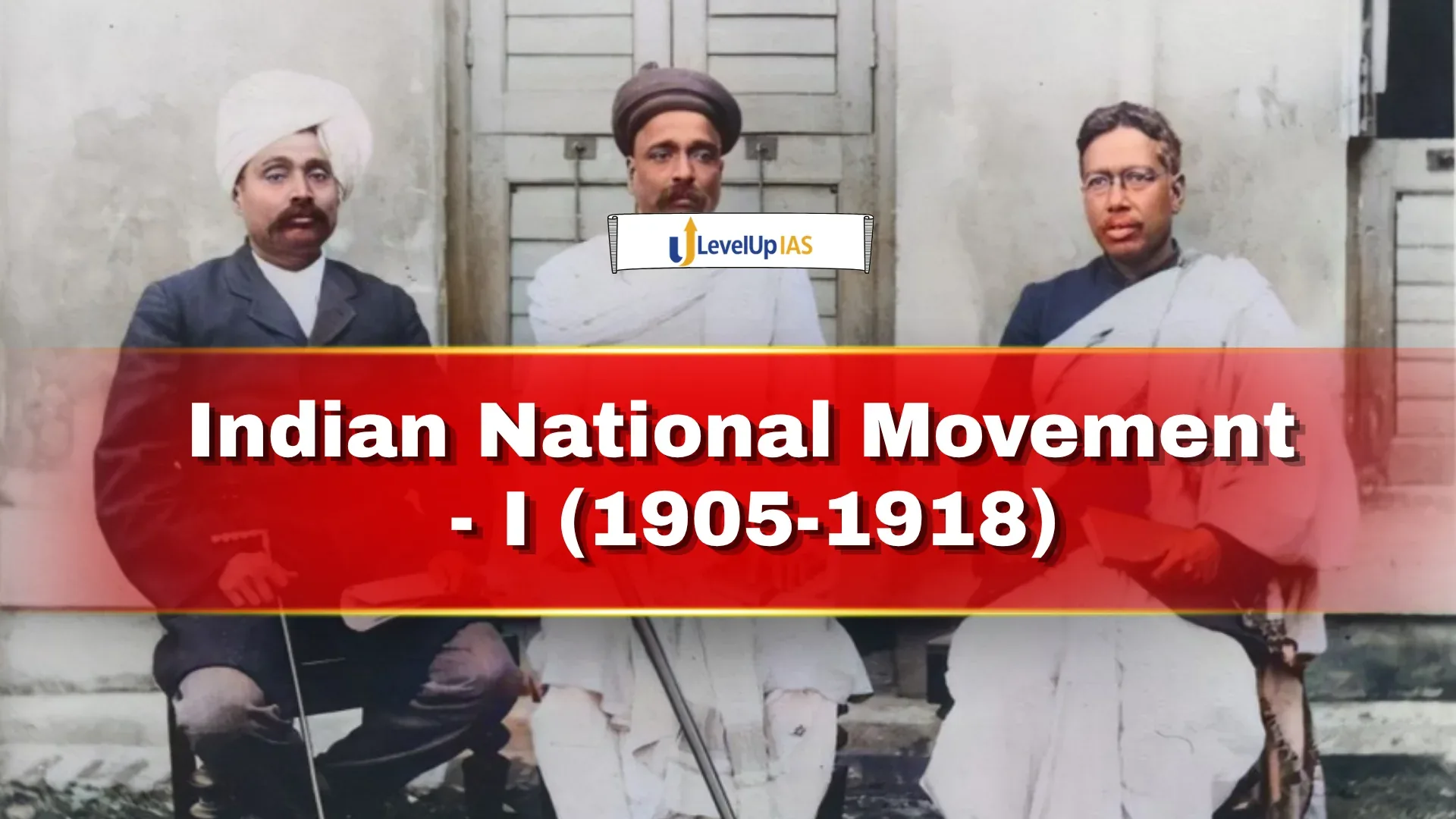
The Maharashtra group was associated primarily with Bal Gangadhar Tilak, Bengal with Bipin Chandra Pal and Aurobindo Ghosh, and Punjab with Lala Lajpat Rai. Together, these leaders represented a more assertive political approach within the Congress and are often remembered as the prominent trio of the Extremist phase.
Bal Gangadhar Tilak
Bal Gangadhar Tilak, popularly known as Lokamanya, was one of the most influential leaders of radical nationalism. His famous declaration, “Swaraj is my birthright, and I will have it,” captured the central political aspiration of the Extremists.
Tilak believed that an alien government should not interfere unnecessarily in the social and private life of Indians. His opposition to the Age of Consent Bill in 1891 reflected this broader concern regarding colonial interference. He also understood the importance of cultural symbols in creating political consciousness among ordinary people. His organisation of the Ganapati festival in 1893 and Shivaji festival in 1896 helped transform cultural and historical traditions into instruments of public mobilisation.
Tilak also used journalism extensively to spread nationalist ideas through his newspapers Kesari and Mahratta. His political influence extended beyond Maharashtra, and his role became particularly important in the broader nationalist politics that emerged after the Partition of Bengal. In 1916, he established the Poona Home Rule League, marking his continued commitment to the demand for self-government.
Lala Lajpat Rai
Lala Lajpat Rai, popularly known as the Lion of Punjab, represented the Punjab stream of Extremist nationalism. He was dissatisfied with the soft and vacillating policies of the Congress and believed that political leadership needed to be more responsive to the interests of the country rather than merely concerned with constitutional reforms.
His involvement in the Swadeshi phase strengthened the nationalist movement in Punjab and helped extend radical political consciousness beyond Bengal and Maharashtra. His later opposition to the Simon Commission and his famous slogan “Go back, Simon” further reflected his uncompromising nationalist position.
Bipin Chandra Pal and Aurobindo Ghosh
Bipin Chandra Pal emerged as an important voice of radical nationalism in Bengal. Although he had earlier been associated with Moderate politics, he moved towards Extremism by 1902. Through powerful speeches and writings, he popularised the ideas of Swadeshi, self-reliance and active resistance.
Aurobindo Ghosh provided the movement with a strong intellectual and ideological dimension. His early writings, including ‘New Lamps for Old’, criticised the existing political approach and argued for a more vigorous nationalist movement. His statement that “Political freedom is the life-breath of a nation” expressed the central belief of the new nationalist school. Other figures associated with the Extremist tendency included Rajnarayan Bose, Ashwini Kumar Dutt and V.O. Chidambaram Pillai.
Ideology and Methods of the Extremists
- The Extremists did not necessarily advocate violent revolution. Their fundamental disagreement with the Moderates concerned the pace, objectives and methods of political struggle. They believed that dependence on British goodwill would not produce genuine self-government and that Indians had to develop their own political strength.
- For the Extremists, Swaraj was not merely a distant constitutional objective but a political right. They emphasised self-reliance and sought to awaken national pride by drawing upon India's cultural and historical heritage. Instead of restricting politics to educated elites, they attempted to involve wider sections of society by creating emotional and cultural bonds with the nationalist cause.
- Their programme centred around Swadeshi, boycott, national education and passive resistance. The boycott of foreign goods was intended not merely as an economic measure but also as a political weapon against colonial rule. Swadeshi encouraged Indians to depend upon indigenous goods and industries, thereby connecting economic self-reliance with political freedom.
- National education was another important component because the Extremists believed that colonial educational institutions could not adequately develop national consciousness. They therefore supported educational initiatives that would cultivate patriotism, self-respect and awareness of India's cultural heritage.
Moderates vs Extremists
The conflict between the two groups should not be understood as a complete difference in their ultimate nationalist objectives. Both criticised the economic exploitation of India and ultimately sought greater self-government. The major difference lay in their understanding of British rule and the methods required to challenge it.
The Moderates retained greater faith in British liberalism and constitutional politics. They believed that petitions, representations, legislative reforms and appeals to British public opinion could gradually secure political concessions. The Extremists, in contrast, had lost faith in the benevolence of colonial rule and emphasised pressure, boycott, Swadeshi, passive resistance and non-cooperation with the colonial bureaucracy.
The Extremists were also more willing to mobilise the masses and appeal to national pride and India's cultural heritage. At the same time, they should not be equated with revolutionary terrorists. Extremist leaders generally opposed violent methods, even though they recognised the political circumstances and repression that contributed to the growth of revolutionary activities.
The Surat Split, 1907
The differences between Moderates and Extremists eventually resulted in the formal split of the Indian National Congress at Surat in 1907. The roots of the conflict had appeared earlier, particularly in Maharashtra, where the Extremists had strengthened their position within the Poona Sarvajanik Sabha while Gopal Krishna Gokhale and his associates established the Deccan Sabha.
The immediate background to the Surat crisis involved disagreements over the Congress presidency and the venue of the 1907 session. The Extremists preferred Nagpur, whereas the venue was shifted to Surat, where the Moderates had greater organisational strength. There was also a controversy over the choice of the Congress president, with the Extremists opposing attempts to marginalise Tilak's influence.
The political atmosphere became increasingly confrontational. At the Surat session, disorder broke out between the two factions and the proceedings had to be suspended. The confrontation eventually became physical, and the Extremists, being in a minority within the organisation, were forced out of the Congress. Thus, the internal differences that had developed over political strategy culminated in an organisational split.
Consequences of the Split
The Surat Split weakened the organisational unity of the Congress at a critical stage of the national movement. The British government exploited the division between the two groups and intensified repression against radical nationalists, particularly in Bengal, Maharashtra and Punjab.
The period following the split also witnessed constitutional concessions aimed at attracting the Moderates. The Morley-Minto Reforms of 1909 introduced further constitutional changes, while the provision for separate electorates for Muslims contributed to the development of communal politics. The Extremists, meanwhile, faced greater governmental repression and their influence remained concentrated in particular regions.
Yet, the split did not mean that the Extremist phase had failed completely. Its emphasis on Swaraj, Swadeshi, boycott, self-reliance and mass political mobilisation permanently broadened the nature of Indian nationalism. It challenged the limitations of elite constitutional politics and helped prepare the political ground for later phases of the national movement.
Towards Reunion: Lucknow, 1916 and Beyond
The division between the Moderates and Extremists could not remain permanent. The changing political environment gradually created conditions for reconciliation. By the Lucknow Session of the Congress in 1916, the two factions were reunited.
The return of the Extremists strengthened the Congress and demonstrated that different political approaches could ultimately be brought together in the larger struggle for self-government. Tilak's political activities, particularly through the Home Rule movement, also helped revive the demand for Swaraj. His establishment of the Poona Home Rule League in 1916 represented the continuation of the earlier Extremist emphasis on political self-assertion.
Significance of the Extremist Phase
The importance of the Extremist phase lies in the transformation it brought to the political psychology of Indian nationalism. It challenged the belief that political rights could be obtained primarily through appeals to colonial rulers and instead emphasised self-reliance, sacrifice and organised political pressure.
The Extremists also expanded the social and emotional basis of nationalism. Through Swadeshi, boycott, national education and cultural mobilisation, they attempted to connect political freedom with everyday economic and social behaviour. Their activities encouraged Indians to view the struggle for independence as a collective national endeavour rather than merely a constitutional demand made by an educated elite.
At the same time, the Extremist phase created an important bridge between early constitutional nationalism and later mass movements. Although the Extremists themselves did not develop a fully mass-based movement on the scale that would emerge under Mahatma Gandhi, their insistence on Swaraj, self-reliance and active political participation helped create conditions for the further radicalisation and expansion of Indian nationalism.
Conclusion
The Extremist phase of the Indian National Movement represented a decisive shift from constitutional petitioning towards assertive nationalism. The Partition of Bengal in 1905 provided the immediate context, but the movement had deeper roots in political dissatisfaction, economic hardship, cultural awakening, colonial repression and international developments.
FAQs
Q1. What was the Extremist phase of the Indian National Movement?
The Extremist phase emerged strongly after 1905, advocating more assertive methods and demanding Swaraj rather than relying mainly on constitutional petitions.
Q2. Who were the main Extremist leaders?
The prominent leaders were Bal Gangadhar Tilak, Lala Lajpat Rai and Bipin Chandra Pal, popularly known as Lal-Bal-Pal.
Q3. What factors led to the rise of Extremism?
Major factors included the Partition of Bengal (1905), dissatisfaction with moderate politics, economic exploitation, racial discrimination and the influence of international nationalist movements.
Q4. What were the main ideas of the Extremists?
They emphasised Swaraj, Swadeshi, Boycott and National Education, along with self-reliance, mass mobilisation and active resistance to colonial rule.
Q5. What was the Swadeshi Movement?
Launched in response to the Partition of Bengal in 1905, it promoted indigenous goods and industries while encouraging the boycott of British goods.
Related reads.

Coral Reefs
22 Oct 2026 7 min

Ocean Pollution
21 Oct 2026 7 min

Thermohaline Circulation
21 Oct 2026 7 min

Ocean Waves
19 Oct 2026 7 min
Decolonisation in Asia and Africa
18 Oct 2026 8 min

Temperature Distribution in Oceans
10 Oct 2026 9 min
Put it into practice
Reading is step one.
Turn what you've just read into exam-ready answers with mentor-led practice and our structured test series.