
GS-I (History, Geography, Society)
Indian National Movement – II (1918-1929)
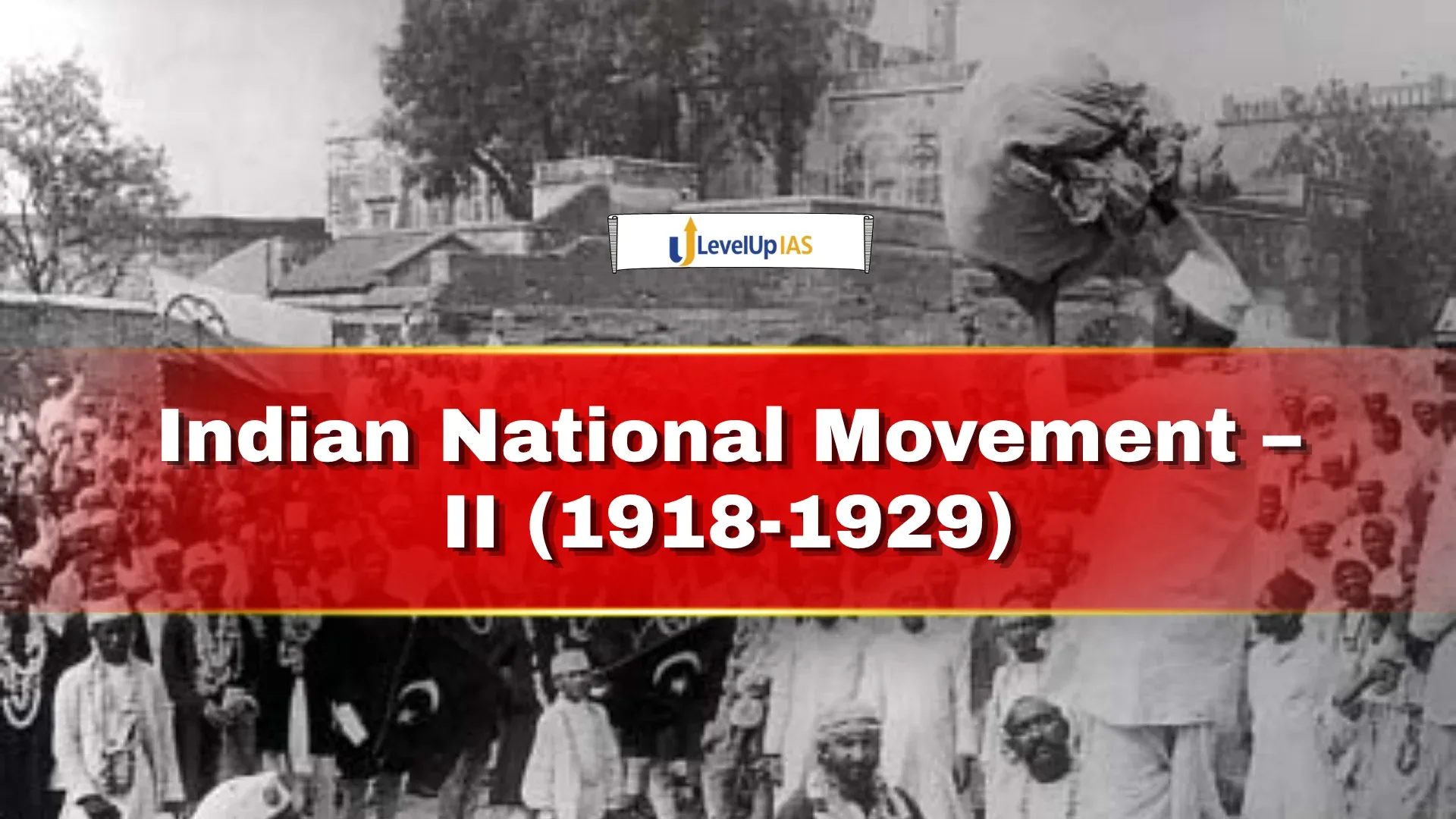
The period between 1918 and 1929 marked a decisive transformation in India's struggle for independence. The national movement moved from constitutional agitation towards mass politics, non-cooperation, civil resistance and the demand for complete independence. Mahatma Gandhi emerged as the central figure of Indian nationalism, while new political groups, revolutionary organisations, workers, peasants and students increasingly participated in the freedom struggle.
The period also witnessed important constitutional developments, including the Montagu-Chelmsford Reforms and Government of India Act, 1919, the Rowlatt Act and the Jallianwala Bagh massacre. The withdrawal of the Non-Cooperation Movement in 1922 was followed by debates within the Congress over council entry, resulting in the rise of the Swarajists. By the end of the decade, the failure of constitutional negotiations and the growing influence of younger nationalists prepared the ground for the demand for Purna Swaraj.
Montagu-Chelmsford Reforms and Government of India Act, 1919
The British government adopted a combination of constitutional concessions and political repression in response to growing nationalist pressure. The Montagu Declaration of August 1917 had promised the gradual development of self-governing institutions and the progressive realisation of responsible government in India. However, the declaration did not provide a definite timeline for achieving self-government, and nationalists remained dissatisfied.
The subsequent Montagu-Chelmsford Reforms were announced in 1918 and incorporated into the Government of India Act, 1919. The most significant feature of the Act was the introduction of dyarchy in the provinces. Provincial subjects were divided into two categories. Reserved subjects such as law and order, finance, land revenue and irrigation remained under the governor and his executive council, while transferred subjects such as education, public health, agriculture, local government and industries were placed under Indian ministers responsible to elected legislative councils.
The reforms were regarded by many nationalists as inadequate because substantial powers remained with the colonial executive. At the special Congress session held in Bombay in 1918, the reforms were criticised as disappointing and insufficient to establish meaningful self-government.
Mahatma Gandhi and the Early Satyagrahas in India
Mahatma Gandhi returned to India from South Africa in January 1915. His experiences in South Africa had shaped his distinctive method of Satyagraha, based on truth, non-violence and the willingness to accept suffering rather than inflict it on the opponent.
On returning to India, Gandhi initially followed Gopal Krishna Gokhale's advice to travel across the country and understand its social and political conditions. His early experiments in India were primarily connected with local grievances of peasants and workers. These movements allowed him to develop a method of mass mobilisation that connected nationalist politics with everyday economic problems.
Champaran Satyagraha, 1917
The Champaran Satyagraha was Gandhi's first major civil resistance movement in India. Raj Kumar Shukla persuaded him to investigate the problems faced by indigo cultivators in Champaran, Bihar.
The peasants were subjected to the Tinkathia system, under which they were compelled to cultivate indigo on a portion of their land. With the decline in demand for natural indigo following the development of synthetic dyes, European planters attempted to extract higher payments and other dues from cultivators.
Gandhi's investigation and civil resistance forced the government to establish an inquiry committee that included him. The movement eventually resulted in the abolition of the Tinkathia system and partial compensation to the peasants. Champaran demonstrated the effectiveness of Gandhi's method of combining investigation, mass mobilisation and non-violent resistance.
Ahmedabad Mill Strike, 1918
The Ahmedabad Mill Strike arose from a dispute between textile workers and mill owners over wages. Workers were demanding a substantial increase because of wartime inflation, while mill owners were unwilling to meet their demands.
Gandhi intervened in the dispute and undertook a fast, marking his first major use of fasting as a method of political and social pressure in India. The dispute was eventually settled in favour of the workers, who received a wage increase. The movement demonstrated Gandhi's ability to intervene in industrial as well as rural conflicts.
Kheda Satyagraha, 1918
The Kheda Satyagraha was organised in Gujarat after crop failure caused by drought and poor agricultural conditions. The peasants demanded suspension of land revenue because they were unable to pay the assessment under the prevailing conditions.
Gandhi, along with leaders such as Sardar Vallabhbhai Patel, encouraged peasants to refuse payment of revenue. Despite confiscation of property by the authorities, the movement continued. The government eventually agreed to suspend revenue collection under specified conditions and return confiscated property.
These early movements established Gandhi's reputation as a leader capable of connecting nationalist politics with local grievances and mobilising ordinary people through non-violent resistance.
Rowlatt Act and Jallianwala Bagh Massacre, 1919
The end of the First World War did not bring the political freedom expected by Indian nationalists. Instead, the British government introduced the Rowlatt Act in 1919, based on the recommendations of the Rowlatt Committee.
The Act gave the government extensive powers to suppress alleged revolutionary activities, including detention without normal trial procedures. It also restricted civil liberties and provided the colonial administration with extraordinary powers against political activists.
Gandhi described the legislation as a Black Act and launched a nationwide Satyagraha against it. The movement involved hartals, fasting, prayers and peaceful civil disobedience. The agitation acquired particular intensity in Punjab, where wartime repression and forced recruitment had already generated considerable resentment.
Jallianwala Bagh Massacre
The situation in Punjab deteriorated following the arrest of nationalist leaders Dr Satyapal and Saifuddin Kitchlew. On 13 April 1919, a large gathering assembled at Jallianwala Bagh in Amritsar on the occasion of Baisakhi.
Brigadier-General Reginald Dyer ordered troops to fire on the unarmed gathering. The massacre shocked Indian public opinion and became a major turning point in the national movement.
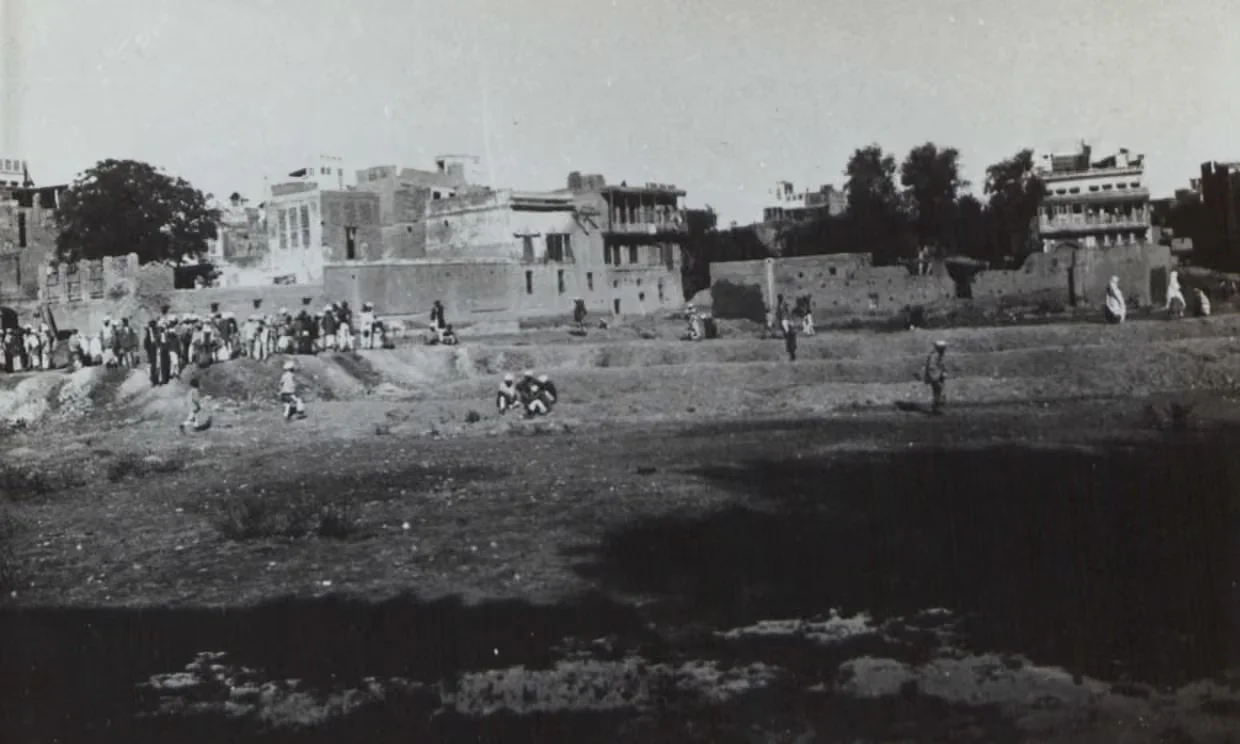
The incident fundamentally damaged the credibility of British rule among large sections of Indians. Rabindranath Tagore renounced his knighthood in protest, while Gandhi withdrew the Rowlatt Satyagraha after recognising the outbreak of violence in different areas. The government subsequently appointed the Hunter Committee to inquire into the disturbances, but its treatment of Dyer failed to satisfy Indian opinion.
Non-Cooperation Movement and Khilafat
The political atmosphere after 1919 created the conditions for the first major nationwide mass movement under Gandhi. Economic hardship after the First World War, rising prices, taxation, the Rowlatt Act, the Punjab atrocities and dissatisfaction with the constitutional reforms contributed to growing anti-colonial sentiment.
At the same time, the Khilafat issue created an opportunity for Hindu-Muslim political cooperation. Indian Muslim leaders, including the Ali brothers, Maulana Abul Kalam Azad, Hakim Ajmal Khan and Hasrat Mohani, opposed the treatment of the Ottoman Empire after the First World War and demanded protection of the position of the Ottoman Sultan as Khalifa.
Gandhi supported the Khilafat cause because he believed that cooperation with the movement could strengthen Hindu-Muslim unity and broaden the national struggle. He also saw non-cooperation as a means of bringing peasants, workers, students, women and other sections into active politics.
The Congress eventually adopted the Non-Cooperation programme in 1920. It included the boycott of government schools and colleges, law courts and legislative councils, the surrender of titles and honours, and the promotion of khadi and hand-spinning. The programme also emphasised Hindu-Muslim unity, removal of untouchability and adherence to non-violence.
The Nagpur Congress Session of December 1920 gave organisational shape to the new strategy. Congress reorganised its provincial committees largely on linguistic lines, established the Congress Working Committee and reduced the barriers to wider popular participation. The Congress consequently developed from an organisation dominated by political elites into a much broader mass organisation.
Spread and Withdrawal of the NCM
The movement spread rapidly across different regions. Students left government institutions and joined national educational institutions such as Jamia Millia, Kashi Vidyapeeth and Gujarat Vidyapeeth. Several prominent lawyers, including Motilal Nehru, C.R. Das and Vallabhbhai Patel, gave up legal practice.
The boycott of foreign cloth became an important symbol of the movement, while the Tilak Swaraj Fund helped finance nationalist activities. In several regions, the national movement also intersected with local peasant and tribal struggles. The Awadh Kisan Movement, Eka Movement, Mappila Revolt and local struggles in Assam and Midnapore reflected the growing penetration of anti-colonial politics into rural society.
However, the movement also faced challenges. In February 1922, protesters at Chauri Chaura in Uttar Pradesh attacked and set fire to a police station, resulting in the deaths of policemen. Gandhi regarded the incident as a violation of the fundamental principle of non-violence and decided to withdraw the Non-Cooperation Movement.
The decision generated disappointment among several nationalists, but Gandhi considered adherence to non-violence essential to the character of the movement. He was arrested in March 1922, after which the nationalist movement entered a period of internal debate over its future strategy.
Swarajists and No-Changers
The withdrawal of Non-Cooperation created a strategic division within the Congress. The group led by C.R. Das, Motilal Nehru and Ajmal Khan argued that nationalists should enter the legislative councils created under the 1919 Act and use them to obstruct colonial governance from within. They came to be known as the Swarajists.
Their objective was not to accept the constitutional system but to use the councils as arenas of political struggle. Their strategy was often described as “end or mend,” enter the councils, expose their limitations and obstruct the functioning of colonial government wherever possible.
The opposing group, commonly known as the No-Changers, included leaders such as C. Rajagopalachari, Vallabhbhai Patel and Rajendra Prasad. They favoured continuing the boycott of councils and concentrating on constructive work, including khadi, national education, Hindu-Muslim unity and the removal of untouchability.
At the Gaya Congress Session of 1922, the Swarajist proposal for council entry was defeated. C.R. Das and Motilal Nehru subsequently formed the Swarajya Party, formally known as the Congress-Khilafat Swarajya Party.
The Swarajists performed strongly in the 1923 elections and became an important force in several legislatures. Motilal Nehru emerged as a major opposition leader in the Central Legislative Assembly, while Vithalbhai Patel became its President in 1925. Swarajists used legislative obstruction, adjournment motions and voting alliances to challenge government measures. They successfully defeated measures such as the Public Safety Bill in 1928.
However, internal divisions, communal tensions, the death of C.R. Das in 1925 and disagreements over cooperation with the government weakened the party. The Swarajists gradually lost their influence, although their legislative activities demonstrated that colonial constitutional institutions could also be used as platforms for nationalist opposition.
Meanwhile, the No-Changers' constructive programme strengthened Congress's organisational base. Ashrams, national educational institutions, khadi programmes and social reform activities helped maintain political mobilisation during the period when mass civil disobedience was not underway.
Towards the Demand for Complete Independence
By the second half of the 1920s, Indian nationalism was increasingly influenced by a younger generation that regarded the existing constitutional framework as inadequate. The failure of British reforms to provide genuine responsible government and the continuing colonial control over key areas of administration strengthened the demand for a more decisive political objective.
The Simon Commission, appointed in 1927 to review constitutional reforms, contained no Indian member. Its arrival in India in 1928 was met with widespread protests and the slogan “Simon Go Back.” Nationalist opposition to the Commission helped bring different political groups together around the demand for constitutional change.
.webp)
In response to the constitutional challenge, an All Parties Conference appointed the Nehru Committee, chaired by Motilal Nehru, to formulate proposals for India's constitutional future. The resulting Nehru Report of 1928 recommended dominion status and a constitutional framework based on parliamentary government and fundamental rights.
However, younger nationalists such as Jawaharlal Nehru and Subhas Chandra Bose increasingly argued that dominion status was inadequate and that India should demand complete independence. The political debate consequently moved from the demand for self-government within the British Empire towards Purna Swaraj.
The Lahore Session of the Indian National Congress in December 1929, presided over by Jawaharlal Nehru, marked the culmination of this transition. Congress adopted the goal of Purna Swaraj, or complete independence. The decision transformed the objective of the national movement and prepared the ground for the Civil Disobedience Movement that began in 1930.
Conclusion
The years 1918-1929 represent one of the most important transitional phases of the Indian national movement. The constitutional reforms of 1919 failed to satisfy nationalist aspirations, while the Rowlatt Act and Jallianwala Bagh massacre deepened Indian opposition to British rule.
Under Gandhi's leadership, the movement acquired a mass character through Satyagraha and Non-Cooperation. Although the withdrawal of Non-Cooperation created a temporary political setback, the rise of the Swarajists, continued constructive work and the growing influence of younger nationalists kept the national movement alive.
FAQs
Q1. What was the Indian National Movement during 1918-1929?
This period marked the expansion of mass nationalism under Mahatma Gandhi, beginning with early Gandhian movements and culminating in the Congress declaration of Purna Swaraj in 1929.
Q2. What were the major movements led by Gandhi during this period?
The major movements included the Champaran Satyagraha (1917), Ahmedabad Mill Strike (1918), Kheda Satyagraha (1918) and the Non-Cooperation Movement (1920-1922).
Q3. What was the Non-Cooperation Movement?
Launched in 1920, it sought to achieve Swaraj through non-violent non-cooperation with British institutions, including the boycott of government schools, colleges, courts and foreign goods.
Q4. Why was the Non-Cooperation Movement withdrawn?
Gandhi withdrew the movement in February 1922 after the Chauri Chaura incident, where protesters attacked a police station and killed policemen, violating the movement's commitment to non-violence.
Q5. What was the Swaraj Party?
Founded in 1923 by C.R. Das and Motilal Nehru, the Swaraj Party aimed to enter legislative councils and obstruct colonial governance from within while continuing the broader struggle for self-government.
Related reads.

Coral Reefs
22 Oct 2026 7 min

Ocean Pollution
21 Oct 2026 7 min

Thermohaline Circulation
21 Oct 2026 7 min

Ocean Waves
19 Oct 2026 7 min
Decolonisation in Asia and Africa
18 Oct 2026 8 min

Temperature Distribution in Oceans
10 Oct 2026 9 min
Put it into practice
Reading is step one.
Turn what you've just read into exam-ready answers with mentor-led practice and our structured test series.