
GS-I (History, Geography, Society)
Indian Paintings: Prehistoric to Modern Times
Introduction
The history of Indian painting can broadly be studied through prehistoric paintings, mural traditions, miniature schools, folk and tribal paintings, and modern Indian art. Each phase introduced new techniques, themes and influences while retaining elements of earlier traditions.
Paintings are also valuable sources for understanding India's cultural history, as they provide visual evidence of costumes, architecture, religious practices, occupations, court life, natural surroundings and everyday activities.
Prehistoric Rock Paintings
The earliest surviving evidence of Indian painting is found in prehistoric rock shelters. These paintings provide important insights into the activities and environment of early human communities.
The Bhimbetka Rock Shelters in Madhya Pradesh constitute the most significant centre of prehistoric rock art in India. The site contains paintings belonging to different periods, extending from the Mesolithic period to historical times. It was declared a UNESCO World Heritage Site in 2003.
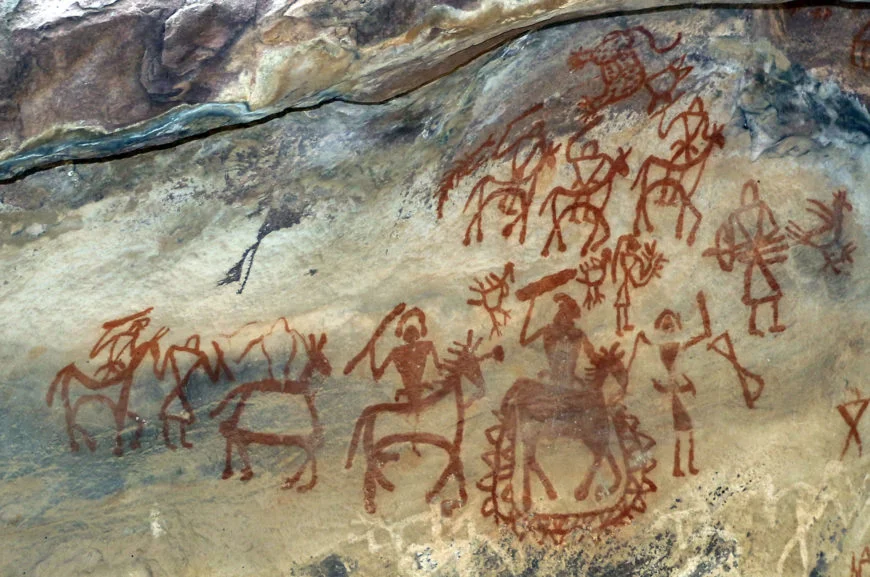
The paintings depict animals, hunting, dancing, warfare, processions and community activities. Red and white are particularly common, while other mineral pigments were also used. A distinctive feature is the superimposition of paintings, with later paintings frequently appearing over earlier ones.
The importance of prehistoric paintings extends beyond their artistic value. Representations of animals, hunting weapons, dances and human activities provide evidence regarding the subsistence patterns, social life and environmental setting of prehistoric communities.
Other important prehistoric rock-art sites include Lakhudiyar in Uttarakhand, Kupgallu in Karnataka and sites in the Vindhyan region.
Mural Painting Tradition
Mural painting developed extensively on the walls and ceilings of caves, monasteries and temples. Some of the finest examples belong to the ancient and early medieval periods.
Ajanta Paintings
The Ajanta Caves in Maharashtra represent the high point of the ancient Indian mural tradition. The earliest phase dates to the 2nd-1st centuries BCE, while the major phase of artistic activity occurred during the 5th-6th centuries CE, particularly under the Vakatakas.
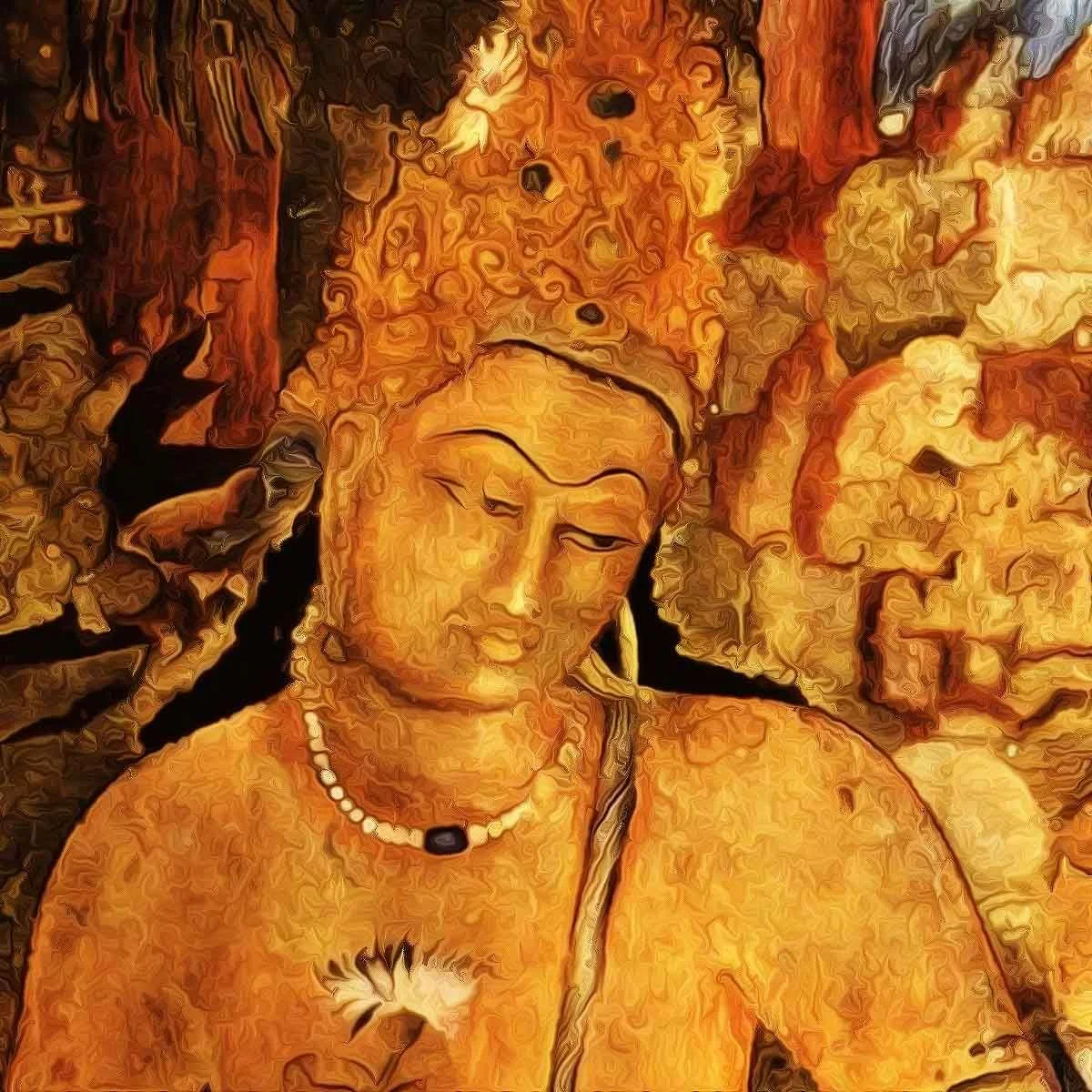
The paintings are predominantly Buddhist and include Jataka stories, Buddha, Bodhisattvas, courtly scenes and processions. The famous image of Bodhisattva Padmapani is among the best-known examples.
Ajanta is notable for its expressive human figures, graceful lines, sophisticated modelling and detailed treatment of costumes and ornaments. The paintings also provide valuable information about the material and social culture of their period.
The site demonstrates the transition from earlier Buddhist traditions towards the increasing representation of Buddha and Bodhisattvas in human form associated with Mahayana Buddhism.
Bagh Caves
The Bagh Caves of Madhya Pradesh contain important Buddhist murals that show similarities with the Ajanta tradition. Their paintings are noted for expressive human figures, strong outlines and a sophisticated treatment of form.
Badami
The Badami Caves in Karnataka, associated with the Chalukyan period, contain some of the earliest surviving examples of South Indian mural painting. They demonstrate the spread of the classical mural tradition into the Deccan.
Sittanavasal
The Sittanavasal caves in Tamil Nadu are particularly important for Jain painting. Their murals include lotus ponds, aquatic life, birds and human figures and reflect the artistic traditions associated with Jain religious establishments.
South Indian Temple Painting
Mural painting continued to develop in South India through the temple traditions of successive dynasties.
The Chola period produced important murals, particularly at the Brihadisvara Temple at Thanjavur, where religious narratives and Shaivite themes are prominent.
The Vijayanagara tradition is represented by murals at monuments such as the Virupaksha Temple at Hampi. These paintings depict Hindu religious and mythological subjects and continue several elements of earlier South Indian mural traditions.
The Nayaka rulers subsequently expanded the temple painting tradition in Tamil Nadu, producing large narrative compositions with elaborate costumes, ornaments and mythological themes.
Kerala also developed a distinctive mural tradition in its temples and palaces, characterised by strong colours, stylised figures and themes drawn primarily from Hindu mythology.
Miniature Painting Tradition
Miniature painting developed primarily through manuscript illustration and court patronage. Unlike murals, miniature paintings were executed on portable surfaces such as palm leaves and paper.
The major traditions include the Pala, Jain, Mughal, Deccani, Rajasthani and Pahari schools.
.webp)
Pala School
The Pala rulers of eastern India patronised Buddhist learning and manuscript production between approximately the 8th and 12th centuries. Buddhist manuscripts associated with centres such as Nalanda and Vikramashila were illustrated with images of Buddhist deities and religious narratives.
The paintings were frequently executed on palm leaves, resulting in a distinctive horizontal format. The Pala tradition also influenced Buddhist artistic traditions beyond eastern India.
Jain Manuscript Painting
Western India developed a significant tradition of illustrated Jain manuscripts, particularly from the medieval period.
Texts such as the Kalpasutra were illustrated with representations of Tirthankaras and religious narratives. The paintings are known for strong colours, stylised figures and distinctive facial features. The transition from palm-leaf manuscripts to paper expanded the possibilities of miniature illustration.
Mughal School of Painting
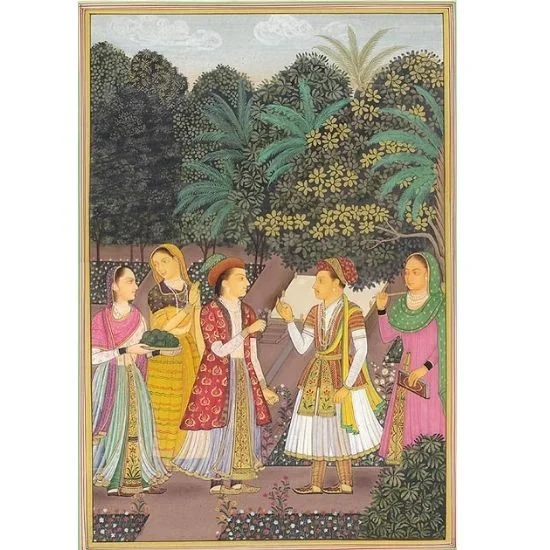
The Mughal School emerged in the 16th century through the interaction of Persian artistic traditions with Indian practices.
Although Humayun laid the foundations by bringing Persian artists to his court, the school developed extensively under Akbar.
Akbar
Akbar established a large imperial atelier and patronised the illustration of major manuscripts, including the Hamzanama and Akbarnama.
The paintings of this period are characterised by detailed narrative compositions depicting battles, court ceremonies, hunting scenes and historical events. Indian artists increasingly participated in the imperial atelier, resulting in a synthesis of Persian and indigenous techniques.
Important artists included Abd al-Samad, Daswanth and Basawan.
Jahangir
Mughal painting reached a high degree of refinement under Jahangir, whose personal interest encouraged portraiture and natural-history studies.
Artists increasingly concentrated on accurate representations of birds, animals, plants and individual personalities. Ustad Mansur, known particularly for his natural-history studies, was one of the prominent artists of this period.
Shah Jahan and Aurangzeb
Under Shah Jahan, courtly elegance and formal portraiture became more prominent. During Aurangzeb's reign, imperial patronage declined, encouraging artists to seek employment in regional courts.
The dispersal of Mughal artists subsequently contributed to the development of regional schools, particularly in Rajasthan and the Himalayan hill states.
Deccani School of Painting
The Deccan developed an independent miniature tradition under the Sultanates of Ahmadnagar, Bijapur and Golconda, followed by Hyderabad.
Deccani paintings are distinguished by rich colours, elaborate costumes, decorative backgrounds and elongated figures. Persian influence is evident, but the school also incorporated local Deccan traditions.
Unlike the Mughal school, which became strongly associated with imperial portraiture and historical representation, Deccani painting developed a distinctive decorative and lyrical character.
Rajasthani School of Painting
Rajasthani painting developed in several Rajput courts, including Mewar, Marwar, Bundi, Kota, Jaipur, Bikaner and Kishangarh.
The school drew extensively upon Hindu mythology, Bhakti traditions and Indian literary works. Subjects from the Ramayana, Mahabharata, Bhagavata Purana and Krishna-Radha traditions were particularly popular. Ragamala paintings also formed an important part of the tradition.
The Mewar school retained strong indigenous characteristics, while Bikaner showed greater Mughal influence.
The Kishangarh school is particularly famous for its idealised representations of Radha and Krishna. The celebrated Bani Thani is associated with this school.
Pahari School of Painting
The Pahari school developed in the Himalayan foothills, particularly from the 17th century onwards, under the patronage of small Rajput states.
Important centres included Basohli, Guler, Kangra, Chamba and Kullu.
The early Basohli school is known for bold colours and strongly stylised figures. The Guler school introduced greater naturalism and softer treatment of figures.
The Kangra school reached particular refinement in the 18th century. It is known for lyrical landscapes, delicate lines and themes centred on Radha-Krishna and the Bhakti tradition. Works based on the Gita Govinda and Bhagavata Purana were especially popular.
Folk and Tribal Painting Traditions
Parallel to courtly and manuscript traditions, India developed numerous forms of folk and tribal painting rooted in community practices.
These traditions were generally transmitted through generations and were associated with rituals, festivals, religious practices and everyday life.
Madhubani Painting
Madhubani or Mithila painting developed in the Mithila region of Bihar. Traditionally associated with women artists, it was used to decorate walls and floors during marriages, festivals and other important occasions.
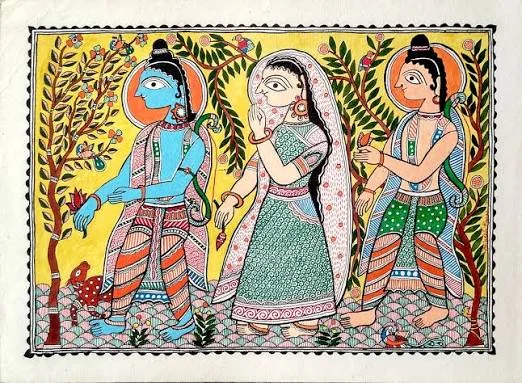
The paintings feature strong outlines, geometric patterns and densely filled surfaces. Common subjects include Hindu deities, marriage rituals, fertility symbols, plants, animals and scenes from the Ramayana and Krishna traditions.
Pattachitra
Pattachitra is particularly associated with Odisha and the Jagannath tradition of Puri. Traditionally painted on prepared cloth, it depicts Jagannath, Krishna, Vishnu and episodes from Hindu mythology.
Its characteristic features include strong outlines, decorative compositions and detailed treatment of figures.
Kalamkari
Kalamkari, associated mainly with Andhra Pradesh and Telangana, is a painted and printed textile tradition. The term derives from kalam, meaning pen.
The Srikalahasti tradition is particularly known for hand-painted narrative compositions, while Machilipatnam developed a strong block-printing tradition. Mythological and floral themes are common.
Phad
Phad painting of Rajasthan is a narrative scroll tradition associated with the storytelling of folk heroes and deities. The stories of Pabuji and Devnarayan are particularly important.
Traditionally, the scroll was used by Bhopas, travelling priest-singers, as a visual aid during performances.
Kalighat
Kalighat painting developed around the Kalighat temple in 19th-century Kolkata. While initially dominated by religious subjects, it later began depicting contemporary urban society, social customs and popular characters.
Its simple outlines and expressive figures made it distinct from the more elaborate miniature traditions.
Tribal Painting Traditions
Indian tribal communities have preserved distinctive painting traditions that express their relationship with nature, ritual and community life.
Warli painting, associated with the Warli community of Maharashtra, uses simple geometric forms to depict agriculture, hunting, marriage and community celebrations. Human figures are commonly constructed from circles, triangles and lines.
Gond painting, associated particularly with central India, uses intricate patterns of dots, lines and repetitive motifs to depict animals, trees, birds and mythical beings. Nature occupies a central place in the visual vocabulary of Gond art.
Pithora painting, associated with the Rathwa and related communities of Gujarat and Madhya Pradesh, is a ritual wall-painting tradition in which horses are prominent motifs.
Saura painting of Odisha is another ritual tradition characterised by stylised human and animal figures arranged in symbolic compositions.
These traditions are important examples of living cultural heritage, where painting continues to perform social and ritual functions rather than existing only as a museum object.
Colonial Influence and Company School
The colonial period introduced European techniques, materials and artistic markets into India.
The Company School of Painting emerged largely under the patronage of British officials and European travellers. Indian artists produced paintings depicting Indian monuments, landscapes, occupations, communities, flora and fauna.
The style combined traditional Indian techniques with European conventions such as perspective, shading and realistic representation. Major centres included Calcutta, Madras, Delhi, Lucknow and Patna.
The Company School therefore represents an important transitional phase between traditional Indian painting and modern Western-influenced art.
Modern Indian Painting
The emergence of modern Indian painting involved two broad developments: the adoption of European academic techniques and the revival or reinterpretation of Indian artistic traditions.
Raja Ravi Varma
Raja Ravi Varma combined European academic realism and oil painting with subjects from Indian mythology and literature.
His representations of characters from the Ramayana, Mahabharata and Puranic traditions brought mythological subjects into a realistic visual idiom.
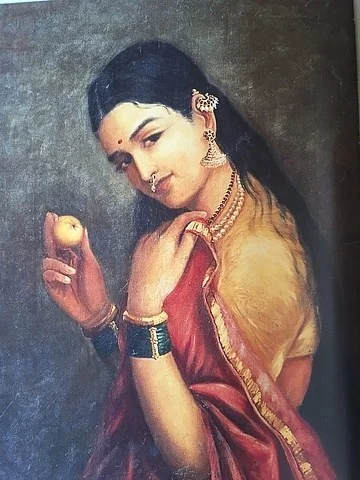
His use of oleographic printing allowed reproductions of his works to circulate widely, giving his images an influence that extended beyond elite art circles.
Bengal School
The Bengal School, associated particularly with Abanindranath Tagore, emerged as a response to the dominance of European academic art.
The artists sought inspiration from Ajanta, Mughal and Rajput painting traditions, as well as East Asian artistic techniques. The movement favoured softer colours, wash techniques and themes derived from Indian history, mythology and literature.
The Bengal School was closely associated with the broader cultural nationalism of the early 20th century and represented an attempt to establish an artistic language rooted in Indian traditions.
Amrita Sher-Gil
Amrita Sher-Gil brought together European artistic training and Indian subject matter. Her paintings increasingly focused on ordinary people, rural communities and women.
Her work represents an important stage in the emergence of modern Indian art because it combined international modernist influences with an engagement with Indian social realities.
Progressive Artists' Group
The Progressive Artists' Group, established in Bombay in 1947, became an important force in post-Independence Indian modernism.
Its prominent members included F.N. Souza, M.F. Husain, S.H. Raza, K.H. Ara, H.A. Gade and S.K. Bakre.
The group rejected rigid adherence to both colonial academic conventions and revivalist approaches. Its artists experimented with modernist tendencies such as Cubism, Expressionism and abstraction, while continuing to draw upon Indian themes and experiences.
The group marked the growing desire among Indian artists to develop an independent modern artistic language in the context of a newly independent nation.
Conclusion
The history of Indian painting is a story of continuous artistic experimentation across different regions and historical periods. From the prehistoric shelters of Bhimbetka and the Buddhist murals of Ajanta to Mughal miniatures, Rajput and Pahari schools, folk and tribal traditions, and modern movements such as the Bengal School and Progressive Artists' Group, Indian painting has repeatedly adapted to changing cultural circumstances.
Its significance lies in the coexistence of classical, courtly, religious, folk, tribal and modern traditions. Rather than following a single trajectory, Indian painting developed through multiple regional and cultural streams that interacted with one another over time.
The study of these traditions therefore provides not only an understanding of India's artistic heritage but also a broader insight into the social, religious, political and cultural evolution of Indian society.
FAQs
Q1. What are the major stages in the evolution of Indian paintings?
Indian painting traditions can broadly be studied through prehistoric rock paintings, ancient murals, medieval miniature traditions, colonial-era art and modern Indian painting.
Q2. What are prehistoric paintings in India?
Prehistoric paintings are primarily rock art created on cave and rock surfaces, depicting animals, hunting scenes, human figures, rituals and everyday activities. Important examples are found at Bhimbetka in Madhya Pradesh.
Q3. What is the significance of Ajanta paintings?
The Ajanta paintings in Maharashtra are among the finest surviving examples of ancient Indian mural art. Dating largely from the 2nd century BCE to about the 5th–6th century CE, they primarily depict Buddhist themes, Jataka stories and scenes from the life of the Buddha.
Q4. What are the main features of Mughal paintings?
Mughal painting developed under imperial patronage and is known for fine miniature technique, detailed portraiture, court scenes, historical narratives, naturalistic representation and rich manuscript illustration.
Q5. What is Rajput painting?
Rajput painting refers to diverse painting traditions that developed in the Rajput courts of Rajasthan and neighbouring regions. Common themes include Hindu mythology, epics, court life, hunting and romantic or devotional themes.
Related reads.
Independence and Partition of India
14 Sep 2026 8 min

Revolutionary Nationalism in India
12 Sep 2026 10 min
Indian National Movement – II (1918-1929)
10 Sep 2026 10 min
Regional States of North and South India
09 Sep 2026 9 min

Wind System, UPSC Geography
08 Sep 2026 9 min
Indian National Movement (Extremists) - I (1905-1918)
07 Sep 2026 10 min
Put it into practice
Reading is step one.
Turn what you've just read into exam-ready answers with mentor-led practice and our structured test series.