
GS-I (History, Geography, Society)
Monsoon, Climatology
Content
- Introduction
- What is Monsoon?
- Characteristics of the Indian Monsoon
- Types of Monsoon in India
- Mechanism of the Indian Monsoon
- Distribution of Monsoon Rainfall
- Importance of the Monsoon
- Monsoon Forecasting and Management
- Conclusion
Introduction
The monsoon is one of the most significant climatic phenomena influencing the Indian subcontinent. More than just a seasonal rainfall event, it is a large-scale atmospheric circulation system that governs India's climate, agriculture, economy, water resources and ecological balance. Nearly three-fourths of India's annual rainfall is received during the monsoon season, making it the lifeline of millions of people, particularly those dependent on agriculture. The timely arrival, proper distribution and adequate intensity of monsoon rainfall determine crop production, food security, groundwater recharge, hydroelectric power generation and overall economic growth.
India's geographical location, the presence of the Himalayas in the north, the Indian Ocean in the south, and the differential heating of land and sea make the Indian monsoon one of the most complex and unique monsoon systems in the world. At the same time, the monsoon is highly variable, often resulting in floods, droughts, landslides and other weather-related disasters. Therefore, understanding the Indian monsoon is essential not only from a geographical perspective but also for disaster management, environmental conservation and sustainable development.
What is Monsoon?
The word Monsoon is derived from the Arabic word "Mausim", meaning season. In meteorology, a monsoon refers to the seasonal reversal of wind direction accompanied by corresponding changes in rainfall due to differential heating and cooling between land and sea.
Unlike ordinary rainfall systems, the monsoon is a large-scale seasonal wind circulation. During summer, winds blow from the oceans towards the land, carrying abundant moisture and causing widespread rainfall. During winter, the wind direction reverses, blowing from the land towards the sea, bringing comparatively dry conditions over most parts of India.
Although monsoon systems occur in different parts of the world such as West Africa, Southeast Asia and Northern Australia, the Indian Monsoon is considered the most extensive and economically significant because of its direct impact on the lives of more than a billion people.
Characteristics of the Indian Monsoon
The Indian monsoon possesses several distinctive characteristics that differentiate it from other climatic systems.
The most important feature is the seasonal reversal of winds, where southwesterly winds dominate during summer while northeasterly winds prevail during winter. Another defining characteristic is the concentration of rainfall within a relatively short period, as nearly 75% of India's annual precipitation occurs between June and September.
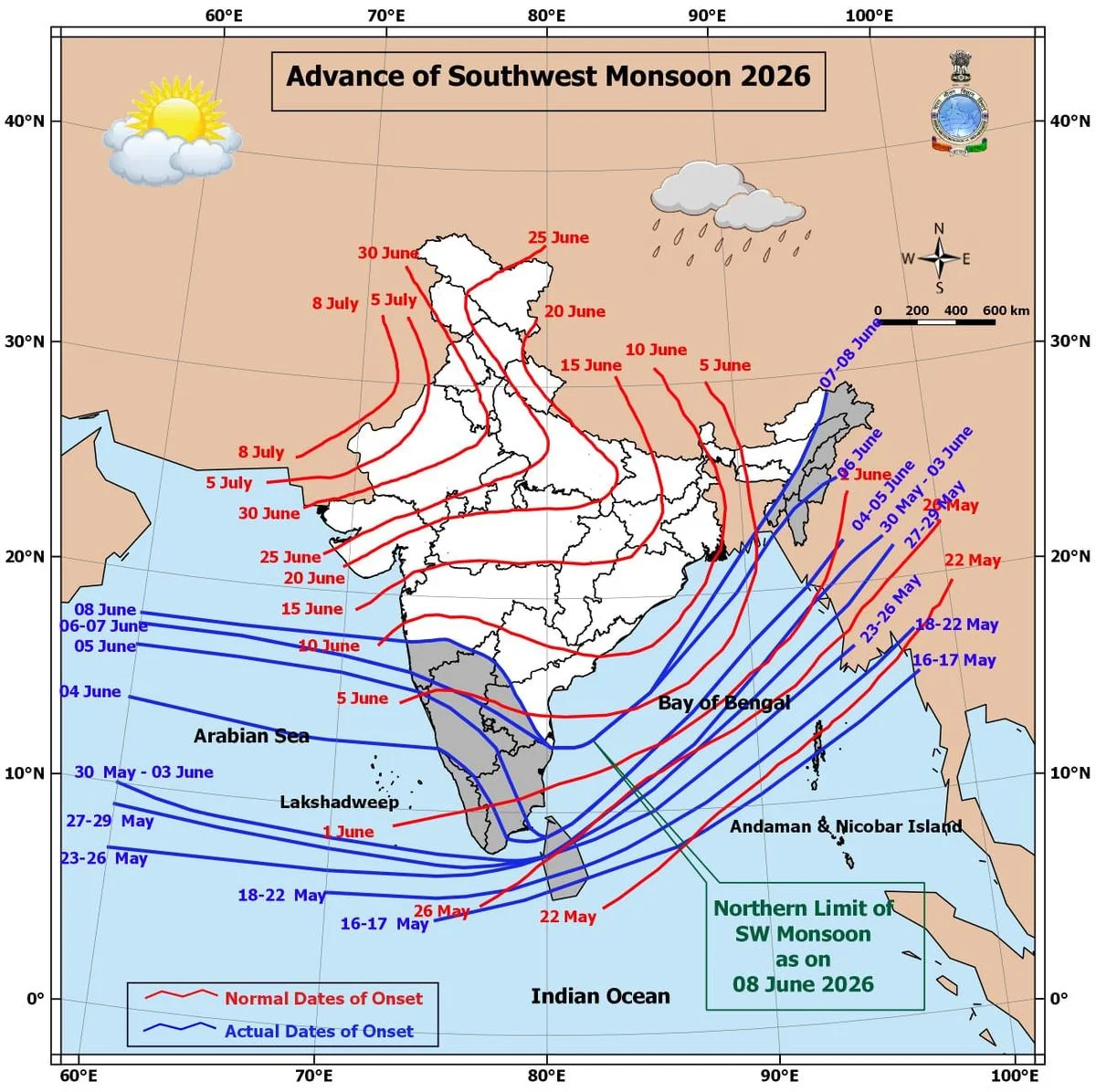
The monsoon is also marked by significant spatial and temporal variability. While places such as Mawsynram and Cherrapunji receive some of the highest rainfall in the world, western Rajasthan remains one of the driest regions of the country. Similarly, the onset of the monsoon begins over Kerala in early June but reaches northwestern India only by early July.
Another important feature is the "Burst of the Monsoon," which refers to the sudden onset of heavy rainfall after the hot summer season. The monsoon is also characterised by alternating active and break phases, during which periods of heavy rainfall are followed by temporary dry spells.
Types of Monsoon in India
India experiences two distinct monsoon systems that together determine the annual rainfall pattern of the country.
Southwest Monsoon
The Southwest Monsoon is the principal rainy season in India and extends from June to September. During summer, intense heating over northwestern India and the Tibetan Plateau creates a vast low-pressure area over the subcontinent. At the same time, comparatively higher pressure develops over the southern Indian Ocean. As air moves from high pressure to low pressure, moisture-laden winds from the Indian Ocean are drawn towards the Indian mainland.
The southwest monsoon contributes nearly 75-80% of India's annual rainfall and forms the basis of the country's agricultural calendar. The monsoon generally arrives over Kerala around 1st June, advances rapidly across the country, and covers almost the entire Indian mainland by the middle of July.
The southwest monsoon divides into two major branches after reaching the Indian peninsula.
The Arabian Sea Branch strikes the Western Ghats first, producing heavy orographic rainfall over Kerala, Karnataka, Goa and Maharashtra. After crossing the Western Ghats, the winds lose much of their moisture, resulting in comparatively lower rainfall over the Deccan Plateau, which lies in the rain-shadow region.
The Bay of Bengal Branch moves towards northeastern India and is obstructed by the hills of Meghalaya and the Eastern Himalayas. Consequently, places like Mawsynram and Cherrapunji receive exceptionally heavy rainfall. Thereafter, the branch moves westward along the Indo-Gangetic Plain, providing rainfall to eastern, central and northern India.
Northeast Monsoon
The Northeast Monsoon, also known as the Retreating Monsoon, occurs from October to December.
As the Sun shifts southward after September, the Indian landmass cools rapidly, creating a high-pressure area over northern India. Winds begin to flow from land towards the sea and are generally dry. However, after crossing the Bay of Bengal, these winds absorb moisture and bring rainfall to the southeastern coast of India.
Unlike the southwest monsoon, the northeast monsoon primarily benefits Tamil Nadu, coastal Andhra Pradesh, Puducherry and parts of Kerala, which receive comparatively little rainfall during the southwest monsoon. Nearly half of Tamil Nadu's annual rainfall is received during this season.
Mechanism of the Indian Monsoon
The Indian monsoon is the result of the combined interaction of atmospheric circulation, pressure systems, landforms and oceanic conditions.
The primary driving force is the differential heating of land and sea. During summer, land heats much faster than water, creating a low-pressure area over northwestern India, while the surrounding Indian Ocean remains relatively cooler with higher pressure. Moisture-laden winds therefore, move towards the Indian landmass.
Another important factor is the Inter-Tropical Convergence Zone (ITCZ). During summer, the ITCZ shifts northward over the Indo-Gangetic Plain. This northward movement strengthens the low-pressure system and attracts moisture-bearing winds from the Southern Hemisphere.
The Tibetan Plateau also plays a crucial role. During summer, it becomes intensely heated and acts as a massive elevated heat source. This strengthens the thermal low-pressure area over northern India and enhances monsoon circulation.
The Jet Streams significantly influence the onset and withdrawal of the monsoon. During winter, the Subtropical Westerly Jet flows south of the Himalayas and prevents the development of monsoon conditions. With the onset of summer, this jet shifts northward, allowing the Tropical Easterly Jet to develop, thereby facilitating the arrival of the southwest monsoon.
The Somali Jet, a strong low-level wind blowing across the Arabian Sea from the East African coast, transports enormous quantities of moisture towards western India and strengthens the Arabian Sea branch of the monsoon.
Large-scale ocean-atmosphere interactions further influence the strength and distribution of rainfall. El Niño conditions generally weaken the Indian monsoon by reducing rainfall, while La Niña usually enhances rainfall. Similarly, a Positive Indian Ocean Dipole (IOD) often supports a stronger monsoon even during El Niño years. In recent years, the Madden-Julian Oscillation (MJO) has also emerged as an important factor influencing active and break phases of the monsoon.
Distribution of Monsoon Rainfall in India
The distribution of rainfall across India is highly uneven because of variations in relief, distance from the sea and wind direction.
The Western Ghats receive very heavy rainfall because moisture-laden Arabian Sea winds are forced to rise along the mountain slopes. The windward side records rainfall exceeding 250 cm annually, while the leeward side experiences much lower rainfall due to the rain-shadow effect.
The Northeastern Hills, especially Meghalaya, receive the highest rainfall in the world because the Bay of Bengal branch is funnelled into a narrow valley before striking the Khasi Hills.
The Indo-Gangetic Plain receives moderate rainfall that gradually decreases from east to west due to the progressive depletion of moisture as the monsoon advances inland.
The Deccan Plateau receives comparatively lower rainfall because of the rain-shadow effect of the Western Ghats.
The Thar Desert receives scanty rainfall owing to its distance from the sea and the parallel orientation of the Aravalli Range, which fails to obstruct the advancing monsoon winds.
Importance of the Monsoon
The significance of the monsoon extends far beyond rainfall. It forms the foundation of India's economy and environmental sustainability.
Agriculture is the sector most dependent on the monsoon. Crops such as rice, maize, cotton, sugarcane, soybean and pulses require timely rainfall during the kharif season. A normal monsoon ensures better agricultural production, while deficient rainfall often results in drought, crop failure and farmer distress.
Monsoon rainfall replenishes rivers, reservoirs, lakes and groundwater, thereby ensuring drinking water supply, irrigation and industrial use throughout the year. Hydroelectric power generation also depends significantly on adequate reservoir storage created by monsoon rainfall.
Ecologically, the monsoon sustains forests, wetlands, grasslands and biodiversity. It maintains river ecosystems, supports wildlife habitats and promotes soil formation and nutrient cycling.
Economically, a favourable monsoon boosts rural incomes, increases agricultural output, controls food inflation and contributes positively to national GDP growth. Conversely, a weak or erratic monsoon often affects food production, employment and overall economic stability.
Challenges Associated with the Indian Monsoon
Despite its immense benefits, the Indian monsoon presents several challenges.
Its high variability often results in floods in some regions and droughts in others during the same season. Increasing urbanisation has aggravated urban flooding due to inadequate drainage systems and unplanned development.
Climate change has altered rainfall patterns, increasing the frequency of extreme rainfall events, cloudbursts and prolonged dry spells. Scientific studies indicate a growing tendency for short-duration, high-intensity rainfall rather than evenly distributed precipitation.
The melting of Himalayan glaciers, warming of the Indian Ocean and rising sea surface temperatures are also influencing monsoon dynamics, making seasonal forecasting increasingly complex.
Another challenge is the heavy dependence of Indian agriculture on rainfall despite continuous expansion of irrigation facilities. Rain-fed agriculture remains highly vulnerable to monsoon failures.
Monsoon Forecasting and Management
India has significantly improved its monsoon forecasting capabilities through advancements in meteorology and remote sensing.
The India Meteorological Department (IMD) uses satellites, Doppler Weather Radars, ocean buoys, automatic weather stations and numerical weather prediction models to monitor and forecast monsoon behaviour.
Institutions such as the Indian Institute of Tropical Meteorology (IITM), Pune, continuously study climate variability and improve seasonal forecasting models.
To minimise the impacts of monsoon-related disasters, India has strengthened flood forecasting, reservoir management, early warning systems, watershed development, rainwater harvesting and climate-resilient agriculture. Government initiatives such as Pradhan Mantri Krishi Sinchai Yojana (PMKSY), Atal Bhujal Yojana, and integrated flood management programmes aim to improve water-use efficiency and reduce vulnerability.
Conclusion
The Indian monsoon is much more than a seasonal weather phenomenon; it is the foundation of India's physical environment, agricultural prosperity and economic stability. It represents a complex interaction between land, oceans and atmospheric circulation that influences every aspect of life across the subcontinent. Although advances in meteorology have significantly improved forecasting and disaster preparedness, increasing climate variability has made the monsoon more unpredictable than ever before. Strengthening scientific forecasting, promoting sustainable water management, improving climate-resilient agriculture and conserving ecosystems will remain essential to ensure that the monsoon continues to support India's long-term food, water and environmental security.
FAQs
Q1. What is a monsoon?
The Monsoon is a seasonal reversal of wind direction between summer and winter, primarily caused by differential heating of land and sea, resulting in distinct wet and dry seasons.
Q2. What causes the Indian monsoon?
The Indian monsoon is caused by a combination of factors, including:
- Differential heating of land and sea
- Seasonal shift of the Intertropical Convergence Zone (ITCZ)
- Formation of low pressure over northwestern India
- Heating of the Tibetan Plateau
- Jet streams
- Surrounding seas and ocean currents
Q3. What are the different types of monsoons in India?
India experiences two main monsoon seasons:
- Southwest Monsoon (June-September): Brings nearly 75% of the annual rainfall.
- Northeast or Retreating Monsoon (October-December): Mainly affects Tamil Nadu and the southeastern coast.
Q4. What are the branches of the Southwest Monsoon?
The Southwest Monsoon divides into two branches:
- Arabian Sea Branch
- Bay of Bengal Branch
Q5. What is the onset and withdrawal of the monsoon?
- Onset refers to the beginning of monsoon rains over India, usually first reaching Kerala in early June.
- Withdrawal begins from northwestern India around September and is generally completed by December.
Related reads.
Independence and Partition of India
14 Sep 2026 8 min

Revolutionary Nationalism in India
12 Sep 2026 10 min

Indian National Movement – II (1918-1929)
10 Sep 2026 10 min
Regional States of North and South India
09 Sep 2026 9 min
Wind System, UPSC Geography
08 Sep 2026 9 min

Indian National Movement (Extremists) - I (1905-1918)
07 Sep 2026 10 min
Put it into practice
Reading is step one.
Turn what you've just read into exam-ready answers with mentor-led practice and our structured test series.