
GS-I (History, Geography, Society)
Ocean Currents
Introduction
Ocean currents are large-scale, persistent and directional movements of seawater. They form an important component of ocean circulation and play a major role in the redistribution of heat, nutrients and moisture across the world's oceans. Ocean currents are generated by a combination of wind, differences in temperature and salinity, Earth's rotation, gravity, tides and the configuration of continents and ocean basins.
Factors Influencing Ocean Currents
1. Prevailing Winds
Persistent winds transfer energy to the ocean surface through friction and are the principal drivers of surface currents. The major wind belts influencing ocean circulation are the trade winds, westerlies and polar easterlies.
Trade winds generally drive tropical surface waters from east to west, while westerlies contribute to the movement of surface waters from west to east in the middle latitudes.
2. Coriolis Force
Because Earth rotates on its axis, moving ocean water is deflected from its original direction. It is deflected towards the right in the Northern Hemisphere and towards the left in the Southern Hemisphere.
The Coriolis effect, combined with prevailing winds and continental boundaries, helps produce the large circular systems of surface circulation known as oceanic gyres.
3. Temperature and Salinity
Differences in temperature and salinity produce variations in seawater density. Cold and saline water is denser and tends to sink, whereas warmer and less saline water is relatively less dense.
This density-driven circulation forms the basis of thermohaline circulation, which is particularly important in the deep ocean.
4. Gravity and Sea-Level Differences
Differences in sea-surface height and pressure gradients can cause water to move from areas of relatively higher water level towards areas of lower water level. Gravity therefore contributes to the maintenance and adjustment of ocean circulation.
5. Configuration of Continents
Continents and underwater topography obstruct, redirect and channel moving water. When major currents encounter continental margins, their direction may change, producing distinctive circulation patterns in different ocean basins.
6. Tides
The gravitational influence of the Moon and the Sun produces tidal currents, particularly significant near coastlines, bays and estuaries. Unlike large-scale wind-driven currents, tidal currents have highly regular and predictable cycles.
Classification of Ocean Currents
Ocean currents can be classified according to their **depth and temperature **.
Surface and Deep-Water Currents
Surface currents occur mainly in the upper part of the ocean and are primarily wind-driven. They account for a relatively small proportion of total ocean water but are important for the horizontal redistribution of heat.
Deep-water currents extend through much deeper parts of the ocean and are largely associated with density differences created by variations in temperature and salinity.
Warm and Cold Currents
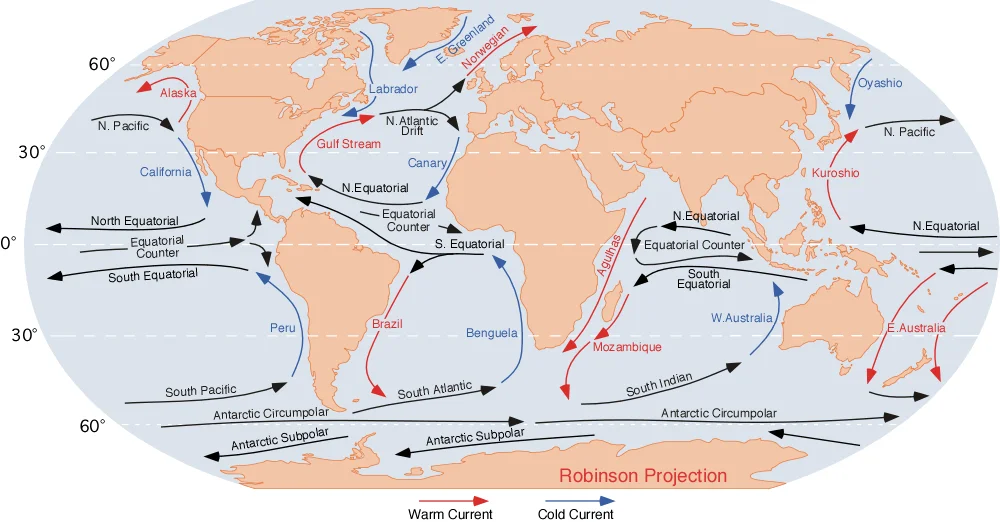
Warm currents generally transport warm tropical water towards higher latitudes. Examples include the Gulf Stream, Kuroshio and Brazil Current.
Cold currents generally transport cooler water from higher latitudes towards lower latitudes. Examples include the California, Peru (Humboldt), Benguela and Labrador Currents.
This classification is important because the temperature of a current can strongly influence the climate of adjacent coastal regions.
Oceanic Gyres
A gyre is a large circular system of surface currents produced by the interaction of prevailing winds, the Coriolis effect and continental boundaries.
There are five major subtropical gyres:
- North Atlantic Gyre
- South Atlantic Gyre
- North Pacific Gyre
- South Pacific Gyre
- Indian Ocean Gyre
In general, subtropical gyres rotate clockwise in the Northern Hemisphere and anticlockwise in the Southern Hemisphere.
Western Boundary Intensification
An important feature of major ocean gyres is the presence of strong, narrow western boundary currents. Examples include the Gulf Stream in the North Atlantic, Kuroshio Current in the North Pacific and Agulhas Current in the Indian Ocean.
These currents are generally warmer, deeper and faster than the corresponding eastern boundary currents. This phenomenon is known as western boundary intensification and results from the interaction between wind stress, Earth's rotation and ocean-basin geometry.
Ekman Transport and Upwelling
When wind blows across the ocean surface, friction causes the upper layer of water to move. Because of the Coriolis effect, the movement of water is not exactly in the direction of the wind.
The resulting cumulative movement of surface water, known as Ekman transport, is approximately 90° to the direction of the wind—to the right in the Northern Hemisphere and to the left in the Southern Hemisphere.
This process is particularly important in coastal upwelling. When winds cause surface water to move away from a coastline, deeper, colder and nutrient-rich water rises to replace it.
Upwelling increases the availability of nutrients such as nitrates and phosphates in surface waters and therefore supports high biological productivity and major fishing grounds.
Important upwelling regions include the western coasts of South America and southern Africa, associated with the Peru and Benguela Currents respectively.
Thermohaline Circulation
The deep-ocean circulation driven by differences in temperature and salinity is known as thermohaline circulation. "Thermo" refers to temperature, while "haline" refers to salinity.
In high-latitude regions, seawater can become extremely cold and, during sea-ice formation, the surrounding water becomes more saline because much of the salt is excluded from the ice. The resulting cold, saline water becomes denser and sinks into the deep ocean.
This sinking forms part of the global ocean conveyor belt, through which deep and surface waters circulate between ocean basins. Upwelling and mixing eventually bring deep water back towards the surface.
Thermohaline circulation is important for the redistribution of heat, oxygen, carbon and nutrients and therefore has major implications for global climate and marine ecosystems.
Major Ocean Currents
Ocean | Warm Currents | Cold Currents |
| Atlantic | Gulf Stream, North Atlantic Drift, Brazil Current | Labrador, Canary, Benguela, Falkland |
| Pacific | Kuroshio, North Pacific Drift, East Australian | California, Oyashio, Peru/Humboldt |
| Indian | Agulhas, Mozambique, South Equatorial | West Australian, Somali |
| Southern Ocean | — | Antarctic Circumpolar Current |
The Antarctic Circumpolar Current (ACC) is particularly significant because it flows continuously from west to east around Antarctica and connects the Atlantic, Pacific and Indian Oceans. It is the world's strongest ocean current and plays an important role in the exchange of water and heat between ocean basins.
Effects of Ocean Currents
Climate Modification
Ocean currents redistribute heat from low latitudes towards higher latitudes and therefore moderate global temperature contrasts. Warm currents can raise temperatures along adjacent coasts, while cold currents generally have a cooling influence.
For example, the North Atlantic Drift, an extension of the Gulf Stream system, contributes to relatively mild conditions in parts of western Europe compared with other regions at similar latitudes.
Rainfall and Aridity
Warm currents increase evaporation and can supply moisture to the atmosphere. Cold currents generally reduce evaporation and can contribute to dry coastal conditions.
The Peru Current and Benguela Current, for example, are associated with the aridity of the western coastal regions of South America and southern Africa respectively.
Fishing Grounds
The meeting of contrasting currents and areas of upwelling brings nutrients to surface waters, encouraging plankton growth and supporting productive fisheries.
The waters influenced by the Oyashio and Kuroshio Currents near Japan are a classic example of a productive fishing region.
Fog Formation
When warm and cold currents meet, temperature contrasts can promote condensation and dense sea fog. Such conditions can create hazards for maritime navigation. The meeting of the Gulf Stream and Labrador Current is a well-known example.
Navigation
Ocean currents can either assist or hinder navigation depending on the direction of travel. Knowledge of currents has therefore historically been important for maritime trade and navigation.
Ocean Currents and India
Ocean circulation in the Indian Ocean is distinctive because of the strong influence of the monsoon system. Unlike many other ocean basins, the direction of several surface currents in the northern Indian Ocean changes seasonally with the reversal of monsoon winds.
The Somali Current is particularly notable because it reverses direction seasonally. The southwest monsoon also promotes strong coastal upwelling along parts of the Somali and Arabian coasts, contributing to enhanced marine productivity.
Ocean currents in the Indian Ocean therefore have an important relationship with monsoon circulation, fisheries, coastal climate and marine ecosystems.
Conclusion
Ocean currents are a fundamental component of the Earth's ocean-atmosphere system. Surface currents are primarily controlled by winds, Coriolis force and continental configuration, while deep circulation is strongly associated with temperature and salinity differences. Their effects extend from global heat redistribution and climate regulation to rainfall, desert formation, fisheries and navigation.
FAQs
1. What are ocean currents?
Ocean currents are continuous, directed movements of seawater along a definite path. They may occur at the surface or at greater depths and play an important role in redistributing heat and nutrients.
2. What are the major types of ocean currents?
Ocean currents can be classified based on:
- Temperature: Warm and cold currents
- Depth: Surface and deep-water currents
- Duration: Permanent, seasonal and temporary currents
3. What causes ocean currents?
Major factors include prevailing winds, differences in temperature and salinity, Earth's rotation, gravity, pressure differences, ocean-basin configuration and tides.
4. What is the role of prevailing winds in ocean currents?
Prevailing winds exert frictional stress on the ocean surface and drive surface currents. Major wind systems such as the trade winds and westerlies help shape the large-scale circulation of the world's oceans.
5. What is the Coriolis effect on ocean currents?
Due to Earth's rotation, moving ocean water is deflected to the right in the Northern Hemisphere and to the left in the Southern Hemisphere. This contributes to the formation and direction of major ocean currents.
Related reads.

Ancient Indian Literature
26 Sep 2026 6 min
Salinity Distribution in Oceans
25 Sep 2026 6 min

Folk Theatre of India
25 Sep 2026 5 min

Indian Classical Music
24 Sep 2026 7 min

Indian Classical Dance Forms
23 Sep 2026 6 min

Indian Paintings: Prehistoric to Modern Times
21 Sep 2026 11 min
Put it into practice
Reading is step one.
Turn what you've just read into exam-ready answers with mentor-led practice and our structured test series.