
GS-I (History, Geography, Society)
Prambanan Temple, Art & Culture

Prambanan Temple recently came into the spotlight after the Prime Minister of India visited the UNESCO World Heritage Site at Yogyakarta along with the President of Indonesia. The visit highlighted the centuries-old civilizational and cultural links between India and Indonesia and reaffirmed the shared heritage rooted in Hindu-Buddhist traditions across Southeast Asia.
For UPSC, the temple is significant from the perspectives of Art and Culture, India's cultural diplomacy, UNESCO World Heritage Sites, and the spread of Indian culture overseas.
Introduction
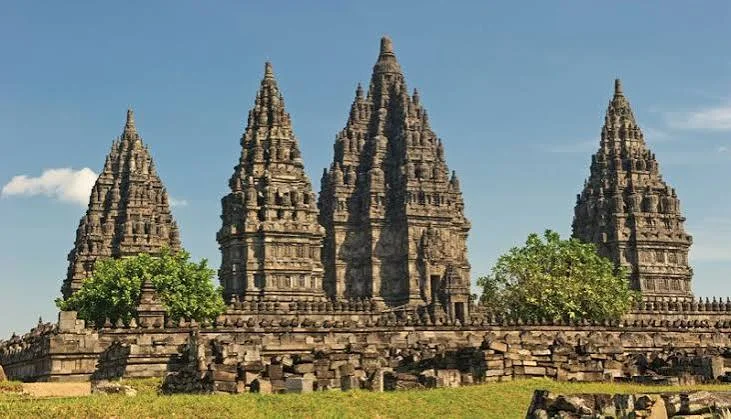
Prambanan Temple is the largest Hindu temple complex in Indonesia and one of the finest surviving examples of Hindu architecture in Southeast Asia. Built during the 9th century CE, the temple reflects the remarkable spread of Indian religious ideas, architecture, literature, and artistic traditions beyond the Indian subcontinent through peaceful cultural interactions, maritime trade, and royal patronage. The monument stands as an enduring symbol of India's soft power and the deep historical ties that continue to shape India–Indonesia relations today.
Located in Sleman Regency near Yogyakarta in Central Java, Prambanan was constructed by the Sanjaya Dynasty, one of the prominent Hindu kingdoms of Java. The temple is locally known as Roro Jonggrang (Temple of the Slender Virgin), associated with a famous Javanese legend.
Historical Background
The emergence of Prambanan coincided with the period when Hinduism and Buddhism flourished across Southeast Asia through extensive maritime trade networks. Indian merchants, scholars, monks, and artisans carried religious beliefs, Sanskrit literature, political ideas, and architectural traditions across the Bay of Bengal to kingdoms such as Srivijaya, Sailendra, Khmer, Champa, and the Javanese kingdoms.
The Sanjaya rulers constructed Prambanan to celebrate the revival of Hindu political authority in Java. The temple became the royal religious centre of the Mataram Kingdom and represented the political legitimacy of Hindu rulers through monumental temple construction.
Although volcanic eruptions and political shifts later led to its abandonment, Prambanan remained an important cultural symbol. Large-scale restoration efforts undertaken during the twentieth century revived the complex, and in 1991 UNESCO declared it a World Heritage Site because of its exceptional cultural and architectural significance.
Architectural Features
Prambanan represents one of the greatest achievements of classical Hindu temple architecture outside India. While its overall layout follows the cosmological concepts found in Indian temple traditions, its artistic execution also reflects indigenous Javanese creativity.
The temple complex originally consisted of 240 temples, arranged according to a carefully planned concentric design symbolising the Hindu conception of the universe. The temples are divided into three successive zones representing different levels of spiritual progression from the outer world to the sacred centre.
The most sacred portion is the central compound, which contains eight principal temples and eight smaller shrines constructed on an elevated platform. These temples are dedicated to the Hindu Trimurti Lord Shiva, Lord Vishnu, and Lord Brahma.
.webp)
The Shiva Temple occupies the central and most prominent position. Rising to nearly 47 metres, it is the tallest structure within the complex and among the tallest Hindu temples in Southeast Asia. The sanctum houses a magnificent image of Lord Shiva, while adjoining chambers contain sculptures of Durga, Agastya, and Ganesha.
To the south stands the Brahma Temple, while the Vishnu Temple lies to the north. Facing each of these temples are shrines dedicated to their respective divine vehicles Nandi, Hamsa, and Garuda.
The architecture demonstrates remarkable engineering precision through soaring towers, symmetrical layouts, intricately carved walls, ornamental gateways, and decorative relief panels. The vertical emphasis of the towers symbolises Mount Meru, regarded in Hindu cosmology as the abode of the gods.
Architectural Influences
Prambanan reflects a unique synthesis of Indian and indigenous Javanese architectural traditions. Scholars identify significant influence from the South Indian Pallava style, particularly in the use of towering temple superstructures, square sanctums, decorative pilasters, and elaborate sculptural programmes.
At the same time, local craftsmen adapted these ideas to suit Javanese building materials, artistic traditions, and environmental conditions, creating a distinctive regional architectural identity rather than merely replicating Indian models.
This cultural adaptation illustrates how Indian civilization spread primarily through exchange and assimilation instead of political conquest.
Sculptural and Artistic Significance
The temple is renowned for its exquisite stone carvings and narrative relief sculptures. The galleries surrounding the temples contain beautifully preserved bas-reliefs depicting scenes from the Ramayana, making Prambanan one of the most important visual representations of the epic outside India.
These reliefs narrate the journey of Lord Rama with remarkable artistic sophistication and continue to inspire the famous Ramayana Ballet, performed regularly against the backdrop of the illuminated temple complex.
Apart from the Ramayana panels, the temple walls contain numerous carvings of celestial beings, floral motifs, divine guardians, mythical creatures, and geometric ornamentation that demonstrate the high level of artistic excellence achieved by Javanese sculptors.
UNESCO World Heritage Status
UNESCO inscribed Prambanan on the World Heritage List in 1991 for its outstanding universal value.
The site was recognised because it:
- Represents one of the greatest masterpieces of Hindu architecture in Southeast Asia.
- Demonstrates the remarkable exchange of cultural values between India and Southeast Asia.
- Preserves exceptional examples of medieval temple planning, engineering, sculpture, and religious art.
- Continues to serve as a symbol of Indonesia's multicultural historical heritage.
Today, Prambanan remains one of Indonesia's most visited cultural landmarks and a major centre of tourism.
Significance for India
Prambanan occupies an important place in India's civilizational history as it reflects the peaceful spread of Indian culture across maritime Asia.
The monument illustrates:
- The expansion of Indian cultural influence through trade, religion, literature, language, and diplomacy.
- The spread of Sanskrit, Hindu philosophy, and temple architecture beyond the Indian subcontinent.
- The historical maritime links between eastern India and Southeast Asia.
- The enduring popularity of Indian epics such as the Ramayana in Southeast Asian societies.
- India's soft power and shared cultural heritage with ASEAN countries.
The recent visit by the Indian Prime Minister further strengthened the role of shared heritage in enhancing India-Indonesia Comprehensive Strategic Partnership under India's Act East Policy and Indo-Pacific vision.
Conclusion
Prambanan Temple is far more than an architectural masterpiece; it is a living testament to the centuries-old cultural exchanges between India and Southeast Asia. Its towering temples, exquisite Ramayana reliefs, and harmonious blend of Indian and Javanese traditions demonstrate how ideas, religion, and art travelled across oceans to shape civilizations. Even today, Prambanan stands as a powerful symbol of India's enduring civilizational connections with Indonesia and highlights the role of shared heritage in strengthening contemporary diplomatic relations.
Related reads.

Salinity Distribution in Oceans
25 Sep 2026 6 min

Folk Theatre of India
25 Sep 2026 5 min

Indian Classical Music
24 Sep 2026 7 min

Indian Classical Dance Forms
23 Sep 2026 6 min

Indian Paintings: Prehistoric to Modern Times
21 Sep 2026 11 min

Independence and Partition of India
14 Sep 2026 8 min
Put it into practice
Reading is step one.
Turn what you've just read into exam-ready answers with mentor-led practice and our structured test series.