
GS-I (History, Geography, Society)
Precipitation (Rainfall & its Types)
Precipitation is one of the most important components of the hydrological (water) cycle and plays a vital role in maintaining the Earth's water balance. It refers to the process through which water, in liquid or solid form, falls from the atmosphere to the Earth's surface after condensation. It includes not only rainfall but also snow, sleet, hail, drizzle and freezing rain.
For UPSC, precipitation is an important topic under Physical Geography, as it forms the basis for understanding climate, monsoon, agriculture, floods, droughts and water resource management.
What is Precipitation?
Precipitation is the process by which condensed water vapour present in clouds falls to the Earth's surface under the influence of gravity. It occurs when atmospheric moisture condenses into tiny water droplets or ice crystals that gradually combine to become heavy enough to overcome air resistance.
The process begins with evaporation from oceans, rivers, lakes and vegetation. The water vapour rises into the atmosphere, cools with increasing altitude and condenses around microscopic dust particles known as condensation nuclei to form clouds. As condensation continues, the droplets or ice crystals increase in size. When their weight exceeds the upward force of air currents, they fall to the ground as precipitation.
The nature of precipitation depends on atmospheric temperature. If temperatures remain above freezing throughout the atmosphere, precipitation reaches the ground as rain. If temperatures remain below freezing, it falls as snow. Intermediate temperature conditions produce sleet or freezing rain.
Factors Influencing Precipitation
The occurrence, intensity and distribution of precipitation are influenced by several atmospheric and geographical factors.
Temperature is the most important factor because it determines the atmosphere's capacity to hold moisture. Warm air can contain much more water vapour than cold air, making tropical regions generally wetter than polar regions.
Humidity represents the amount of moisture present in the atmosphere. Higher humidity increases the likelihood of condensation and cloud formation.
Atmospheric pressure influences the vertical movement of air masses. Low-pressure systems encourage rising air, cloud formation and rainfall, whereas high-pressure systems are generally associated with dry weather due to descending air.
Wind patterns transport moisture from oceans to continents. Moisture-laden winds are responsible for monsoon rainfall, cyclonic precipitation and coastal rainfall.
Relief or topography also plays a crucial role. Mountain ranges force moist air to rise, producing heavy rainfall on windward slopes while creating rain-shadow regions on the leeward side.
Forms of Precipitation
Precipitation occurs in several forms depending upon atmospheric conditions and surface temperature.
Rain is the most common form of precipitation. It consists of water droplets larger than 0.5 mm that fall when the atmospheric temperature remains above 0°C. Rain is the primary source of freshwater and supports agriculture, drinking water supply and ecosystems.
Snow forms when water vapour directly crystallises into ice in temperatures below freezing. Snowfall acts as a natural freshwater reservoir because snow accumulated in mountains gradually melts during summer, feeding rivers and streams.
Drizzle consists of extremely fine water droplets that fall slowly from low clouds. Though light in intensity, drizzle helps maintain soil moisture and often occurs during overcast weather.
Sleet occurs when raindrops freeze into small ice pellets while passing through a layer of cold air before reaching the ground. It commonly occurs in temperate regions during winter.
Freezing rain develops when liquid raindrops fall through cold air but remain unfrozen until they strike cold surfaces, instantly forming a layer of ice. It creates hazardous conditions by coating roads, trees and power lines with ice.
Hail consists of large balls or irregular lumps of ice produced inside towering cumulonimbus clouds. Strong updrafts repeatedly carry water droplets into freezing regions where successive layers of ice accumulate. Hailstorms are particularly destructive because they damage crops, vehicles, buildings and livestock.
Types of Rainfall
From a geographical perspective, rainfall is classified into three major types based on the mechanism responsible for lifting moist air.
Convectional Rainfall
Convectional rainfall occurs when intense solar heating warms the Earth's surface. The heated air becomes lighter and rises rapidly through convection currents. As the air ascends, it expands and cools adiabatically, causing condensation and the formation of cumulonimbus clouds. Heavy rainfall follows, often accompanied by thunderstorms and lightning.
This type of rainfall is generally intense but short-lived and is most common in equatorial regions, where high temperatures prevail throughout the year.
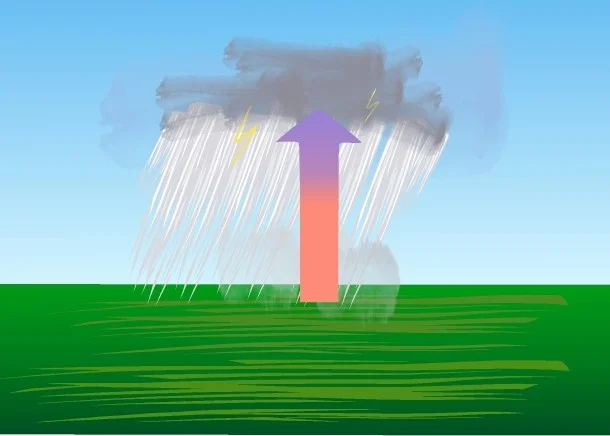
The Amazon Basin, Congo Basin, and parts of Indonesia receive frequent convectional rainfall. In India, convectional showers during the pre-monsoon season are locally known as Kalbaisakhi (Nor'westers) in eastern India and Mango Showers over Kerala and Karnataka.
Orographic (Relief) Rainfall
Orographic rainfall occurs when moisture-laden winds encounter mountain barriers. Unable to move horizontally, the air is forced to rise along the mountain slopes. During ascent, the air cools, reaches its dew point and condenses to produce rainfall on the windward side of the mountain.
After crossing the mountain crest, the air descends along the leeward slope, becoming warmer and drier. As a result, little or no rainfall occurs on the leeward side, creating a rain-shadow region.
Orographic rainfall explains the heavy precipitation received by the Western Ghats, Himalayas, Andes, Rocky Mountains and the exceptionally high rainfall at Mawsynram and Cherrapunji in Meghalaya.
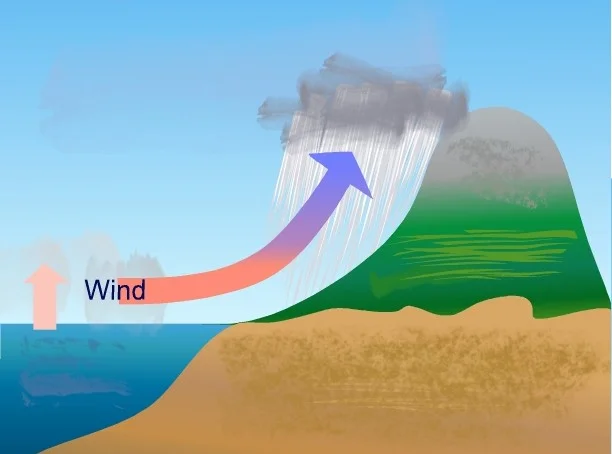
Similarly, the Deccan Plateau receives comparatively lower rainfall because it lies in the rain shadow of the Western Ghats.
Cyclonic (Frontal) Rainfall
Cyclonic rainfall occurs due to the convergence of contrasting air masses in low-pressure systems.
In tropical regions, cyclones draw moisture from warm ocean waters, resulting in widespread heavy rainfall accompanied by strong winds and storm surges.
In temperate regions, rainfall occurs along weather fronts where warm and cold air masses meet. Since warm air is lighter, it rises over the colder air mass, cools gradually and forms extensive cloud systems producing prolonged rainfall.
Cyclonic rainfall is common during tropical cyclones over the Bay of Bengal and Arabian Sea and during temperate cyclones in Europe and North America. In India, Western Disturbances, which are extra-tropical cyclones originating over the Mediterranean region, bring winter rainfall to northwestern India.
Importance of Precipitation
Precipitation is fundamental to both natural ecosystems and human civilisation.
It replenishes surface water resources such as rivers, lakes, reservoirs and wetlands while simultaneously recharging groundwater aquifers. Countries like India, where agriculture remains heavily dependent on rainfall, rely on timely precipitation for crop production and food security.
Precipitation sustains forests, grasslands and wetlands, thereby maintaining biodiversity and ecological balance. It also influences soil formation, vegetation patterns and wildlife habitats.
From a climatic perspective, precipitation redistributes heat energy through condensation and evaporation, thereby regulating regional and global temperatures.
Hydroelectric power generation depends upon river discharge sustained by rainfall and snowmelt, making precipitation an important driver of renewable energy production.
However, excessive or deficient precipitation can also create disasters such as floods, droughts, landslides and soil erosion, highlighting the importance of effective weather forecasting and water management.
Global Distribution of Precipitation
Precipitation is unevenly distributed across the world because of differences in latitude, atmospheric circulation, ocean currents and relief.
The equatorial regions, influenced by the Inter-Tropical Convergence Zone (ITCZ), receive rainfall throughout the year due to intense convection. The Amazon and Congo Basins are prime examples.
Monsoon regions, including India and Southeast Asia, experience highly seasonal rainfall associated with seasonal reversal of winds.
The subtropical deserts, such as the Sahara and Arabian Desert, receive extremely low rainfall because descending air associated with subtropical high-pressure belts suppresses cloud formation.
Mountainous regions experience heavy rainfall on windward slopes due to orographic lifting, while rain-shadow regions remain comparatively dry.
Polar regions receive very little precipitation because cold air contains limited moisture, making Antarctica technically the world's largest desert.
Conclusion
Precipitation is much more than a weather phenomenon; it is the foundation of the Earth's freshwater system and a critical regulator of climate, ecosystems and human livelihoods. Whether occurring as rain, snow, hail or drizzle, precipitation sustains agriculture, replenishes water resources and supports biodiversity across the planet. At the same time, its uneven distribution and increasing variability due to climate change pose serious challenges for food security, water availability and disaster management.
FAQs
Q1. What is precipitation?
Precipitation is the process through which condensed atmospheric water falls to the Earth's surface in the form of rain, snow, sleet, or hail.
Q2. What are the major types of rainfall?
Rainfall is broadly classified into:
- Convectional rainfall
- Orographic or relief rainfall
- Cyclonic or frontal rainfall
Q3. What is convectional rainfall?
Convectional rainfall occurs when the Earth's surface is strongly heated, causing warm and moist air to rise through convection. As the air rises, it cools, condenses and produces rainfall.
It is common in equatorial regions and often produces short-duration, heavy rainfall accompanied by thunderstorms.
Q4. What is orographic rainfall?
Orographic rainfall occurs when moist air is forced to rise over mountains or other elevated terrain. The rising air cools and condenses, producing rainfall on the windward slope.
The leeward side often receives less rainfall and may develop a rain-shadow region.
Q5. What is cyclonic or frontal rainfall?
Cyclonic rainfall occurs when air rises due to the convergence of air masses associated with low-pressure systems or fronts. It is common in the mid-latitudes and may cover large areas.
Related reads.

Modern Indian Literature
29 Sep 2026 6 min

Coastal Landforms
28 Sep 2026 8 min

Medieval Indian Literature
28 Sep 2026 8 min

Ocean Currents
26 Sep 2026 7 min

Ancient Indian Literature
26 Sep 2026 6 min
Salinity Distribution in Oceans
25 Sep 2026 6 min
Put it into practice
Reading is step one.
Turn what you've just read into exam-ready answers with mentor-led practice and our structured test series.