
GS-I (History, Geography, Society)
Regional States of North and South India
Background
The decline of the Mughal Empire during the eighteenth century did not result in an immediate political vacuum. As the authority of the Mughal emperor weakened, governors of large provinces, powerful zamindars, local chiefs and military groups began consolidating their control over different regions. By the middle of the eighteenth century, the Mughal Empire had become an empire largely in name, although the Mughal emperor continued to possess considerable symbolic authority and political legitimacy.
The emergence of regional states was therefore not simply a complete collapse of the existing political order. It represented a process of decentralisation of political power, in which several regional centres of authority emerged while continuing to retain elements of Mughal administrative practices. Even rulers who exercised considerable independence often sought formal recognition from the Mughal emperor because association with the imperial authority provided legitimacy to their rule.
Despite differences in their origins, many of these states continued to use Mughal institutions, administrative practices and revenue arrangements. Their emergence thus reflected political transformation rather than an abrupt breakdown of governance.
Regional States in North India
Bengal
Bengal emerged as one of the most prosperous and powerful regional states following the weakening of Mughal authority. The process of autonomy was closely associated with Murshid Quli Khan, who became the governor or Nazim of Bengal.
An important feature of his administration was the combination of the offices of Nazim and Diwan. Under the Mughal system, political and revenue authority had generally been divided between these offices to maintain checks and balances. The concentration of both responsibilities in Murshid Quli Khan's hands strengthened his control over the province and reduced the effectiveness of imperial supervision.
Bengal's political autonomy was supported by its strong revenue administration. Murshid Quli Khan was known for efficient revenue collection, and Bengal continued to generate a substantial surplus even when political instability affected other parts of the Mughal Empire. Its rich agricultural resources and commercial importance gave the Bengal state a strong economic foundation.
Awadh
Awadh, located in the fertile Ganga plain, was another major successor state. Its strategic location made it particularly important because it controlled rich agricultural territory as well as important routes connecting North India with Bengal.
In 1722, Saadat Khan Burhan-ul-Mulk was appointed the subadar of Awadh and laid the foundation of an autonomous political order. He gradually reduced Mughal influence by attempting to limit the number and influence of Mughal-appointed jagirdars. He also concentrated political, financial and military authority by holding the offices associated with subadari, diwani and faujdari.
Awadh initially had Faizabad as its capital and developed into one of the most important regional powers of eighteenth-century northern India. Its political strength rested on its fertile agricultural base, strategic location and increasing autonomy from the Mughal centre.
Rajput States
The Rajput states represented a somewhat different form of regional political development. Several Rajput rulers, particularly the rulers of Amber and Jodhpur, had enjoyed considerable autonomy through their watan jagirs under the Mughals. With the weakening of imperial authority, these rulers attempted to expand their territorial influence beyond their traditional domains.
Two important figures were Raja Ajit Singh of Jodhpur and Sawai Raja Jai Singh of Amber. Both became involved in the politics of the declining Mughal court and were associated with the administration of important provinces. Ajit Singh was connected with Gujarat, while Jai Singh was associated with Malwa and later the subadari of Agra.
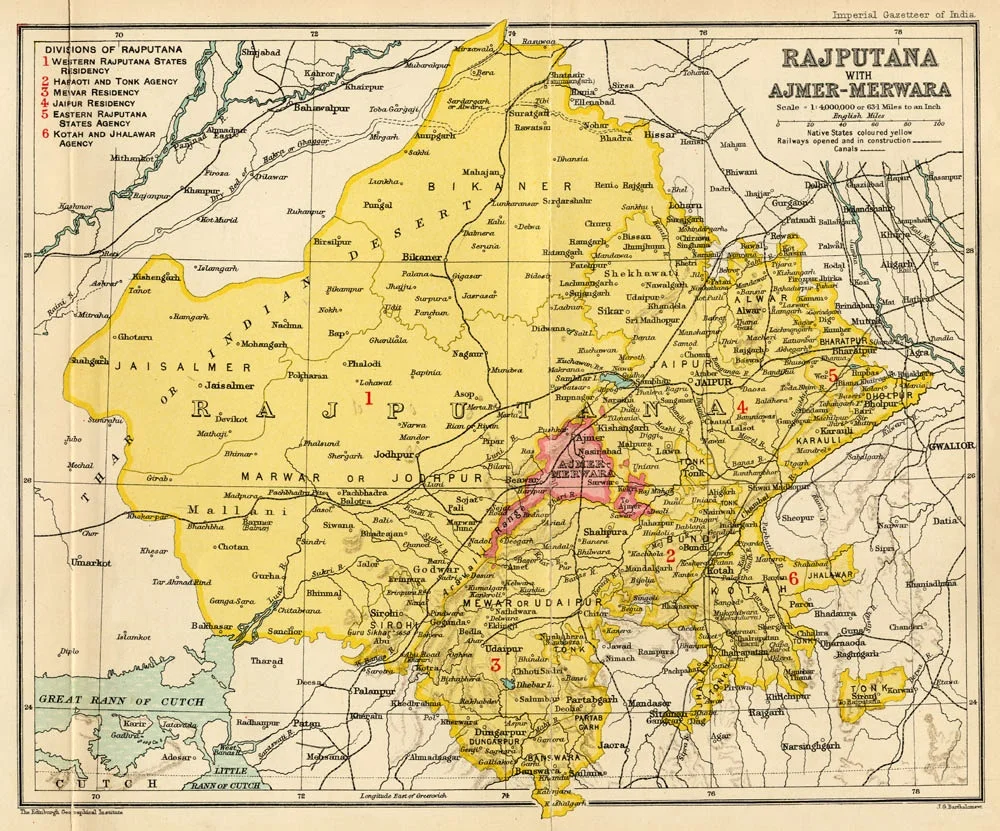
The Rajput rulers also attempted territorial expansion. Amber extended its influence over parts of Bundi, while Nagaur was conquered and incorporated into the Jodhpur sphere. In 1722, Sawai Jai Singh established Jaipur as his new capital, making it an important centre of Rajput power. However, from the 1740s, increasing Maratha intervention in Rajasthan placed severe pressure on these states and restricted their further expansion.
Jats
The Jats developed into another important regional power in the area surrounding Delhi and Agra. Their political consolidation had begun during the late seventeenth and early eighteenth centuries. Under Churaman, they expanded their control over territories west of Delhi and came to dominate areas between the two important imperial cities of Delhi and Agra.
The Jats possessed a strong agricultural base and were associated with the growth of important commercial centres. Their rise demonstrated how powerful local agrarian communities could transform their economic strength into political and military power during the weakening of Mughal authority.
The Jat state reached its greatest strength under Suraj Mal, under whom Bharatpur emerged as a powerful kingdom. The political importance of Bharatpur increased further after the sack of Delhi by Nadir Shah in 1739, when several prominent people from Delhi sought refuge there.
Jat architecture also reflected interaction with established Mughal and Rajput traditions. The fort at Bharatpur retained conventional architectural features, while the palace complex at Dig incorporated styles associated with Amber and Agra, including forms that had developed during the reign of Shah Jahan.
The Sikh State in Punjab
The emergence of the Sikhs as a political community played an important role in the formation of a regional power in Punjab. The process gained momentum during the seventeenth century, particularly under Guru Gobind Singh, who fought several battles against Mughal and Rajput rulers and established the Khalsa in 1699.
After Guru Gobind Singh's death in 1708, the Khalsa increasingly challenged Mughal authority. Under Banda Bahadur, the Sikh movement entered a more direct phase of political and military resistance. Although Banda Bahadur was captured in 1715 and executed in 1716, Sikh political organisation continued to develop.
During the eighteenth century, the Sikhs organised themselves into military groups known as jathas, which later developed into misls under different leaders. Their combined military organisation was known as the Dal Khalsa. Important collective decisions were taken when the Sikh community gathered at Amritsar during festivals such as Baisakhi and Diwali, where resolutions known as gurmatas were adopted.
Another important institution was Rakhi, under which protection was provided to cultivators in return for a share of agricultural produce. Sikh organisation enabled them to resist both Mughal governors and later Ahmad Shah Abdali.
By 1765, the Khalsa asserted its sovereignty by minting its own coin. By the late eighteenth century, Sikh territories extended across a large part of Punjab, although they remained divided among different rulers. In 1799, Maharaja Ranjit Singh brought several of these factions together and established Lahore as his capital, laying the foundation of a powerful Sikh kingdom.
Regional States in South India
Hyderabad
In the Deccan, Nizam-ul-Mulk Asaf Jah, originally a powerful Mughal noble known as Chin Qulich Khan, established the autonomous state of Hyderabad in 1724. He did not openly announce complete independence from the Mughal emperor. Nevertheless, in practical terms, he exercised independent political authority in the Deccan.
The Nizam consolidated his position by controlling powerful zamindars and building relationships with economically influential Hindu groups. This contributed to the emergence of a new regional elite that supported the Nizam's authority.
Hyderabad became one of the major successor states of the Mughal Empire. However, after the death of Nizam Asaf Jah, the state faced increasing political pressures. The Marathas, Mysore and the Carnatic became involved in struggles over territory and influence, weakening Hyderabad's position in the changing political environment of eighteenth-century South India.
Mysore
Mysore represented another important regional power in southern India. Unlike Bengal, Awadh and Hyderabad, its political autonomy had deeper roots. It had maintained a precarious independence following the decline of the Vijayanagara Empire and was only nominally incorporated into the Mughal political system.
Mysore rose to greater prominence under Haider Ali, who transformed it into one of the most powerful states in South India. One of his major achievements was the modernisation of the army. With the assistance of French experts, Mysore developed more efficient infantry and artillery and adopted elements of European military discipline.
Haider Ali and later Tipu Sultan also strengthened the state's financial base through changes in revenue collection. Land taxes were collected more directly from peasants through salaried officials and increasingly in cash. This strengthened the state's ability to mobilise resources and maintain a powerful military establishment.
The Bahmani Kingdom and Deccan States
The Bahmani Kingdom was established in 1347 by Ala-ud-Din Bahman Shah in the Deccan. It was the first independent Muslim kingdom in the Deccan and remained involved in prolonged conflicts with the Vijayanagara Empire.
The Bahmani kingdom eventually fragmented into the Deccan Sultanates. Among the most important successor states were Ahmednagar, Bijapur and Golconda. These Deccan states frequently competed with one another, but they could also unite when faced with a common opponent.
In 1565, the major Deccan states joined together against Vijayanagara and defeated it at the Battle of Talikota, after which the Vijayanagara capital was sacked. The alliance, however, did not last permanently, and the Deccan states soon returned to their earlier rivalries. Competition over fertile and commercially valuable territories, such as Sholapur, remained an important source of conflict between states such as Ahmednagar and Bijapur.
Nature and Significance of Regional States
The regional states that emerged during the decline of Mughal authority differed considerably in their origins, political structures and social bases. Bengal, Awadh and Hyderabad developed largely from the autonomisation of Mughal provinces, whereas the Marathas, Sikhs and Jats emerged through more prolonged struggles against Mughal authority. Rajput states, meanwhile, had already enjoyed considerable autonomy within the Mughal framework.
Yet, these differences should not obscure an important common feature: many regional states retained Mughal administrative and political institutions. They continued to depend heavily on land revenue, zamindars, jagirdars and established systems of administration. Thus, the eighteenth century witnessed both continuity and change.
The emergence of regional states also did not automatically lead to economic transformation. Although several states protected internal trade and attempted to encourage external commerce, they largely remained rent-seeking political structures. Competition among zamindars and jagirdars over agricultural surplus continued, while the condition of peasants often deteriorated.
This limited capacity for structural economic and industrial transformation became an important weakness. The regional states could establish strong armies and sophisticated courts, but they generally failed to modernise their wider economic and commercial foundations sufficiently to withstand sustained external pressures.
Conclusion
The rise of regional states was one of the defining features of eighteenth-century Indian history. The decline of Mughal central authority enabled provinces, local elites, military groups and established regional powers to consolidate political control. The result was not an absence of political authority but the redistribution of authority among multiple regional centres.
Bengal, Awadh and Hyderabad illustrate the rise of successor states from within the Mughal administrative structure, while the Rajputs, Jats, Sikhs and Mysore demonstrate other paths of regional state formation. Together, these states created a politically fragmented but active landscape in which older institutions coexisted with new centres of power. Their inability to undertake deeper economic and institutional transformation, however, limited their capacity to consolidate power against expanding external forces.
FAQs
Q1. What are regional states in medieval India?
Regional states were politically autonomous kingdoms and successor states that emerged or strengthened as central imperial authority weakened, particularly during the decline of the Mughal Empire.
Q2. Why did regional states emerge in India?
The weakening of Mughal authority, administrative decentralisation, succession conflicts, economic pressures and the rise of powerful local elites enabled several regional powers to establish greater autonomy.
Q3. Which major regional states emerged in North India?
Important states included Awadh, Bengal, Punjab, Rohilkhand and the Jat state of Bharatpur. The Rajput states also retained considerable political autonomy.
Q4. What was the significance of Awadh?
Awadh emerged as an important autonomous state under Saadat Khan Burhan-ul-Mulk. It developed a strong administrative and revenue system and became an important political centre in northern India.
Q5. How did Bengal emerge as a regional power?
Under Murshid Quli Khan, Bengal gained substantial autonomy from the Mughal Empire. Its rich agriculture, textile production and maritime trade made it one of the wealthiest regions of India.
Related reads.

Coral Reefs
22 Oct 2026 7 min

Ocean Pollution
21 Oct 2026 7 min

Thermohaline Circulation
21 Oct 2026 7 min

Ocean Waves
19 Oct 2026 7 min
Decolonisation in Asia and Africa
18 Oct 2026 8 min

Temperature Distribution in Oceans
10 Oct 2026 9 min
Put it into practice
Reading is step one.
Turn what you've just read into exam-ready answers with mentor-led practice and our structured test series.