
GS-I (History, Geography, Society)
Russian Revolution (1917)
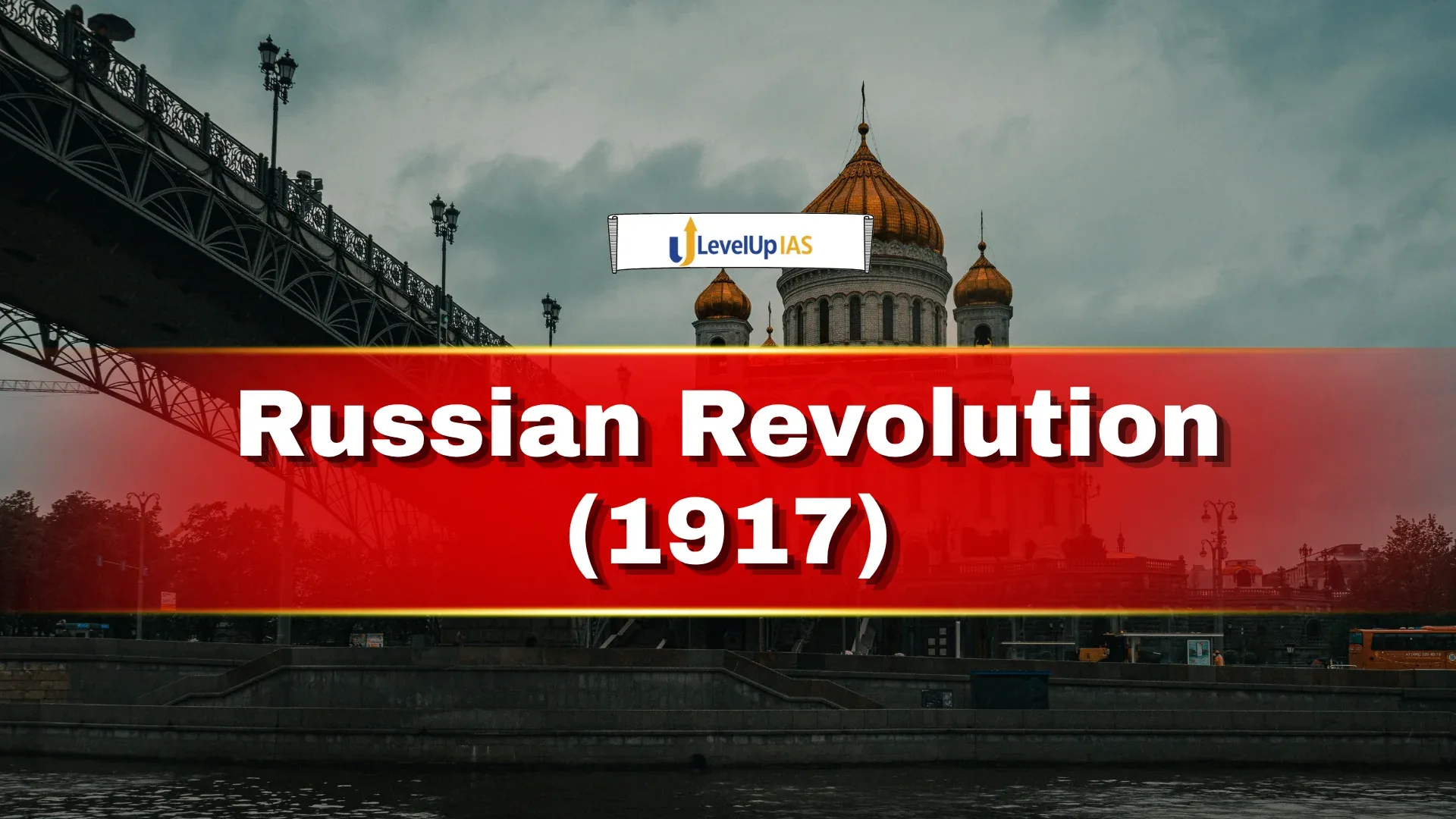
Introduction
The Russian Revolution of 1917 was one of the most significant events of the twentieth century. It transformed Russia from an autocratic monarchy into the world’s first socialist state and profoundly influenced global politics, economics, and society. The revolution not only ended the rule of the Romanov dynasty but also laid the foundation for the establishment of the Soviet Union in 1922.
For students of UPSC, the Russian Revolution is important not only as a major event in World History but also because of its impact on anti-colonial movements, socialist ideologies, and the freedom struggle in countries such as India. It marked the beginning of a new ideological conflict between capitalism and socialism that shaped international relations for much of the twentieth century.
Background of Russia before the Revolution
At the beginning of the twentieth century, Russia was the largest empire in the world, stretching across Europe and Asia. It was ruled by the Romanov dynasty, with Tsar Nicholas II exercising absolute authority. Unlike many Western European countries that had embraced constitutional government and industrial capitalism, Russia remained politically autocratic and economically backward.
The Russian economy was predominantly agrarian. A large majority of the population consisted of peasants who lived in poverty and had limited access to land. Although serfdom had been abolished in 1861 by Tsar Alexander II, peasants continued to suffer from heavy debts, low agricultural productivity, and exploitation by landlords.
At the same time, industrialisation began in Russia during the late nineteenth century. New industries emerged in cities such as Petrograd and Moscow, creating a growing urban working class. However, workers faced poor working conditions, long hours, low wages, and a lack of political rights. These social and economic inequalities generated widespread dissatisfaction among both peasants and industrial workers.
Causes of the Russian Revolution
Autocratic Rule of the Tsar
The most fundamental cause of the revolution was the autocratic nature of the Tsarist regime. Tsar Nicholas II believed in the divine right of kings and resisted demands for democratic reforms. Political parties were suppressed, civil liberties were restricted, and public participation in governance was minimal.
The Revolution of 1905 had already exposed the weaknesses of the regime. The massacre of peaceful protesters on "Bloody Sunday" in January 1905 led to widespread unrest. Although the Tsar introduced the Duma (Parliament) through the October Manifesto, its powers remained limited, and real authority continued to rest with the monarchy.
Agrarian Distress
The agrarian question remained unresolved despite the abolition of serfdom. Most peasants owned small and fragmented plots of land and struggled to survive. Population growth increased pressure on land resources, while agricultural technology remained outdated.
Peasant discontent grew steadily, resulting in frequent uprisings and demands for land redistribution. By 1917, the peasantry had become a major force supporting revolutionary change.
Industrialisation and Workers’ Grievances
Industrialisation created a large working-class population concentrated in urban centres. Workers endured harsh conditions, including low wages, overcrowded housing, and unsafe workplaces. Labour unions were weak, and workers lacked political representation.
These grievances encouraged the spread of socialist ideas among workers and strengthened revolutionary organisations such as the Bolsheviks.
Rise of Revolutionary Ideologies
The spread of socialist and Marxist ideas played a crucial role in shaping revolutionary consciousness. Thinkers such as Karl Marx and Friedrich Engels inspired Russian intellectuals and activists who sought to overthrow the existing social order.
Writers like Leo Tolstoy, Fyodor Dostoevsky, and Maxim Gorky exposed social injustices through their works. Revolutionary leaders such as Vladimir Lenin and Leon Trotsky mobilised workers and peasants around the idea of a socialist revolution.
.webp)
Impact of World War I
Russia's participation in the First World War proved disastrous. Military defeats, heavy casualties, inflation, food shortages, and economic collapse weakened public confidence in the government.
The war placed enormous strain on the economy and intensified popular suffering. Soldiers became demoralised, while civilians faced shortages of essential goods. By 1917, Russia was on the verge of collapse.
February Revolution (1917)
The immediate trigger for the revolution came in February 1917. Food shortages, rising prices, and public frustration led to strikes and demonstrations in Petrograd.
Workers, soldiers, and ordinary citizens joined mass protests against the government. Significantly, many soldiers refused to suppress the demonstrators and instead sided with them. Faced with overwhelming opposition, Tsar Nicholas II abdicated on 15 March 1917 (Gregorian Calendar), bringing an end to over three centuries of Romanov rule.
Following the abdication, a Provisional Government was established under the leadership of Alexander Kerensky. Simultaneously, workers' and soldiers' councils known as Soviets emerged as alternative centres of power. This situation created a system of "dual power" in Russia.
The Provisional Government and Its Failures
The Provisional Government promised democratic reforms and elections to a Constituent Assembly. However, it faced several challenges.
Its biggest mistake was continuing Russia's participation in World War I despite widespread public opposition. Economic conditions continued to deteriorate, while demands for land redistribution remained unaddressed.
The government also failed to resolve the power struggle with the Soviets. As dissatisfaction grew, support for radical socialist groups increased, particularly for the Bolsheviks led by Vladimir Lenin.
Role of Lenin and the Bolsheviks
Lenin returned to Russia in April 1917 after years of exile. Through his famous April Theses, he called for an immediate end to the war, transfer of land to peasants, workers' control over industries, and the establishment of Soviet power.
His slogan of "Peace, Land and Bread" appealed directly to soldiers, peasants, and workers. Unlike the Provisional Government, the Bolsheviks offered clear solutions to Russia's pressing problems.
Under Lenin's leadership, the Bolshevik Party rapidly gained influence among the masses.
October Revolution (1917)
In October 1917, the Bolsheviks launched an armed uprising against the Provisional Government. Led by Lenin and Trotsky, revolutionary forces seized key government institutions in Petrograd.
The Winter Palace, the seat of the Provisional Government, was captured with minimal resistance. The government collapsed, and power was transferred to the Soviets dominated by the Bolsheviks.
This event, known as the October Revolution or Bolshevik Revolution, marked the beginning of socialist rule in Russia. Lenin became the head of the new government.
Russian Civil War and Formation of the Soviet Union
The Bolshevik seizure of power triggered a civil war between the Red Army (Bolsheviks) and the White Army (a coalition of monarchists, liberals, and anti-Bolshevik groups).
Several foreign countries, including Britain, France, Japan, and the United States, supported the Whites. Despite this, the Red Army emerged victorious under the leadership of Trotsky.
The civil war ended in Bolshevik victory, and in 1922 the Union of Soviet Socialist Republics (USSR) was formally established.
Significance of the Russian Revolution
The Russian Revolution ended centuries of Tsarist autocracy and established the first socialist state in history. It introduced state ownership of major industries, land redistribution, and centralised economic planning.
Socially, it promoted education, healthcare, women's rights, and social welfare. Politically, it inspired revolutionary movements across Asia, Africa, and Latin America.
Internationally, it challenged the dominance of capitalism and created an ideological rivalry that later shaped the Cold War.
Impact on India
The Russian Revolution had a profound influence on India's freedom struggle. It inspired Indian nationalists by demonstrating that oppressive regimes could be overthrown through mass mobilisation.
Leaders such as Jawaharlal Nehru, Subhas Chandra Bose, and many socialist thinkers were influenced by Soviet ideas. The revolution also contributed to the growth of the communist movement in India and encouraged discussions on economic planning, social justice, and anti-imperialism.
Many of the developmental policies adopted after independence, including Five-Year Plans and public sector-led industrialisation, reflected the influence of Soviet economic models.
Conclusion
The Russian Revolution of 1917 was a watershed moment in modern world history. It overthrew an autocratic monarchy, established the first socialist state, and transformed global political thought. Its influence extended far beyond Russia, shaping anti-colonial struggles, socialist movements, and international relations throughout the twentieth century. For UPSC aspirants, the revolution remains crucial for understanding the evolution of modern political ideologies, the rise of socialism, and its impact on India and the wider world.
FAQs
Q1. What was the Russian Revolution of 1917?
The Russian Revolution of 1917 was a series of political upheavals that ended Tsarist rule and eventually brought the Bolsheviks, led by Vladimir Lenin, to power.
Q2. What were the main causes of the Russian Revolution?
Major causes included:
- Autocratic rule of the Tsar
- Poor economic and social conditions
- Land hunger among peasants
- Exploitation of industrial workers
- Growth of socialist and revolutionary ideas
- Russia's disastrous experience in the First World War
- Weakness of the Tsarist administration
Q3. What was the February Revolution?
The February Revolution of 1917 began with strikes and demonstrations in Petrograd amid food shortages and wartime hardship. The Tsar eventually abdicated, bringing an end to the Romanov monarchy.
Q4. What happened after the February Revolution?
A Provisional Government was established, while workers' and soldiers' councils known as Soviets also exercised considerable influence. This created a situation of dual power.
Q5. What was the role of Lenin in the Russian Revolution?
Lenin provided ideological and political leadership to the Bolsheviks. His April Theses called for an end to the war, transfer of power to the Soviets, and a socialist transformation.
Related reads.

Indian Classical Music
24 Sep 2026 7 min

Indian Classical Dance Forms
23 Sep 2026 6 min

Indian Paintings: Prehistoric to Modern Times
21 Sep 2026 11 min
Independence and Partition of India
14 Sep 2026 8 min

Revolutionary Nationalism in India
12 Sep 2026 10 min
Indian National Movement – II (1918-1929)
10 Sep 2026 10 min
Put it into practice
Reading is step one.
Turn what you've just read into exam-ready answers with mentor-led practice and our structured test series.