
GS-I (History, Geography, Society)
Salinity Distribution in Oceans
Introduction
Salinity refers to the concentration of dissolved salts in seawater and is one of the most important physical properties of ocean water, along with temperature. The average salinity of seawater is approximately 35 parts per thousand (ppt), meaning that about 35 grams of dissolved salts are present in one kilogram of seawater. However, salinity is not uniformly distributed across the oceans. It varies spatially and vertically due to differences in evaporation, precipitation, river discharge, ice formation and melting, ocean currents and water mixing. These variations influence seawater density and are therefore important for ocean circulation and climate.
Sources and Composition of Oceanic Salts
The salts dissolved in seawater originate mainly from the weathering of rocks on land, with dissolved minerals being transported to the oceans by rivers. Other sources include hydrothermal activity, submarine volcanic processes and reactions between seawater and the ocean floor. At the same time, salts are removed through biological processes, sedimentation and chemical reactions.
Sodium and chloride ions constitute the largest proportion of dissolved ions in seawater. Although the composition of seawater is relatively stable, the concentration of salts varies from one region to another.
Factors Affecting Ocean Salinity
1. Evaporation
Evaporation increases salinity because water is removed while dissolved salts remain behind. Regions characterised by high temperature, clear skies, dry air and descending air currents generally experience greater evaporation.
This is why subtropical regions between about 20° and 30° latitudes generally record high surface salinity. Enclosed seas such as the Red Sea and Persian Gulf also have high salinity because of intense evaporation and relatively limited freshwater input.
2. Precipitation
Rainfall adds freshwater to the ocean and therefore generally reduces surface salinity. Regions receiving heavy precipitation, particularly around the equatorial belt, tend to have lower salinity despite high temperatures.
Thus, the relationship between temperature and salinity is not always direct. High temperature can promote evaporation, but where rainfall is very high, precipitation may dominate and produce relatively low surface salinity.
3. River Discharge
Large rivers introduce substantial quantities of freshwater into the oceans and lower coastal and surface salinity.
The Bay of Bengal, for example, has relatively low surface salinity because of heavy freshwater input from major river systems, particularly the Ganga-Brahmaputra-Meghna system.
4. Freezing and Melting of Ice
The formation and melting of sea ice produce contrasting effects.
During freezing, much of the salt is excluded from the forming ice and remains in the surrounding seawater, increasing its salinity and density. In contrast, melting of sea ice and continental ice adds freshwater and reduces surface salinity.
This process is particularly significant in polar and sub-polar regions and can influence deep-water formation.
5. Ocean Currents
Ocean currents redistribute water masses with different salinity characteristics. They can transport saline water from one region to another and modify the local salinity pattern.
Therefore, salinity at a particular location depends not only on local evaporation and precipitation but also on the movement and mixing of water masses.
6. Enclosure and Degree of Water Exchange
Semi-enclosed and enclosed seas often show unusual salinity conditions because their connection with the open ocean is restricted.
The Red Sea and Persian Gulf have high salinity because evaporation is intense and freshwater supply is limited. In contrast, the Baltic Sea and Black Sea have relatively low salinity because of substantial freshwater inflow.
.webp)
Horizontal Distribution of Ocean Salinity
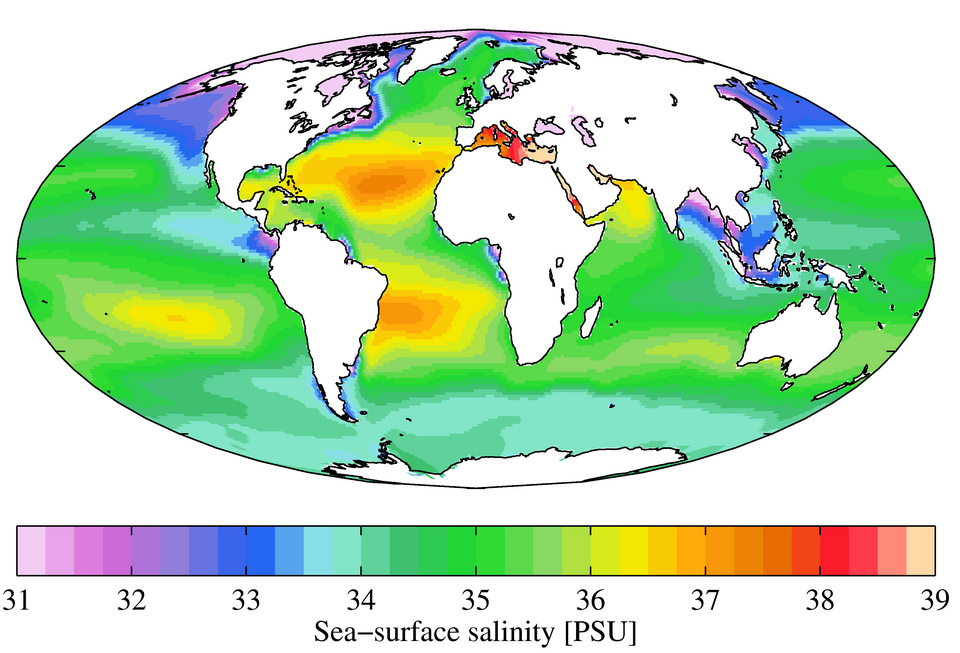
The horizontal distribution of salinity refers to variations across the ocean surface from the equator towards the poles and between different oceanic regions.
Equatorial Region
Surface salinity is generally lower than in the subtropics because of heavy rainfall and high freshwater input. Although evaporation is significant because of high temperatures, intense precipitation largely offsets its effect.
Subtropical Regions
The highest open-ocean surface salinity generally occurs around 20°-30° N and S. These regions are dominated by subtropical high-pressure conditions, clear skies, low precipitation and high evaporation.
This produces a characteristic pattern in which salinity rises from the equator towards the subtropics.
Higher Latitudes
Salinity generally decreases towards higher latitudes because of lower evaporation, precipitation and freshwater input from melting ice. Seasonal changes in sea-ice formation and melting further modify polar salinity.
Thus, the broad latitudinal pattern of surface salinity can be represented as:
Equator → Subtropics: Salinity increases
Subtropics → Poles: Salinity generally decreases
However, this pattern is modified by regional factors such as ocean currents, river discharge and marginal seas.
Regional Variations
The Atlantic Ocean is generally more saline than the Pacific because of differences in evaporation, precipitation and freshwater balance.
Within the Indian Ocean, marked regional contrasts are visible. The Arabian Sea has relatively high salinity because of strong evaporation and comparatively lower freshwater input, while the Bay of Bengal has lower salinity because of heavy rainfall and river discharge.
The Red Sea has exceptionally high salinity because of intense evaporation and restricted freshwater supply. Conversely, the Baltic Sea has very low salinity because of substantial river inflow and limited exchange with the North Atlantic.
These regional variations are important for understanding water-mass formation and ocean circulation.
Vertical Distribution of Salinity
Salinity also varies with depth, producing distinct vertical patterns.
The upper ocean is directly influenced by evaporation, precipitation, river runoff, ice formation and melting. Below the surface mixed layer, salinity may change rapidly over a relatively short depth range.
The halocline is the zone in which salinity changes sharply with depth. It acts as an important component of ocean stratification.
Below the halocline, salinity generally becomes more uniform because deep waters are less directly affected by surface freshwater and evaporation processes. However, the exact vertical pattern varies with latitude and water-mass characteristics.
At high latitudes, surface water may be relatively fresh because of ice melting and precipitation, while deeper water can be more saline. In equatorial regions, heavy rainfall produces relatively low surface salinity, while salinity may increase with depth.
Salinity and Ocean Circulation
Salinity is closely linked with seawater density. Together, temperature and salinity determine the density of seawater, and variations in density contribute to the formation and movement of deep and surface water masses.
This relationship is fundamental to thermohaline circulation, often described as the global ocean conveyor system. Changes in salinity can influence the sinking of dense water in high-latitude regions and thereby affect large-scale ocean circulation.
Salinity also influences the freezing point, electrical conductivity and other physical properties of seawater. Changes in salinity therefore have implications for marine ecosystems, ocean-atmosphere interactions and climate processes.
Significance for Climate and Oceanography
The distribution of salinity provides important information about the global water cycle. Increasing freshwater input, changing precipitation patterns, evaporation and ice melt can alter regional salinity.
Salinity observations are therefore useful for studying ocean circulation, water-mass formation, climate variability and changes in the hydrological cycle. Since salinity affects density, changes in freshwater balance can also influence ocean stratification and the exchange of heat and gases between surface and deeper waters.
Conclusion
Ocean salinity is the result of a dynamic balance between evaporation, precipitation, freshwater inflow, freezing and melting of ice, ocean currents and water exchange. Its distribution is neither uniform horizontally nor vertically. The characteristic high salinity of the subtropical belts, lower salinity near the equator and poles, regional contrasts such as the Arabian Sea-Bay of Bengal, and the formation of haloclines are particularly important for understanding oceanography.
FAQs
1. What is ocean salinity?
Ocean salinity refers to the total concentration of dissolved salts in seawater. The average salinity of the world's oceans is about 35‰ (35 parts per thousand).
2. What are the major factors affecting ocean salinity?
Ocean salinity is influenced mainly by evaporation, precipitation, freshwater inflow from rivers, melting and freezing of ice, ocean currents and wind conditions.
3. How is salinity distributed horizontally across the oceans?
Surface salinity generally varies with latitude. It tends to be relatively high in the subtropical regions (around 20°–30°) due to high evaporation and lower precipitation, while it is generally lower near the equator and high latitudes.
4. Why is salinity relatively low near the Equator?
The equatorial region receives heavy rainfall, which adds freshwater to the ocean surface. High cloud cover and rainfall generally reduce surface salinity despite high temperatures.
5. Why is salinity high in subtropical regions?
The subtropical belts experience high evaporation, relatively low rainfall and descending dry air. As evaporation removes water while leaving salts behind, surface salinity tends to increase.
Related reads.

Folk Theatre of India
25 Sep 2026 5 min

Indian Classical Music
24 Sep 2026 7 min

Indian Classical Dance Forms
23 Sep 2026 6 min

Indian Paintings: Prehistoric to Modern Times
21 Sep 2026 11 min

Independence and Partition of India
14 Sep 2026 8 min

Revolutionary Nationalism in India
12 Sep 2026 10 min
Put it into practice
Reading is step one.
Turn what you've just read into exam-ready answers with mentor-led practice and our structured test series.