
GS-I (History, Geography, Society)
Wind System, UPSC Geography
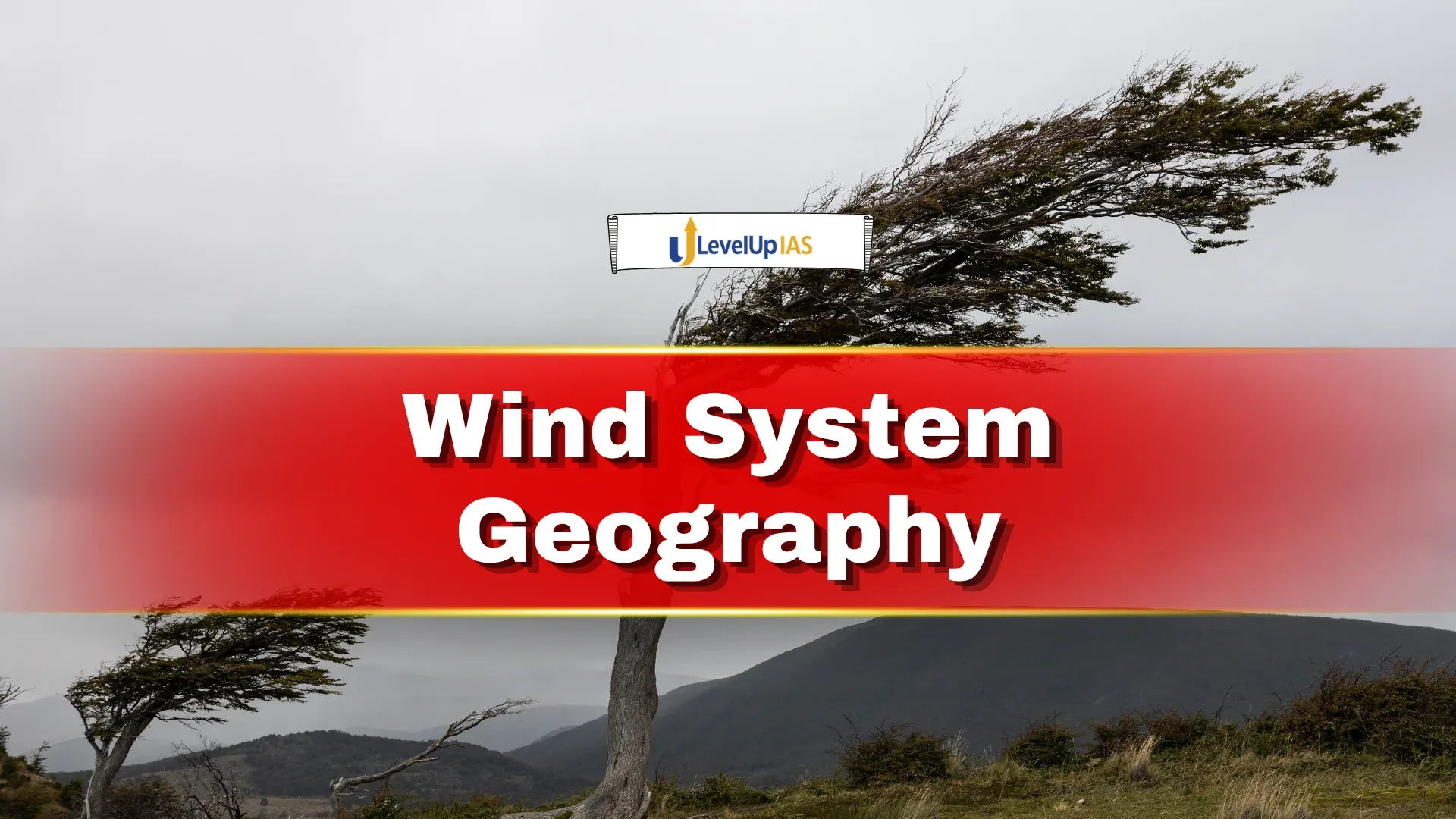
Wind is one of the most important elements of the atmospheric circulation system. It helps redistribute heat, moisture and energy across different parts of the Earth and therefore plays a crucial role in determining weather and climate. Winds are not simply horizontal movements of air; their direction, speed and circulation are controlled by pressure differences, Earth's rotation, friction and the nature of the Earth's surface.
What is Wind?
Wind may be defined as the natural and continuous movement of air or other gaseous substances in the atmosphere with reference to the Earth's surface. It develops primarily because atmospheric pressure is not uniform over the Earth's surface. Air generally moves from areas of relatively high pressure towards areas of relatively low pressure, although its actual direction is modified by Earth's rotation, friction and local topography.
The unequal distribution of solar radiation is the fundamental cause behind the development of pressure differences. The equatorial regions receive greater solar heating, causing air to become warmer, less dense and rise, while colder and denser air tends to sink in higher-latitude regions. This continuous redistribution of air forms the basis of the global wind system.
Causes and Factors Affecting Wind Movement
- The pressure gradient is the fundamental driving force behind wind. Unequal heating of the Earth's surface produces differences in atmospheric pressure, and these differences generate a pressure gradient force. The greater the pressure difference over a given distance, the stronger the pressure gradient and generally the faster the resulting wind.
- Solar radiation is therefore indirectly responsible for much of the world's wind circulation. The equatorial regions receive relatively intense solar heating, which warms the air and promotes its upward movement. The resulting low-pressure conditions contrast with areas where colder, denser air produces relatively higher pressure. This pressure contrast initiates large-scale atmospheric circulation.
- However, wind does not move in a simple straight line from high pressure to low pressure. The Coriolis effect, produced by Earth's rotation, deflects moving air. In the Northern Hemisphere, moving air is deflected towards the right, while in the Southern Hemisphere it is deflected towards the left. The effect becomes increasingly important with increasing latitude and is one of the major reasons why global wind belts do not flow directly along north-south pressure gradients.
- Friction also influences wind movement, particularly close to the Earth's surface. Trees, buildings, mountains and other surface features create drag and reduce wind speed. Consequently, winds generally move faster at higher altitudes where the influence of surface friction is weaker. The effect of friction is particularly important in understanding differences between surface winds and winds in the upper atmosphere.
- Topography further modifies wind direction and velocity. Mountains, valleys and plains can either obstruct or channel air movement. Mountain ranges can force air to rise on the windward side, often resulting in greater precipitation, while descending air on the leeward side can produce comparatively dry rain-shadow conditions.
Major Forces Governing Wind
The movement of wind can be understood through the interaction of several forces:
- Pressure Gradient Force: Drives air from areas of higher pressure towards areas of lower pressure.
- Coriolis Force: Deflects moving air because of Earth's rotation, towards the right in the Northern Hemisphere and towards the left in the Southern Hemisphere.
- Frictional Force: Slows wind near the Earth's surface and modifies its direction.
- Centripetal Force: Acts towards the centre of curved airflow and helps maintain circular movement around pressure systems.
Atmospheric pressure itself is closely connected with temperature and air density. Warm air tends to rise and is associated with lower surface pressure, while cold, dense air tends to sink and is associated with higher pressure.
Types of Winds
Winds are commonly classified into primary or planetary winds, secondary or periodic winds, and tertiary or local winds. This classification is based mainly on their geographical extent, regularity and the factors responsible for their movement.
Primary or Planetary Winds
Primary winds operate on a global scale and generally blow throughout the year in relatively consistent directions. They are closely associated with the Earth's major pressure belts and the global atmospheric circulation system.
Trade Winds blow from the subtropical high-pressure belts towards the equatorial low-pressure belt. Because of the Coriolis effect, they become northeasterly trades in the Northern Hemisphere and southeasterly trades in the Southern Hemisphere. Their relatively steady nature historically made them useful to sailing ships and contributed to the origin of the term "trade winds."
.webp)
Westerlies generally blow from the subtropical high-pressure regions towards the subpolar low-pressure belts. They are predominantly westerly in direction and are particularly important in the middle latitudes. In the Southern Hemisphere, strong westerlies around the middle and higher latitudes were historically referred to by sailors as the "Roaring Forties" and "Furious Fifties" because of their strength and associated rough seas.
Secondary or Periodic Winds
Secondary winds change their direction or character periodically because of seasonal variations, differences in heating and cooling, or local geographical conditions. They are therefore different from the relatively persistent planetary wind belts.
The monsoon winds are the most important example. They undergo a seasonal reversal and are particularly significant in South Asia. During the summer, differential heating produces conditions that draw moist air from the Indian Ocean towards the Indian subcontinent, bringing substantial rainfall. During winter, the circulation reverses, with winds generally flowing from the land towards the sea.
Sea breeze and land breeze are another example of periodic wind circulation. During the day, land heats faster than the sea, producing relatively lower pressure over land and causing air to move from the cooler sea towards the land. This is the sea breeze. At night, land cools more rapidly, and the pressure relationship reverses, resulting in a land breeze that flows from land towards the sea.
.webp)
Similarly, mountain and valley breezes develop because of differences in heating and cooling between mountain slopes and valleys. During the day, slopes become heated and air moves upward along the slopes, producing a valley-breeze circulation. At night, cooling produces denser air that moves downslope, resulting in a mountain breeze.
Tertiary or Local Winds
Local winds operate over relatively limited geographical areas and are strongly influenced by local climatic and topographic conditions. They can be particularly important because they affect local temperature, humidity, agriculture and human activities.
In India, the Loo is a prominent example. It is a hot and dry wind that blows across parts of northern India during the hot summer season. Its high temperature and dryness can produce severe heat conditions.
The Foehn is a warm, dry wind associated with the Alps. Air descending on the leeward side of the mountains becomes warmer and drier, producing rapid changes in local temperature and contributing to the melting of snow.
The Bora is a cold and gusty wind that descends from the mountainous areas towards the Adriatic Sea, particularly affecting the Balkan region.
Major Local Winds of the World
Local winds occur in different parts of the world and are often given distinctive regional names.
In Africa, important examples include the Berg Wind, a seasonal katabatic wind descending from the high central plateau towards the coast of South Africa; the Cape Doctor, a dry coastal wind associated with the South African coast; and the Haboob, a large and mobile dust or sandstorm associated with strong winds and rapidly changing conditions.
In Asia, examples include the Karaburan of Central Asia, the cold Khazri over the northern Caspian region, and the Karakaze and Oroshi associated with Japan. Around Lake Baikal, the Barguzin and Sarma are locally important winds. Along the Malabar Coast of India, the Elephanta is a southerly or southeasterly wind. The Kali Andhi refers to violent pre-monsoon dust squalls affecting northwestern parts of the Indo-Gangetic Plain, while mango showers are pre-monsoon thunderstorms and rainfall events associated particularly with parts of southern India.
Other continents also have characteristic local winds. Mistral occurs in France, while the Chinook affects the Rocky Mountain region of North America and the Santa Ana is associated with Southern California. In South America, Pampero affects Argentina and Uruguay, while Zonda is associated with the Andes. In Australia, the Fremantle Doctor and Brickfielder are notable regional winds.
Jet Streams
Jet streams are narrow bands of very strong winds occurring at high altitudes in the atmosphere. They generally flow from west to east, although their paths are not straight. Instead, they develop meanders, waves and curves as they move around the globe.
Jet streams are generally found at altitudes of roughly 30,000 feet or more, particularly near boundaries between major atmospheric circulation cells. Their development is closely related to unequal solar heating, Earth's rotation and strong temperature contrasts between air masses.
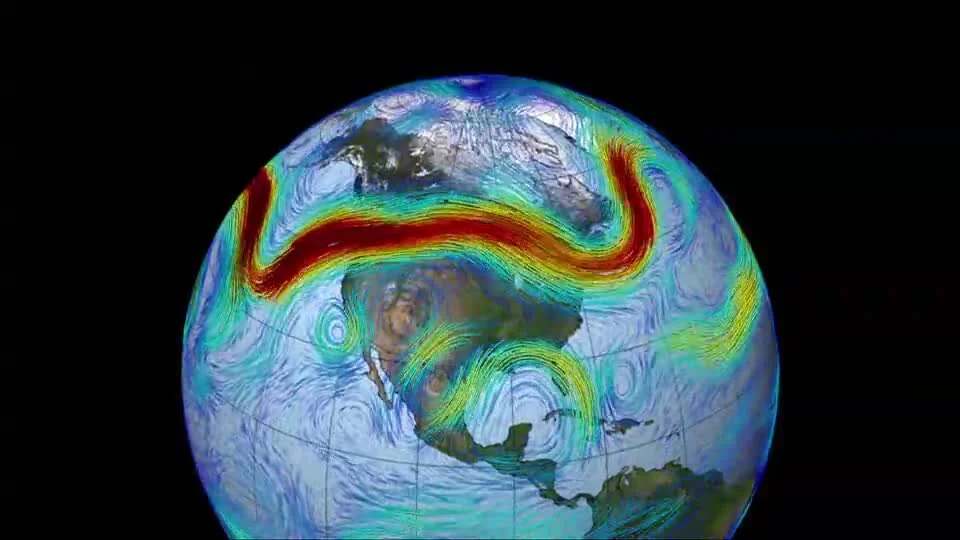
The unequal distribution of solar heating produces the major atmospheric circulation cells, Hadley, Ferrel and Polar cells. At the boundaries between these circulation systems, strong horizontal temperature and pressure gradients develop. Combined with the Coriolis effect, these gradients contribute to the formation of fast-moving upper-air currents.
Major Types of Jet Streams
The Polar Jet Stream is found at approximately 9-12 km altitude and develops near the boundary between the polar and mid-latitude air masses. It is particularly important for the movement of weather systems in the middle and higher latitudes of both hemispheres.
The Subtropical Jet Stream occurs at a greater altitude, generally around 10-16 km, near the boundary between the Hadley and Ferrel circulation cells. It extends across both continents and oceans and has considerable influence on atmospheric circulation.
.webp)
In addition to these major westerly jet streams, easterly jet streams can develop in tropical regions, particularly during the Northern Hemisphere summer. Such seasonal upper-air circulation is especially important in understanding atmospheric circulation over the tropics.
Significance of the Wind System
The global wind system is fundamental to the functioning of the Earth's climate system because it redistributes heat and moisture from one region to another. Without atmospheric circulation, the contrast between the highly heated equatorial regions and the colder polar regions would become much more extreme.
Winds also play a major role in determining the distribution of rainfall. Moisture-bearing winds transport water vapour from oceans towards land, while the interaction of winds with mountains can produce contrasting windward and leeward climatic conditions. Seasonal wind reversals such as the monsoon therefore have enormous importance for agriculture and human livelihoods.
At the local scale, winds influence temperature, humidity, dust transport and weather conditions. At the upper-atmospheric level, jet streams influence the movement of weather systems and the broader circulation of the atmosphere. Thus, the wind system operates across multiple scales, from a local sea breeze to planetary circulation belts and high-altitude jet streams.
Conclusion
The wind system is a fundamental component of atmospheric circulation produced primarily by unequal heating and pressure differences, but its actual movement is modified by the Coriolis effect, friction, centripetal force and topography. Depending on their scale and regularity, winds may be classified as planetary, periodic or local winds.
From the permanent trade winds and westerlies to seasonal monsoons, local winds and high-altitude jet streams, each category represents a different expression of atmospheric circulation. Understanding these wind systems is therefore essential for explaining global heat distribution, rainfall patterns, regional climates, weather systems and human activities.
FAQs
Q1. What is a wind system?
A wind system refers to the large-scale or local movement of air from areas of relatively high pressure towards areas of relatively low pressure, influenced by pressure gradients, Earth’s rotation and surface conditions.
Q2. What are the major types of wind systems?
Wind systems can broadly be classified into planetary winds, seasonal winds and local winds based on their spatial extent, duration and causes.
Q3. What are planetary or permanent winds?
Planetary winds blow throughout the year in relatively consistent global circulation patterns. The major types are Trade Winds, Westerlies and Polar Easterlies.
Q4. What are Trade Winds?
Trade Winds blow from the subtropical high-pressure belts towards the equatorial low-pressure belt. They are deflected by the Coriolis force and become northeast trades in the Northern Hemisphere and southeast trades in the Southern Hemisphere.
Q5. What are Westerlies?
Westerlies are permanent winds that generally blow from the subtropical high-pressure belts towards the subpolar low-pressure belts. They move predominantly from west to east and are particularly strong in the Southern Hemisphere’s mid-to-high latitudes.
Related reads.

Coral Reefs
22 Oct 2026 7 min

Ocean Pollution
21 Oct 2026 7 min
Thermohaline Circulation
21 Oct 2026 7 min

Ocean Waves
19 Oct 2026 7 min
Decolonisation in Asia and Africa
18 Oct 2026 8 min
Temperature Distribution in Oceans
10 Oct 2026 9 min
Put it into practice
Reading is step one.
Turn what you've just read into exam-ready answers with mentor-led practice and our structured test series.