
GS-I (History, Geography, Society)
Imperialism and Colonialism, World History
Content
- Introduction
- Imperialism
- Colonialism
- Difference between Imperialism and Colonialism
- Rise of Modern Imperialism and Colonialism
- Causes of Imperialism and Colonialism
- New Imperialism (1870-1914)
- Impact of Imperialism and Colonialism
- Imperialism in India
- Decline of Imperialism
- Neo-Imperialism
- Conclusion
- FAQs
Introduction
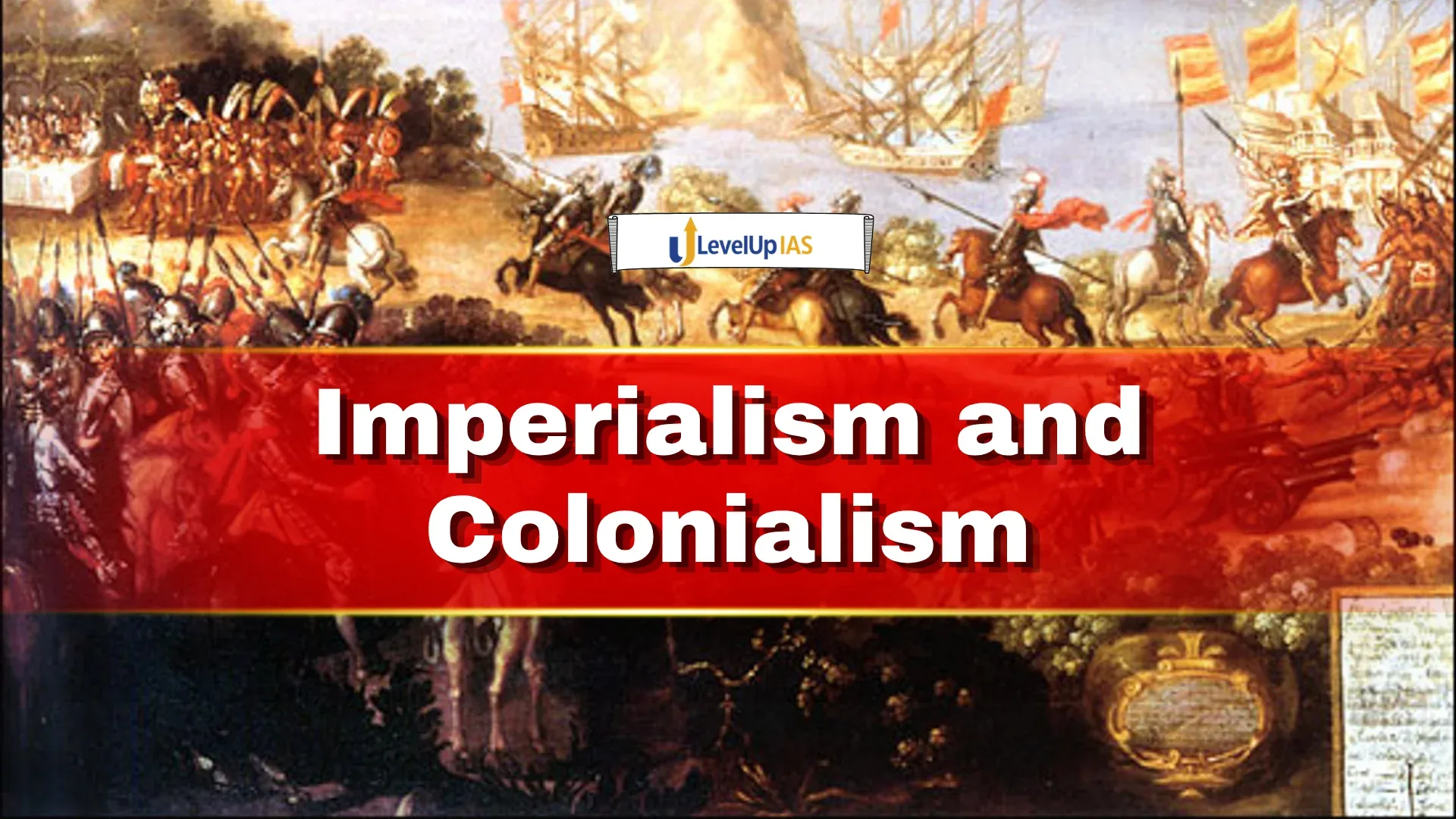
Imperialism and Colonialism are two of the most significant historical processes that transformed the political, economic and social landscape of the modern world. Between the fifteenth and twentieth centuries, European powers expanded their influence across Asia, Africa and the Americas, creating vast overseas empires. This expansion not only reshaped the international balance of power but also altered the economies, societies and cultures of colonised regions. Although the terms Imperialism and Colonialism are often used interchangeably, they differ in both meaning and application. Understanding these concepts is essential for analysing the emergence of the modern world order, decolonisation movements and contemporary global inequalities.
Imperialism
Imperialism refers to the policy or ideology through which a powerful state seeks to extend its political, economic, military or cultural influence over weaker territories. Such expansion may occur through direct conquest, political domination, economic dependence or strategic control. Thus, imperialism represents the broader idea of extending state power beyond national boundaries.
Unlike colonialism, imperialism does not always require physical occupation or settlement. A country may exercise imperial influence through military alliances, economic pressure, unequal treaties or political intervention without formally annexing a territory. Therefore, imperialism is fundamentally an ideology of domination and expansion.
Colonialism
Colonialism is the practical manifestation of imperialism. It refers to the establishment of colonies in foreign territories where the colonising power exercises direct political control, settles its population, exploits local resources and reorganises the administration according to its own interests.
The principal objective of colonialism was to extract raw materials, secure markets for manufactured goods, obtain strategic military bases and increase national wealth. Colonies were generally administered for the benefit of the mother country rather than for the welfare of the indigenous population.
Thus, while imperialism represents the guiding philosophy, colonialism is one of its most visible and organised forms.
Difference between Imperialism and Colonialism
Basis | Imperialism | Colonialism |
| Nature | Ideology or policy of expansion | Practical implementation of imperialism |
| Objective | Political, economic or strategic dominance | Establishment of colonies for exploitation |
| Method | Direct or indirect control | Direct territorial occupation and administration |
| Settlement | Not necessary | Usually involves settlement of colonisers |
| Scope | Broader concept | Subset of imperialism |
Rise of Modern Imperialism and Colonialism
Although empires had existed since ancient times, modern imperialism emerged after the fifteenth century with the rise of powerful European nation-states such as Portugal, Spain, Britain, France and the Netherlands. Several developments collectively accelerated overseas expansion.
The fall of Constantinople in 1453 disrupted traditional trade routes connecting Europe with Asia. This encouraged European powers to search for alternative sea routes to the East. Portuguese navigators such as Bartolomeu Dias and Vasco da Gama opened the maritime route around the Cape of Good Hope, while Christopher Columbus's voyage in 1492 led to European expansion into the Americas.
Initially, overseas settlements functioned mainly as trading posts and naval bases. Over time, commercial interests evolved into political domination, transforming trade into territorial conquest.
Causes of Imperialism and Colonialism
The emergence of imperialism cannot be explained by a single factor. It resulted from the interaction of economic, political, technological and ideological forces.
Economic motives became particularly important after the Industrial Revolution. Rapid industrialisation created an enormous demand for raw materials such as cotton, rubber, minerals and oil. Simultaneously, European industries required overseas markets to sell manufactured goods and profitable avenues for capital investment. Mercantilist ideas, which emphasised favourable trade balances and accumulation of bullion, further strengthened colonial expansion.
Political considerations also encouraged imperialism. European nationalism increasingly became associated with military prestige and territorial expansion. Possession of colonies came to symbolise national greatness, while strategic locations such as the Suez Canal, Cape of Good Hope and Singapore acquired immense military significance.
Technological superiority greatly facilitated colonial conquest. Steamships, railways, telegraph communication, modern firearms, machine guns and medical advances such as quinine enabled Europeans to penetrate previously inaccessible regions of Asia and Africa.
Ideological factors equally contributed to imperial expansion. Europeans propagated the belief that they had a civilising mission to educate and modernise supposedly "backward" societies. Rudyard Kipling popularised this idea through the concept of the "White Man's Burden." Christian missionaries further justified colonial expansion as a means of spreading Christianity and Western civilisation.
New Imperialism (1870-1914)
The period between 1870 and the outbreak of the First World War is generally known as the Age of New Imperialism. Unlike earlier colonial expansion, this phase witnessed intense competition among industrial powers for territories, particularly in Africa and Asia.
Countries such as Germany, Italy, Belgium, the United States and Japan entered the imperial race alongside Britain and France. Industrial capitalism, nationalism, military rivalry and technological progress collectively accelerated overseas expansion.
The Berlin Conference (1884-85) became a landmark event during this period. European powers divided Africa among themselves without consulting African societies, laying down rules for territorial acquisition and preventing conflicts among themselves. Consequently, within three decades almost the entire African continent, except Ethiopia and Liberia, came under European colonial rule.
Major Colonial Powers and Their Areas of Influence
Spain and Portugal pioneered overseas expansion by establishing colonies across Latin America, Africa and Asia. Britain eventually emerged as the world's largest colonial empire with possessions in India, Canada, Australia, large parts of Africa and several island territories. France built a vast empire in North and West Africa and Southeast Asia. Belgium controlled the Congo, while the Netherlands dominated Indonesia. Germany and Italy acquired colonies comparatively late but actively participated in the partition of Africa.
Impact of Imperialism and Colonialism
Imperialism profoundly transformed both colonisers and colonised societies.
Economically, colonies became suppliers of raw materials and consumers of manufactured goods. Indigenous industries declined due to unequal trade policies, resulting in widespread deindustrialisation and economic dependency. Traditional agricultural systems were reoriented towards commercial cash crops, often causing food insecurity and famines.
Politically, colonial powers dismantled indigenous institutions and replaced them with centralised bureaucratic administrations. Although these administrative systems later influenced modern nation-states, they primarily served imperial interests rather than local welfare.
Socially and culturally, colonialism disrupted indigenous traditions, languages and knowledge systems. Western education created an educated middle class that eventually led nationalist movements, yet colonial rule also institutionalised racial discrimination and cultural superiority.
At the same time, imperialism introduced railways, roads, ports, telegraph networks, modern education and public health systems. These developments improved connectivity and administrative efficiency but were largely designed to facilitate resource extraction and strengthen colonial control.
Imperialism in India
British imperialism in India evolved gradually from commercial activities of the East India Company into complete political domination. Following the Battle of Plassey (1757), British control expanded rapidly. India became an important supplier of raw materials and a market for British manufactured goods.
Colonial policies resulted in the decline of traditional handicrafts, frequent famines, heavy taxation and economic exploitation, often described as the "Drain of Wealth." Simultaneously, English education, modern legal institutions, railways and communication networks transformed Indian society and contributed to the growth of nationalism.
Decline of Imperialism
The decline of imperialism accelerated after the First and Second World Wars. European powers emerged economically weakened, while anti-colonial nationalism gained momentum across Asia and Africa. The establishment of the United Nations, growing emphasis on self-determination and the emergence of the United States and the Soviet Union as global powers further undermined colonial empires.
Between the late 1940s and the 1970s, large-scale decolonisation led to the independence of India, Indonesia, Ghana, Algeria and numerous African nations, marking the end of formal colonial rule.
Neo-Imperialism
Although classical colonial empires disappeared, many scholars argue that imperialism continues in new forms. Neo-imperialism refers to indirect control exercised through economic dependence, multinational corporations, international financial institutions, strategic military alliances and technological dominance rather than direct territorial occupation. Contemporary debates on debt diplomacy, resource extraction, digital dependence and geopolitical competition often draw upon the concept of neo-imperialism.
Conclusion
Imperialism and colonialism were defining features of modern world history that reshaped global politics, economics and international relations. While they facilitated technological diffusion, infrastructure development and global integration, they were fundamentally systems of political domination and economic exploitation. The legacies of colonial boundaries, unequal development, ethnic conflicts and global power asymmetries continue to influence contemporary international relations. Therefore, a critical understanding of imperialism and colonialism remains indispensable for analysing both the historical evolution of the modern world and the challenges of the present global order.
FAQs
Q1. What is Imperialism?
Imperialism is the policy or practice by which a powerful nation extends its influence over other countries or territories through political, economic, military, or cultural means.
Q2. What is Colonialism?
Colonialism is a form of imperialism in which a country establishes colonies, settles its population, and exercises direct political and administrative control over another territory.
Q3. What is the difference between Imperialism and Colonialism?
| Feature | Imperialism | Colonialism |
|---|---|---|
| Meaning | Expansion of influence and dominance | Establishment of colonies and direct rule |
| Control | Direct or indirect | Mainly direct political control |
| Objective | Political, economic, and strategic dominance | Resource extraction, settlement, and administration |
| Scope | Broader concept | A specific form of imperialism |
Q4. What were the major causes of Imperialism and Colonialism?
The major causes were:
- Industrial Revolution and demand for raw materials
- Search for new markets
- Nationalism and competition among European powers
- Strategic and military interests
- Missionary activities and the idea of the "civilizing mission"
Q5. Which countries were the major colonial powers?
The leading colonial powers included:
- United Kingdom
- France
- Spain
- Portugal
- Netherlands
- Belgium
- Germany
Related reads.
Independence and Partition of India
14 Sep 2026 8 min

Revolutionary Nationalism in India
12 Sep 2026 10 min
Indian National Movement – II (1918-1929)
10 Sep 2026 10 min
Regional States of North and South India
09 Sep 2026 9 min
Wind System, UPSC Geography
08 Sep 2026 9 min
Indian National Movement (Extremists) - I (1905-1918)
07 Sep 2026 10 min
Put it into practice
Reading is step one.
Turn what you've just read into exam-ready answers with mentor-led practice and our structured test series.